
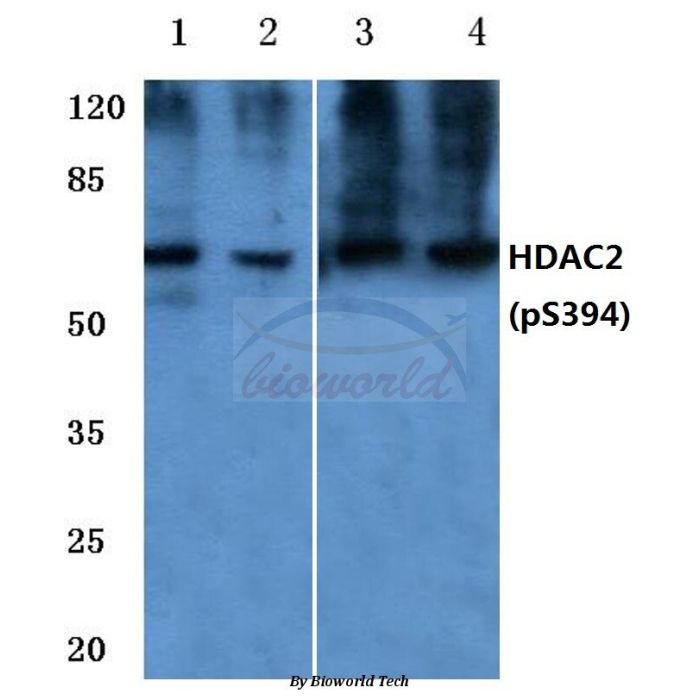
HDAC2 (phospho-S394) polyclonal, anti-human, mouse, rat
€328.00
In stock
SKU
BS4637
Background:
In the intact cell, DNA closely associates with histones and other nuclear proteins to form chromatin. The remodeling of chromatin is believed to be a critical component of transcriptional regulation and a major source of this remodeling is brought about by the acetylation of nucleosomal histones. Acetylation of lysine residues in the amino-terminal tail domain of histone results in an allosteric change in the nucleosomal conformation and an increased accessibility to transcription factors by DNA. Conversely, the deacetylation of histones is associated with transcriptional silencing. Several mammalian proteins have been identified as nuclear histone acetylases, including GCN5, PCAF (for p300/CBP-associated factor), p300/CBP and the TFIID subunit TAF II p250. Mammalian HDAC1 (also designated HD1), HDAC2 (also designated mammalian RPD3) and HDAC3, all of which are related to the yeast transcriptional regulator Rpd3p, have been identified as histone deacetylases.
Alternative Name:
Histone deacetylase 2, HD2, Name: HDAC 2
Application Dilution: WB: 1:500~1:1000
Specificity: p-HDAC2 (S394) polyclonal antibody detects endogenous levels of HDAC2 protein only when phosphorylated at Ser394.
Immunogen:
Synthetic phosphopeptide derived from human HDAC2 around the phosphorylation site of Serine 394.
MW: ~ 60 kDa
Swis Prot.: Q92769
Purification & Purity:
The antibody was affinity-purified from rabbit antiserum by affinity-chromatography using epitope-specific immunogen and the purity is > 95% (by SDS-PAGE).
Format:
1 mg/ml in Phosphate buffered saline (PBS) with 0.05% sodium azide, approx. pH 7.2.
Storage:
Store at 4°C short term. Aliquot and store at -20°C long term. Avoid freeze-thaw cycles.
For research use only, not for use in diagnostic procedure.
In the intact cell, DNA closely associates with histones and other nuclear proteins to form chromatin. The remodeling of chromatin is believed to be a critical component of transcriptional regulation and a major source of this remodeling is brought about by the acetylation of nucleosomal histones. Acetylation of lysine residues in the amino-terminal tail domain of histone results in an allosteric change in the nucleosomal conformation and an increased accessibility to transcription factors by DNA. Conversely, the deacetylation of histones is associated with transcriptional silencing. Several mammalian proteins have been identified as nuclear histone acetylases, including GCN5, PCAF (for p300/CBP-associated factor), p300/CBP and the TFIID subunit TAF II p250. Mammalian HDAC1 (also designated HD1), HDAC2 (also designated mammalian RPD3) and HDAC3, all of which are related to the yeast transcriptional regulator Rpd3p, have been identified as histone deacetylases.
Alternative Name:
Histone deacetylase 2, HD2, Name: HDAC 2
Application Dilution: WB: 1:500~1:1000
Specificity: p-HDAC2 (S394) polyclonal antibody detects endogenous levels of HDAC2 protein only when phosphorylated at Ser394.
Immunogen:
Synthetic phosphopeptide derived from human HDAC2 around the phosphorylation site of Serine 394.
MW: ~ 60 kDa
Swis Prot.: Q92769
Purification & Purity:
The antibody was affinity-purified from rabbit antiserum by affinity-chromatography using epitope-specific immunogen and the purity is > 95% (by SDS-PAGE).
Format:
1 mg/ml in Phosphate buffered saline (PBS) with 0.05% sodium azide, approx. pH 7.2.
Storage:
Store at 4°C short term. Aliquot and store at -20°C long term. Avoid freeze-thaw cycles.
For research use only, not for use in diagnostic procedure.
| Is Featured? | No |
|---|
Write Your Own Review