
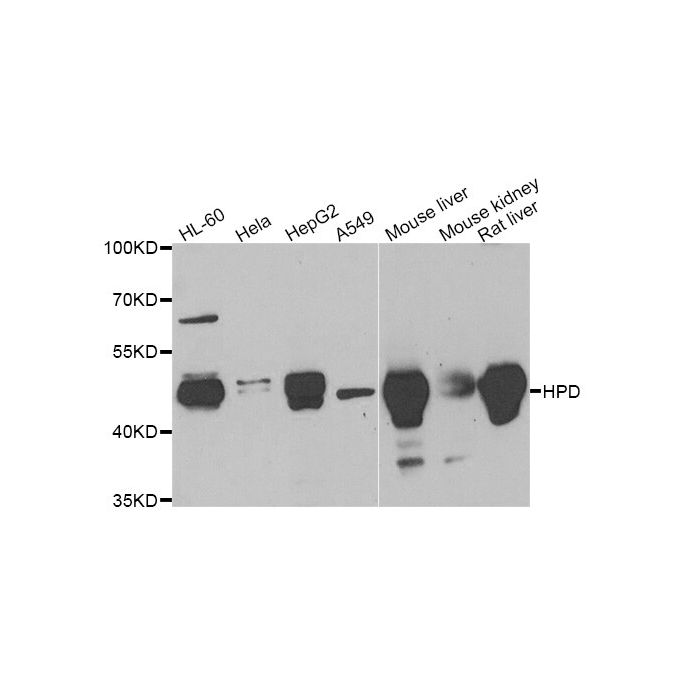
HPD polyclonal, anti-human, mouse, rat
€388.00
In stock
SKU
BS8265
Background:
HPPD (4-hydroxyphenylpyruvate dioxygenase), also known as PPD, GLOD3 or HPD, is a 393 amino acid protein that belongs to the 4HPPD family and is involved in amino acid degradation. Existing as a homodimer, HPPD uses zinc as a cofactor to catalyze the third step in the conversion of L-phenylalanine to fumarate and acetoacetic acid. Defects in the gene encoding HPPD are the cause of tyrosinemia type 3 (TYRO3) and hawkinsinuria (HAWK), both of which are inborn errors of metabolism that are associated with a variety of symptoms, including mental retardation and seizures (associated with TYRO3) and hair and urine abnormalities (associated with HAWK). The gene encoding HPPD maps to human chromosome 12, which encodes over 1,100 genes and comprises approximately 4.5% of the human genome.
Alternative Name:
4-hydroxyphenylpyruvate dioxygenase, 4-hydroxyphenylpyruvic acid oxidase, 4HPPD, HPD, HPPDase, HPD, PPD
Application Dilution: WB: 1:500~1:2000, IHC/IF: 1:50~1:200
Specificity: HPD polyclonal antibody detects endogenous levels of HPD protein.
Immunogen:
Recombinant full length Human HPD.
MW: ~ 45 kDa
Swis Prot.: P32754
Purification & Purity:
The antibody was affinity-purified from rabbit antiserum by affinity-chromatography using epitope-specific immunogen and the purity is > 95% (by SDS-PAGE).
Format:
1mg/ml in PBS with 0.1% Sodium Azide, 50% Glycerol.
Storage:
Store at 4°C short term. Aliquot and store at -20°C long term. Avoid freeze-thaw cycles.
For research use only, not for use in diagnostic procedure.
HPPD (4-hydroxyphenylpyruvate dioxygenase), also known as PPD, GLOD3 or HPD, is a 393 amino acid protein that belongs to the 4HPPD family and is involved in amino acid degradation. Existing as a homodimer, HPPD uses zinc as a cofactor to catalyze the third step in the conversion of L-phenylalanine to fumarate and acetoacetic acid. Defects in the gene encoding HPPD are the cause of tyrosinemia type 3 (TYRO3) and hawkinsinuria (HAWK), both of which are inborn errors of metabolism that are associated with a variety of symptoms, including mental retardation and seizures (associated with TYRO3) and hair and urine abnormalities (associated with HAWK). The gene encoding HPPD maps to human chromosome 12, which encodes over 1,100 genes and comprises approximately 4.5% of the human genome.
Alternative Name:
4-hydroxyphenylpyruvate dioxygenase, 4-hydroxyphenylpyruvic acid oxidase, 4HPPD, HPD, HPPDase, HPD, PPD
Application Dilution: WB: 1:500~1:2000, IHC/IF: 1:50~1:200
Specificity: HPD polyclonal antibody detects endogenous levels of HPD protein.
Immunogen:
Recombinant full length Human HPD.
MW: ~ 45 kDa
Swis Prot.: P32754
Purification & Purity:
The antibody was affinity-purified from rabbit antiserum by affinity-chromatography using epitope-specific immunogen and the purity is > 95% (by SDS-PAGE).
Format:
1mg/ml in PBS with 0.1% Sodium Azide, 50% Glycerol.
Storage:
Store at 4°C short term. Aliquot and store at -20°C long term. Avoid freeze-thaw cycles.
For research use only, not for use in diagnostic procedure.
| Is Featured? | No |
|---|
Write Your Own Review