
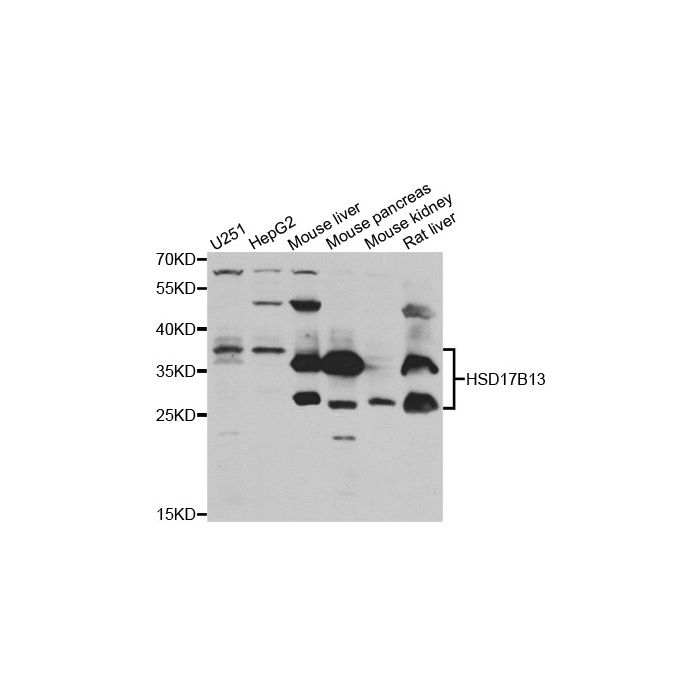
HSD17B13 polyclonal, anti-human, mouse, rat
€388.00
In stock
SKU
BS7998
Background:
17β-HSD13 (17β hydroxysteroid dehydrogenase type 13), also designated Short-chain dehydrogenase/reductase 9 (SCDR9), belongs to the 17β-HSD family of proteins, which regulate the availability of steroids within various tissues throughout the body. 17β-HSD13 is a 300 amino acid secreted protein that is highly expressed in liver and is also detected in ovary, bone marrow, kidney, brain, lung, skeletal muscle, bladder and testis. The gene encoding 17β-HSD13 maps to chromosome 4, which houses nearly 6% of the human genome and has the largest gene deserts (regions of the genome with no protein encoding genes) of all of the human chromosomes. Defects in some of the genes located on chromosome 4 are associated with Huntington's disease, Ellis-van Creveld syndrome, methylmalonic acidemia and polycystic kidney disease.
Alternative Name:
17β-HSD13, 17-beta-HSD 13, 17-beta-hydroxysteroid dehydrogenase 13, DHB13_HUMAN, HMFN0376, Hsd17b13, SCDR9, Short-chain dehydrogenase/reductase 9, UNQ497/PRO1014,
Application Dilution: WB: 1:500~1:2000, IHC: 1:50~1:200
Specificity: HSD17B13 polyclonal antibody detects endogenous levels of HSD17B13 protein.
Immunogen:
Recombinant full length Human HSD17B13.
MW: ~ 34 kDa
Swis Prot.: Q7Z5P4
Purification & Purity:
The antibody was affinity-purified from rabbit antiserum by affinity-chromatography using epitope-specific immunogen and the purity is > 95% (by SDS-PAGE).
Format:
1mg/ml in PBS with 0.1% Sodium Azide, 50% Glycerol.
Storage:
Store at 4°C short term. Aliquot and store at -20°C long term. Avoid freeze-thaw cycles.
For research use only, not for use in diagnostic procedure.
17β-HSD13 (17β hydroxysteroid dehydrogenase type 13), also designated Short-chain dehydrogenase/reductase 9 (SCDR9), belongs to the 17β-HSD family of proteins, which regulate the availability of steroids within various tissues throughout the body. 17β-HSD13 is a 300 amino acid secreted protein that is highly expressed in liver and is also detected in ovary, bone marrow, kidney, brain, lung, skeletal muscle, bladder and testis. The gene encoding 17β-HSD13 maps to chromosome 4, which houses nearly 6% of the human genome and has the largest gene deserts (regions of the genome with no protein encoding genes) of all of the human chromosomes. Defects in some of the genes located on chromosome 4 are associated with Huntington's disease, Ellis-van Creveld syndrome, methylmalonic acidemia and polycystic kidney disease.
Alternative Name:
17β-HSD13, 17-beta-HSD 13, 17-beta-hydroxysteroid dehydrogenase 13, DHB13_HUMAN, HMFN0376, Hsd17b13, SCDR9, Short-chain dehydrogenase/reductase 9, UNQ497/PRO1014,
Application Dilution: WB: 1:500~1:2000, IHC: 1:50~1:200
Specificity: HSD17B13 polyclonal antibody detects endogenous levels of HSD17B13 protein.
Immunogen:
Recombinant full length Human HSD17B13.
MW: ~ 34 kDa
Swis Prot.: Q7Z5P4
Purification & Purity:
The antibody was affinity-purified from rabbit antiserum by affinity-chromatography using epitope-specific immunogen and the purity is > 95% (by SDS-PAGE).
Format:
1mg/ml in PBS with 0.1% Sodium Azide, 50% Glycerol.
Storage:
Store at 4°C short term. Aliquot and store at -20°C long term. Avoid freeze-thaw cycles.
For research use only, not for use in diagnostic procedure.
| Is Featured? | No |
|---|
Write Your Own Review