
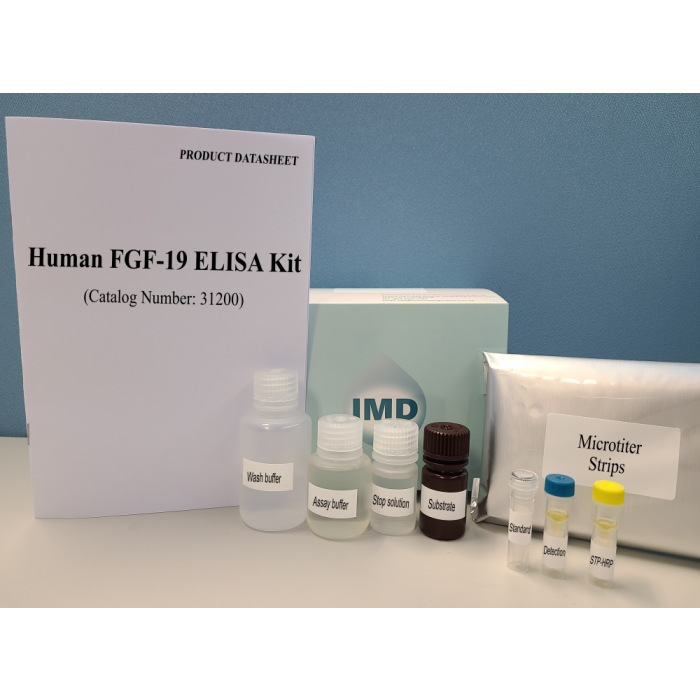
Human FGF-19 ELISA Kit
€400.00
In stock
SKU
IMD-31200
Catalog Number: IMD-31200
Size: 96 tests/kit
Assay range: 31.2-2000 pg/mL
Datasheet
Questions? Contact us!
Size: 96 tests/kit
Assay range: 31.2-2000 pg/mL
Datasheet
Questions? Contact us!
INTENDED USE:
For the quantitative determination of human FGF-19 concentrations in serum, plasma or cell culture supernate samples
INTRODUCTION:
Fibroblast growth factor 19 (FGF-19) is a member of a subfamily of FGFs that includes FGF-21 and FGF-23, each member functions as an important regular of nutrient metabolism. The primary source of endocrine FGF-19 is the ileum, bile acids release into the intestine after a meal to induce expression of FGF-19. Circulating FGF-19 plays an important role in maintaining proper bile acid homeostasis. Several pharmacologic studies in hyperglycaemic, obese animal models have shown that FGF-19 can improve metabolic rate and lower serum glucose and hepatic triglyceride and cholesterol levels. Like insulin, FGF-19 functions as postprandial hormone to govern hepatic protein synthesis, glycogen synthesis and gluconeogenesis, but does not stimulate lipogenesis.
PRINCIPLE OF THE ASSAY:
This assay is a quantitative sandwich ELISA. The immunoplate is pre-coated with a rabbit polyclonal antibody specific for human FGF-19. Standards and samples are pipetted into the wells and any human FGF-19 present is bound by the immobilized antibody. After washing away any unbound substances, a biotin labelled polyclonal antibody specific for human FGF-19 is added to the wells. After wash step to remove any unbound reagents, streptavidin-HRP conjugate (STP-HRP) is added. After the last wash step, an HRP substrate solution is added and colour develops in proportion to the amount of human FGF-19 bound initially. The assay is stopped and the optical density of the wells determined using a microplate reader. Since the increases in absorbance are directly proportional to the amount of captured human FGF-19, the unknown sample concentration can be interpolated from a reference curve included in each assay.The lowest level of FGF-19 that can be measured by this assay is 31.2 pg/mL.
PUBLICATIONS CITING THIS PRODUCT
Fang Q, Li H, Song Q, Yang W, Hou X, Ma X, Lu J, Xu A, Jia W. Serum fibroblast growth factor 19 levels are decreased in Chinese subjects with impaired fasting glucose and inversely associated with fasting plasma glucose levels. Diabetes Care. 2013 Sep 1;36(9):2810-4.
Chen DL, Liess C, Poljak A, Xu A, Zhang J, Thoma C, Trenell M, Milner B, Jenkins AB, Chisholm DJ, Samocha-Bonet D. Phenotypic characterization of insulin-resistant and insulin-sensitive obesity. The Journal of Clinical Endocrinology & Metabolism. 2015 Nov 1;100(11):4082-91.
Chen DL, Brown R, Liess C, Poljak A, Xu A, Zhang J, Trenell M, Jenkins A, Chisholm D, Samocha-Bonet D, Macefield VG. Muscle sympathetic nerve activity is associated with liver insulin sensitivity in obese non-diabetic men. Frontiers in physiology. 2017 Feb 28;8:101.
Zhang J, Li H, Zhou H, Fang L, Xu J, Yan H, Chen S, Song Q, Zhang Y, Xu A, Fang Q. Lowered fasting chenodeoxycholic acid correlated with the decrease of fibroblast growth factor 19 in Chinese subjects with impaired fasting glucose. Scientific reports. 2017 Jul 20;7(1):1-1.
Hu X, Xiong Q, Xu Y, Zhang X, Pan X, Ma X, Bao Y, Jia W. Association of serum fibroblast growth factor 19 levels with visceral fat accumulation is independent of glucose tolerance status. Nutrition, Metabolism and Cardiovascular Diseases. 2018 Feb 1;28(2):119-25.
Wong YK, Cheung CY, Tang CS, Au KW, Hai JS, Lee CH, Lau KK, Cheung BM, Sham PC, Xu A, Lam KS. Age-biomarkers-clinical risk factors for prediction of cardiovascular events in patients with coronary artery disease. Arteriosclerosis, thrombosis, and vascular biology. 2018 Oct;38(10):2519-27.
Tang A, Coster AC, Tonks KT, Heilbronn LK, Pocock N, Purtell L, Govendir M, Blythe J, Zhang J, Xu A, Chisholm DJ. Longitudinal changes in insulin resistance in normal weight, overweight and obese individuals. Journal of clinical medicine. 2019 May;8(5):623.
Zhang J, Li H, Bai N, Xu Y, Song Q, Zhang L, Wu G, Chen S, Hou X, Wang C, Wei L. Decrease of FGF19 contributes to the increase of fasting glucose in human in an insulin-independent manner. Journal of endocrinological investigation. 2019 Sep;42(9):1019-27.
Harari A, Coster AC, Jenkins A, Xu A, Greenfield JR, Harats D, Shaish A, Samocha-Bonet D. Obesity and insulin resistance are inversely associated with serum and adipose tissue carotenoid concentrations in adults. The Journal of nutrition. 2020 Jan 1;150(1):38-46.
Hu J, Liu Z, Tong Y, Mei Z, Xu A, Zhou P, Chen X, Tang W, Zhou Z, Xiao Y. Fibroblast Growth Factor 19 Levels predict subclinical atherosclerosis in men with type 2 diabetes. Frontiers in Endocrinology. 2020 May 22;11:282.
For the quantitative determination of human FGF-19 concentrations in serum, plasma or cell culture supernate samples
INTRODUCTION:
Fibroblast growth factor 19 (FGF-19) is a member of a subfamily of FGFs that includes FGF-21 and FGF-23, each member functions as an important regular of nutrient metabolism. The primary source of endocrine FGF-19 is the ileum, bile acids release into the intestine after a meal to induce expression of FGF-19. Circulating FGF-19 plays an important role in maintaining proper bile acid homeostasis. Several pharmacologic studies in hyperglycaemic, obese animal models have shown that FGF-19 can improve metabolic rate and lower serum glucose and hepatic triglyceride and cholesterol levels. Like insulin, FGF-19 functions as postprandial hormone to govern hepatic protein synthesis, glycogen synthesis and gluconeogenesis, but does not stimulate lipogenesis.
PRINCIPLE OF THE ASSAY:
This assay is a quantitative sandwich ELISA. The immunoplate is pre-coated with a rabbit polyclonal antibody specific for human FGF-19. Standards and samples are pipetted into the wells and any human FGF-19 present is bound by the immobilized antibody. After washing away any unbound substances, a biotin labelled polyclonal antibody specific for human FGF-19 is added to the wells. After wash step to remove any unbound reagents, streptavidin-HRP conjugate (STP-HRP) is added. After the last wash step, an HRP substrate solution is added and colour develops in proportion to the amount of human FGF-19 bound initially. The assay is stopped and the optical density of the wells determined using a microplate reader. Since the increases in absorbance are directly proportional to the amount of captured human FGF-19, the unknown sample concentration can be interpolated from a reference curve included in each assay.The lowest level of FGF-19 that can be measured by this assay is 31.2 pg/mL.
PUBLICATIONS CITING THIS PRODUCT
Fang Q, Li H, Song Q, Yang W, Hou X, Ma X, Lu J, Xu A, Jia W. Serum fibroblast growth factor 19 levels are decreased in Chinese subjects with impaired fasting glucose and inversely associated with fasting plasma glucose levels. Diabetes Care. 2013 Sep 1;36(9):2810-4.
Chen DL, Liess C, Poljak A, Xu A, Zhang J, Thoma C, Trenell M, Milner B, Jenkins AB, Chisholm DJ, Samocha-Bonet D. Phenotypic characterization of insulin-resistant and insulin-sensitive obesity. The Journal of Clinical Endocrinology & Metabolism. 2015 Nov 1;100(11):4082-91.
Chen DL, Brown R, Liess C, Poljak A, Xu A, Zhang J, Trenell M, Jenkins A, Chisholm D, Samocha-Bonet D, Macefield VG. Muscle sympathetic nerve activity is associated with liver insulin sensitivity in obese non-diabetic men. Frontiers in physiology. 2017 Feb 28;8:101.
Zhang J, Li H, Zhou H, Fang L, Xu J, Yan H, Chen S, Song Q, Zhang Y, Xu A, Fang Q. Lowered fasting chenodeoxycholic acid correlated with the decrease of fibroblast growth factor 19 in Chinese subjects with impaired fasting glucose. Scientific reports. 2017 Jul 20;7(1):1-1.
Hu X, Xiong Q, Xu Y, Zhang X, Pan X, Ma X, Bao Y, Jia W. Association of serum fibroblast growth factor 19 levels with visceral fat accumulation is independent of glucose tolerance status. Nutrition, Metabolism and Cardiovascular Diseases. 2018 Feb 1;28(2):119-25.
Wong YK, Cheung CY, Tang CS, Au KW, Hai JS, Lee CH, Lau KK, Cheung BM, Sham PC, Xu A, Lam KS. Age-biomarkers-clinical risk factors for prediction of cardiovascular events in patients with coronary artery disease. Arteriosclerosis, thrombosis, and vascular biology. 2018 Oct;38(10):2519-27.
Tang A, Coster AC, Tonks KT, Heilbronn LK, Pocock N, Purtell L, Govendir M, Blythe J, Zhang J, Xu A, Chisholm DJ. Longitudinal changes in insulin resistance in normal weight, overweight and obese individuals. Journal of clinical medicine. 2019 May;8(5):623.
Zhang J, Li H, Bai N, Xu Y, Song Q, Zhang L, Wu G, Chen S, Hou X, Wang C, Wei L. Decrease of FGF19 contributes to the increase of fasting glucose in human in an insulin-independent manner. Journal of endocrinological investigation. 2019 Sep;42(9):1019-27.
Harari A, Coster AC, Jenkins A, Xu A, Greenfield JR, Harats D, Shaish A, Samocha-Bonet D. Obesity and insulin resistance are inversely associated with serum and adipose tissue carotenoid concentrations in adults. The Journal of nutrition. 2020 Jan 1;150(1):38-46.
Hu J, Liu Z, Tong Y, Mei Z, Xu A, Zhou P, Chen X, Tang W, Zhou Z, Xiao Y. Fibroblast Growth Factor 19 Levels predict subclinical atherosclerosis in men with type 2 diabetes. Frontiers in Endocrinology. 2020 May 22;11:282.
| Is Featured? | No |
|---|
Write Your Own Review