
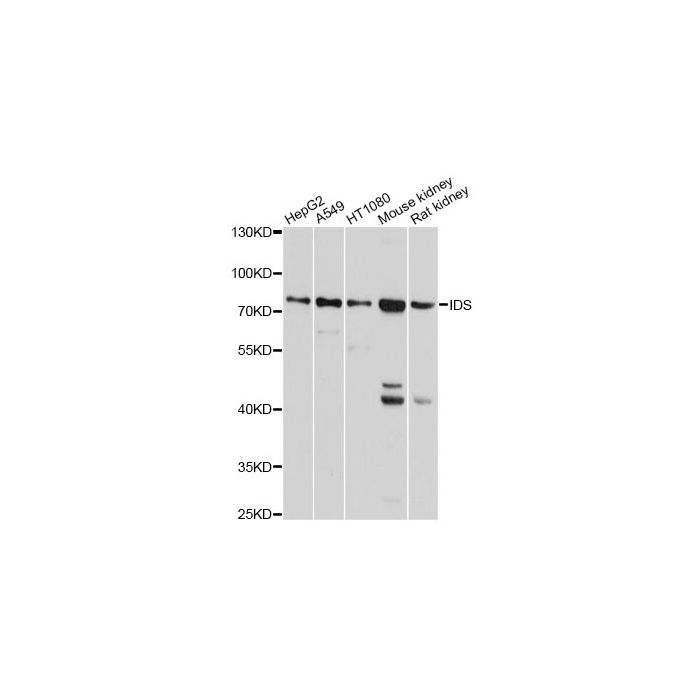
IDS polyclonal, anti-human, mouse, rat
€388.00
In stock
SKU
BS7690
Background:
IDS (Iduronate 2-sulfatase), also known as SIDS, is a 550 amino acid protein that localizes to the lysosome and belongs to the sulfatase family. Expressed in lung, liver, kidney and placenta, IDS uses calcium as a cofactor to catalyze the hydrolysis of select sulfate groups on dermatan sulfate, heparan sulfate and heparin and, via this catalytic activity, is essential for the lysosomal degradation of both dermatan and heparan sulfate. Defects in the gene encoding IDS are the cause of mucopolysaccharidosis type 2 (MPS2), more commonly known as Hunter syndrome, which is characterized by skeletal deformities, hepatosplenomegaly and progressive cardiopulmonary deterioration, as well as neurological damage and, in some cases, death. IDS exists as two alternatively spliced isoforms, designated long and short.
Alternative Name:
Alpha L iduronate sulfate sulfatase, Alpha-L-iduronate sulfate sulfatase, AW214631, Ids, IDS_HUMAN, Iduronate 2 sulfatase 14 kDa chain, Iduronate 2 sulfatase 42 kDa chain, Iduronate 2 sulfatase, Iduronate 2-sulfatase 14 kDa chain, Iduronate sulfatase, Idursulfase, MPS2, RP23-29M4.1, SIDS,
Application Dilution: WB: 1:500~1:2000
Specificity: IDS polyclonal antibody detects endogenous levels of IDS protein.
Immunogen:
Recombinant full length Human IDS.
MW: ~ 62 kDa
Swis Prot.: P22304
Purification & Purity:
The antibody was affinity-purified from rabbit antiserum by affinity-chromatography using epitope-specific immunogen and the purity is > 95% (by SDS-PAGE).
Format:
1mg/ml in PBS with 0.1% Sodium Azide, 50% Glycerol.
Storage:
Store at 4°C short term. Aliquot and store at -20°C long term. Avoid freeze-thaw cycles.
For research use only, not for use in diagnostic procedure.
IDS (Iduronate 2-sulfatase), also known as SIDS, is a 550 amino acid protein that localizes to the lysosome and belongs to the sulfatase family. Expressed in lung, liver, kidney and placenta, IDS uses calcium as a cofactor to catalyze the hydrolysis of select sulfate groups on dermatan sulfate, heparan sulfate and heparin and, via this catalytic activity, is essential for the lysosomal degradation of both dermatan and heparan sulfate. Defects in the gene encoding IDS are the cause of mucopolysaccharidosis type 2 (MPS2), more commonly known as Hunter syndrome, which is characterized by skeletal deformities, hepatosplenomegaly and progressive cardiopulmonary deterioration, as well as neurological damage and, in some cases, death. IDS exists as two alternatively spliced isoforms, designated long and short.
Alternative Name:
Alpha L iduronate sulfate sulfatase, Alpha-L-iduronate sulfate sulfatase, AW214631, Ids, IDS_HUMAN, Iduronate 2 sulfatase 14 kDa chain, Iduronate 2 sulfatase 42 kDa chain, Iduronate 2 sulfatase, Iduronate 2-sulfatase 14 kDa chain, Iduronate sulfatase, Idursulfase, MPS2, RP23-29M4.1, SIDS,
Application Dilution: WB: 1:500~1:2000
Specificity: IDS polyclonal antibody detects endogenous levels of IDS protein.
Immunogen:
Recombinant full length Human IDS.
MW: ~ 62 kDa
Swis Prot.: P22304
Purification & Purity:
The antibody was affinity-purified from rabbit antiserum by affinity-chromatography using epitope-specific immunogen and the purity is > 95% (by SDS-PAGE).
Format:
1mg/ml in PBS with 0.1% Sodium Azide, 50% Glycerol.
Storage:
Store at 4°C short term. Aliquot and store at -20°C long term. Avoid freeze-thaw cycles.
For research use only, not for use in diagnostic procedure.
| Is Featured? | No |
|---|
Write Your Own Review