
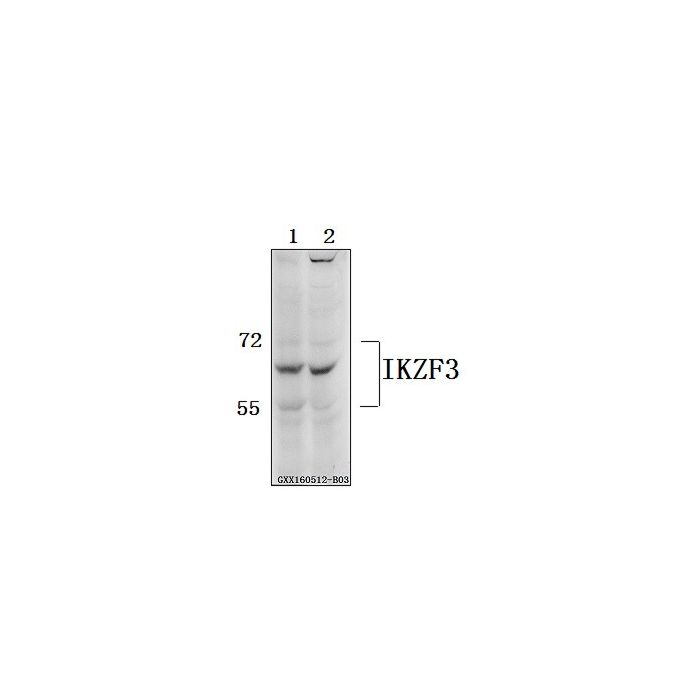
IKZF3 polyclonal, anti-human
€305.00
In stock
SKU
BS61559
Background:
Aiolos is an Ikaros family transcription factor composed of several zinc fingers that mediate DNA binding and homodimerization or heterodimerization with other Ikaros family members. Multiple Aiolos isoforms are generated through alternative splicing of the portion of the transcript encoding the amino-terminal zinc fingers. Aiolos is expressed by lymphoid tissues, with highest expression levels seen in mature B and T cells. Ikaros family proteins control lymphocyte development by recruiting chromatin remodeling complexes to DNA. B cells from mice lacking Aiolos have a reduced threshold for activation, increased proliferation, and elevated levels of IgG and IgE. In addition, Aiolos null mice develop B cell lymphomas. In T cells, Aiolos contributes to Th17 cell differentiation by suppressing IL-2 expression. Aberrant expression of Aiolos in transformed epithelial cells promotes anchorage independence through downregulation of adhesion-related genes. Alterations in the Aiolos gene are observed in near haploid acute lymphoblastic leukemia, and the genetic locus containing Aiolos is linked to increased susceptibility to rheumatoid arthritis and systemic lupus erythematosus.
Alternative Name:
Zinc finger protein Aiolos, Ikaros family zinc finger protein 3
Application Dilution: WB: 1:500~1:1000
Specificity: IKZF3 polyclonal antibody detects endogenous levels of IKZF3 protein.
Immunogen:
Synthetic peptide, corresponding to amino acids 363-407 of Human IKZF3
MW: ~ 50, 58, 65 kDa
Swis Prot.: Q9UKT9
Purification & Purity:
The antibody was affinity-purified from rabbit antiserum by affinity-chromatography using epitope-specific immunogen and the purity is > 95% (by SDS-PAGE)
Format:
1 mg/ml in Phosphate buffered saline (PBS) with 0.05% sodium azide, approx. pH 7.3.
Storage:
Store at 4°C short term. Aliquot and store at -20°C long term. Avoid freeze-thaw cycles.
For research use only, not for use in diagnostic procedure.
Aiolos is an Ikaros family transcription factor composed of several zinc fingers that mediate DNA binding and homodimerization or heterodimerization with other Ikaros family members. Multiple Aiolos isoforms are generated through alternative splicing of the portion of the transcript encoding the amino-terminal zinc fingers. Aiolos is expressed by lymphoid tissues, with highest expression levels seen in mature B and T cells. Ikaros family proteins control lymphocyte development by recruiting chromatin remodeling complexes to DNA. B cells from mice lacking Aiolos have a reduced threshold for activation, increased proliferation, and elevated levels of IgG and IgE. In addition, Aiolos null mice develop B cell lymphomas. In T cells, Aiolos contributes to Th17 cell differentiation by suppressing IL-2 expression. Aberrant expression of Aiolos in transformed epithelial cells promotes anchorage independence through downregulation of adhesion-related genes. Alterations in the Aiolos gene are observed in near haploid acute lymphoblastic leukemia, and the genetic locus containing Aiolos is linked to increased susceptibility to rheumatoid arthritis and systemic lupus erythematosus.
Alternative Name:
Zinc finger protein Aiolos, Ikaros family zinc finger protein 3
Application Dilution: WB: 1:500~1:1000
Specificity: IKZF3 polyclonal antibody detects endogenous levels of IKZF3 protein.
Immunogen:
Synthetic peptide, corresponding to amino acids 363-407 of Human IKZF3
MW: ~ 50, 58, 65 kDa
Swis Prot.: Q9UKT9
Purification & Purity:
The antibody was affinity-purified from rabbit antiserum by affinity-chromatography using epitope-specific immunogen and the purity is > 95% (by SDS-PAGE)
Format:
1 mg/ml in Phosphate buffered saline (PBS) with 0.05% sodium azide, approx. pH 7.3.
Storage:
Store at 4°C short term. Aliquot and store at -20°C long term. Avoid freeze-thaw cycles.
For research use only, not for use in diagnostic procedure.
| Is Featured? | No |
|---|
Write Your Own Review