
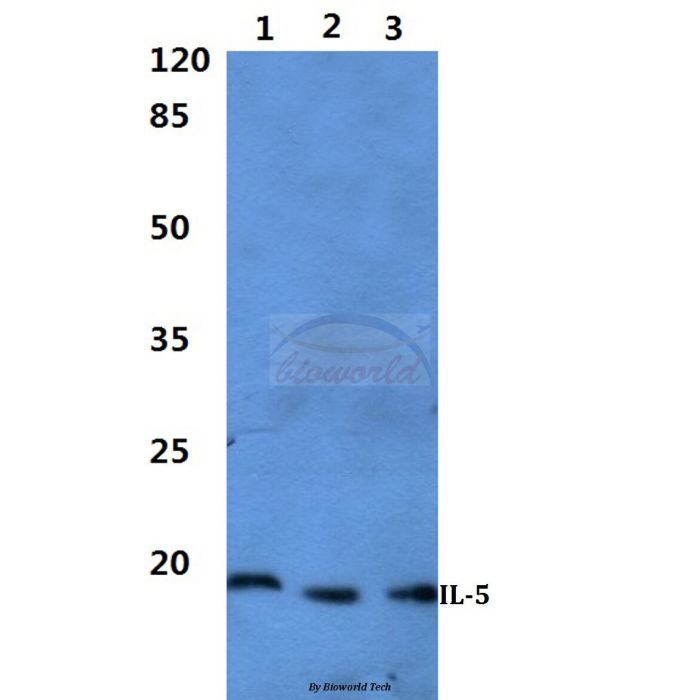
IL-5 polyclonal, anti-human, mouse, rat
€305.00
In stock
SKU
BS60300
Background:
Interleukin 5 (IL-5) is a soluble T cell-derived factor, also known as T cellreplacing factor (TRF), that induces B cell and eosinophil growth and differentiation. IL-5 exerts its biological activity through the IL-5 receptor (IL-5R), which is composed of two chains: an α chain that binds IL-5 with low affinity and a β chain that does not bind IL-5, but together with the IL-5 α chain, constitutes the high affinity IL-5 receptor. The cytoplasmic domain of both the α and β chains is essential for signal transduction. Specifically, the membrane-proximal proline-rich sequence of the cytoplasmic domain of the IL-5R receptor α subunit, IL-5Rα, is critical for the IL-5 induced proliferative response, expression of nuclear proto-oncogenes and tyrosine phosphorylation of cellular proteins, such as JAK1 and JAK2.
Alternative Name:
Interleukin-5, Interleukin5, Interleukin 5, IL-5, B-cell differentiation factor I, Eosinophil differentiation factor, T-cell replacing factor, TRF, IL5
Application Dilution: WB: 1:500~1:1000
Specificity: IL-5 polyclonal antibody detects endogenous levels of IL-5 protein.
Immunogen:
A synthetic peptide corresponding to residues in Human IL-5.
MW: ~ 15,45 kDa
Swis Prot.: P05113
Purification & Purity:
The antibody was affinity-purified from rabbit antiserum by affinity-chromatography using epitope-specific immunogen and the purity is > 95% (by SDS-PAGE).
Format:
1 mg/ml in Phosphate buffered saline (PBS) with 0.05% sodium azide, approx. pH 7.2.
Storage:
Store at 4°C short term. Aliquot and store at -20°C long term. Avoid freeze-thaw cycles.
For research use only, not for use in diagnostic procedure.
Interleukin 5 (IL-5) is a soluble T cell-derived factor, also known as T cellreplacing factor (TRF), that induces B cell and eosinophil growth and differentiation. IL-5 exerts its biological activity through the IL-5 receptor (IL-5R), which is composed of two chains: an α chain that binds IL-5 with low affinity and a β chain that does not bind IL-5, but together with the IL-5 α chain, constitutes the high affinity IL-5 receptor. The cytoplasmic domain of both the α and β chains is essential for signal transduction. Specifically, the membrane-proximal proline-rich sequence of the cytoplasmic domain of the IL-5R receptor α subunit, IL-5Rα, is critical for the IL-5 induced proliferative response, expression of nuclear proto-oncogenes and tyrosine phosphorylation of cellular proteins, such as JAK1 and JAK2.
Alternative Name:
Interleukin-5, Interleukin5, Interleukin 5, IL-5, B-cell differentiation factor I, Eosinophil differentiation factor, T-cell replacing factor, TRF, IL5
Application Dilution: WB: 1:500~1:1000
Specificity: IL-5 polyclonal antibody detects endogenous levels of IL-5 protein.
Immunogen:
A synthetic peptide corresponding to residues in Human IL-5.
MW: ~ 15,45 kDa
Swis Prot.: P05113
Purification & Purity:
The antibody was affinity-purified from rabbit antiserum by affinity-chromatography using epitope-specific immunogen and the purity is > 95% (by SDS-PAGE).
Format:
1 mg/ml in Phosphate buffered saline (PBS) with 0.05% sodium azide, approx. pH 7.2.
Storage:
Store at 4°C short term. Aliquot and store at -20°C long term. Avoid freeze-thaw cycles.
For research use only, not for use in diagnostic procedure.
| Is Featured? | No |
|---|
Write Your Own Review