
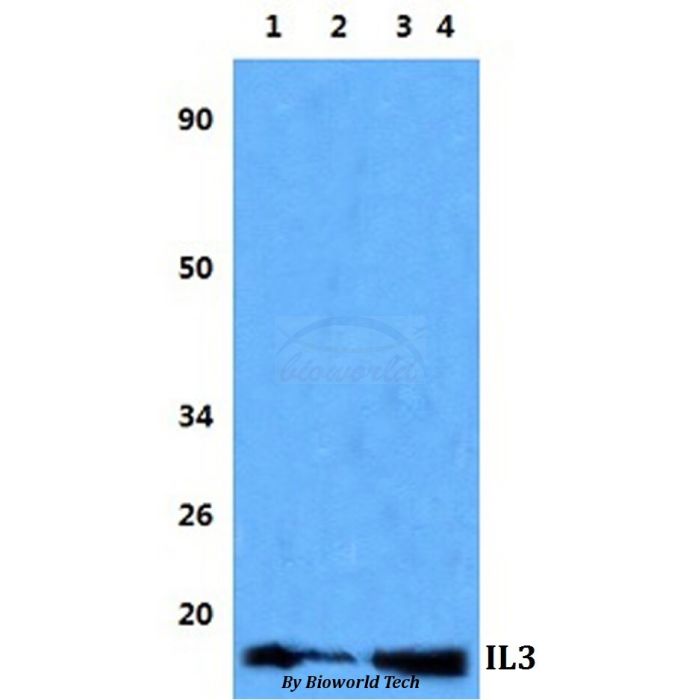
IL3 polyclonal, anti-human, mouse, rat
€305.00
In stock
SKU
BS60516
Background:
Interleukin-3, or IL-3, is a pleiotropic cytokine that is primarily secreted by activated T lymphocytes and stimulates the proliferation and differentiation of hematopoietic cells. IL-3 not only supports growth of both pluripotent stem cells and the more differentiated committed progenitors, but it also stimulates the functional activity of some fully differentiated cells. IL-3 has also been shown to protect mast cells from undergoing apoptosis. IL-3 exerts its biological effects through a receptor which consists of a ligand-specific α subunit and a signal transducing β subunit common to the IL-3/IL-5/GM-CSF receptors. The carboxy terminus of the β subunit has been shown to be necessary for activation of the MAP kinase signaling pathway. Although the IL-3 receptor has no intrinsic kinase activity, stimulation with IL-3 leads to tyrosine phosphorylation of the JAK/Tyk 2 family member, JAK2, which in turn activates and causes nuclear translocation of Stat5a and Stat5b.
Alternative Name:
Interleukin-3, IL-3, Hematopoietic growth factor, Mast cell growth factor, MCGF, Multipotential colony-stimulating factor, P-cell-stimulating factor, IL3
Application Dilution: WB: 1:500~1:1000, IHC: 1:50~1:200
Specificity: IL3 polyclonal antibody detects endogenous levels of IL3 protein.
Immunogen:
A synthetic peptide corresponding to residues in Human IL3.
MW: ~ 17 kDa
Swis Prot.: P08700
Purification & Purity:
The antibody was affinity-purified from rabbit antiserum by affinity-chromatography using epitope-specific immunogen and the purity is > 95% (by SDS-PAGE).
Format:
1 mg/ml in Phosphate buffered saline (PBS) with 0.05% sodium azide, approx. pH 7.3.
Storage:
Store at 4°C short term. Aliquot and store at -21°C long term. Avoid freeze-thaw cycles.
For research use only, not for use in diagnostic procedure.
Interleukin-3, or IL-3, is a pleiotropic cytokine that is primarily secreted by activated T lymphocytes and stimulates the proliferation and differentiation of hematopoietic cells. IL-3 not only supports growth of both pluripotent stem cells and the more differentiated committed progenitors, but it also stimulates the functional activity of some fully differentiated cells. IL-3 has also been shown to protect mast cells from undergoing apoptosis. IL-3 exerts its biological effects through a receptor which consists of a ligand-specific α subunit and a signal transducing β subunit common to the IL-3/IL-5/GM-CSF receptors. The carboxy terminus of the β subunit has been shown to be necessary for activation of the MAP kinase signaling pathway. Although the IL-3 receptor has no intrinsic kinase activity, stimulation with IL-3 leads to tyrosine phosphorylation of the JAK/Tyk 2 family member, JAK2, which in turn activates and causes nuclear translocation of Stat5a and Stat5b.
Alternative Name:
Interleukin-3, IL-3, Hematopoietic growth factor, Mast cell growth factor, MCGF, Multipotential colony-stimulating factor, P-cell-stimulating factor, IL3
Application Dilution: WB: 1:500~1:1000, IHC: 1:50~1:200
Specificity: IL3 polyclonal antibody detects endogenous levels of IL3 protein.
Immunogen:
A synthetic peptide corresponding to residues in Human IL3.
MW: ~ 17 kDa
Swis Prot.: P08700
Purification & Purity:
The antibody was affinity-purified from rabbit antiserum by affinity-chromatography using epitope-specific immunogen and the purity is > 95% (by SDS-PAGE).
Format:
1 mg/ml in Phosphate buffered saline (PBS) with 0.05% sodium azide, approx. pH 7.3.
Storage:
Store at 4°C short term. Aliquot and store at -21°C long term. Avoid freeze-thaw cycles.
For research use only, not for use in diagnostic procedure.
| Is Featured? | No |
|---|
Write Your Own Review