
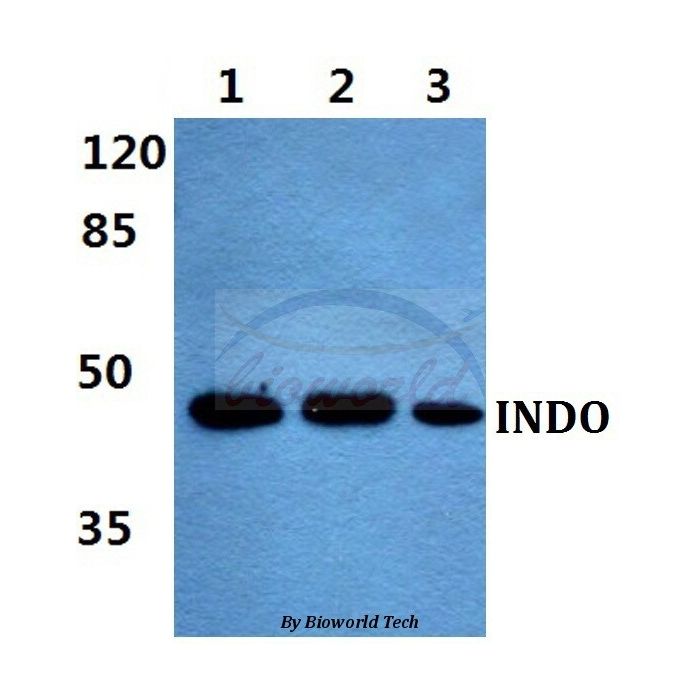
INDO polyclonal, anti-human, mouse, rat
€305.00
In stock
SKU
BS60456
Background:
Indoleamine 2,3-dioxygenase (IDO) is an IFN-γ inducible enzyme that catalyzes the degradation of the essential amino acid L-tryptophan to N-formylkynurenine. The gene encoding human IDO maps to chromosome 8p12-p11. IDO, also known as INDO, is an important modulator of immunological responses and protects allogeneic concepti from alloreactive maternal lymphocytes. IDO mediates an interesting inhibitory effect of HeLa cells co-cultured with human PBLs. The ILN-2-induced proliferation response of PBLs is diminished in the presence of HeLa cells while an IDO inhbitor negates this effect. Flow cytometric analysis indicates both mature and immature CD123-positive dentritic cells suppress T cell activity using IDO. IDO-transfected cells co-cultured with T cells reduces T cell proliferation.
Alternative Name:
Indoleamine 2,3-dioxygenase 1, IDO-1, Indoleamine-pyrrole 2,3-dioxygenase, IDO1, IDO, INDO
Application Dilution: WB: 1:500~1:1000
Specificity: INDO polyclonal antibody detects endogenous levels of INDO protein.
Immunogen:
A synthetic peptide corresponding to residues in Human INDO.
MW: ~ 45 kDa
Swis Prot.: P14902
Purification & Purity:
The antibody was affinity-purified from rabbit antiserum by affinity-chromatography using epitope-specific immunogen and the purity is > 95% (by SDS-PAGE).
Format:
1mg/ml in PBS with 0.1% Sodium Azide, 50% Glycerol.
Storage:
Store at 4°C short term. Aliquot and store at -20°C long term. Avoid freeze-thaw cycles.
For research use only, not for use in diagnostic procedure.
Indoleamine 2,3-dioxygenase (IDO) is an IFN-γ inducible enzyme that catalyzes the degradation of the essential amino acid L-tryptophan to N-formylkynurenine. The gene encoding human IDO maps to chromosome 8p12-p11. IDO, also known as INDO, is an important modulator of immunological responses and protects allogeneic concepti from alloreactive maternal lymphocytes. IDO mediates an interesting inhibitory effect of HeLa cells co-cultured with human PBLs. The ILN-2-induced proliferation response of PBLs is diminished in the presence of HeLa cells while an IDO inhbitor negates this effect. Flow cytometric analysis indicates both mature and immature CD123-positive dentritic cells suppress T cell activity using IDO. IDO-transfected cells co-cultured with T cells reduces T cell proliferation.
Alternative Name:
Indoleamine 2,3-dioxygenase 1, IDO-1, Indoleamine-pyrrole 2,3-dioxygenase, IDO1, IDO, INDO
Application Dilution: WB: 1:500~1:1000
Specificity: INDO polyclonal antibody detects endogenous levels of INDO protein.
Immunogen:
A synthetic peptide corresponding to residues in Human INDO.
MW: ~ 45 kDa
Swis Prot.: P14902
Purification & Purity:
The antibody was affinity-purified from rabbit antiserum by affinity-chromatography using epitope-specific immunogen and the purity is > 95% (by SDS-PAGE).
Format:
1mg/ml in PBS with 0.1% Sodium Azide, 50% Glycerol.
Storage:
Store at 4°C short term. Aliquot and store at -20°C long term. Avoid freeze-thaw cycles.
For research use only, not for use in diagnostic procedure.
| Is Featured? | No |
|---|
Write Your Own Review