
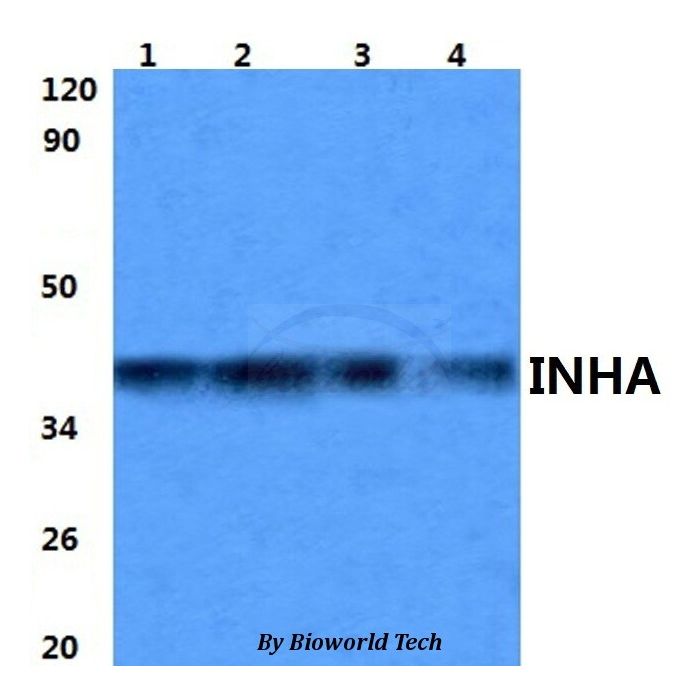
INHA polyclonal, anti-human, mouse, rat
€305.00
In stock
SKU
BS60979
Background:
Inhibin is a gonadal protein that preferentially suppresses the secretion of pituitary follicle-stimulating hormone (FSH). Inhibin comprises two subunits, Inhibin A and Inhibin B. Each subunit consists of the same α subunit, covalently linked to 1 of 2 distinct subunits, β-α or β-β. Originally isolated from ovarian follicular fluid and characterized as a disulphide-linked dimeric glycoprotein, inhibin belongs to the transforming growth factor β (TGFβ) superfamily of growth and differentiation factors. TGFβ proteins affect a range of tissues and systems beyond their role in reproduction. In addition to their role in endocrine feedback in the reproductive sytem, inhibins subserve local regulatory roles in numerous extragonadal tissues, including brain, adrenal, bone marrow, placenta and, most notably, anterior pituitary. Inhibin α-subunit gene expression is down regulated in human prostate cancer, suggesting a tumor-suppressive role. The human Inhibin α gene maps to chromosome 2q33-q36.
Alternative Name:
Inhibin alpha chain, INHA
Application Dilution: WB: 1:500~1:1000, IHC: 1:50~1:200
Specificity: INHA polyclonal antibody detects endogenous levels of INHA protein.
Immunogen:
A synthetic peptide corresponding to residues in Human INHA.
MW: ~ 40 kDa
Swis Prot.: P05111
Purification & Purity:
The antibody was affinity-purified from rabbit antiserum by affinity-chromatography using epitope-specific immunogen and the purity is > 95% (by SDS-PAGE).
Format:
1 mg/ml in Phosphate buffered saline (PBS) with 0.05% sodium azide, approx. pH 7.6.
Storage:
Store at 4°C short term. Aliquot and store at -20°C long term. Avoid freeze-thaw cycles.
For research use only, not for use in diagnostic procedure.
Inhibin is a gonadal protein that preferentially suppresses the secretion of pituitary follicle-stimulating hormone (FSH). Inhibin comprises two subunits, Inhibin A and Inhibin B. Each subunit consists of the same α subunit, covalently linked to 1 of 2 distinct subunits, β-α or β-β. Originally isolated from ovarian follicular fluid and characterized as a disulphide-linked dimeric glycoprotein, inhibin belongs to the transforming growth factor β (TGFβ) superfamily of growth and differentiation factors. TGFβ proteins affect a range of tissues and systems beyond their role in reproduction. In addition to their role in endocrine feedback in the reproductive sytem, inhibins subserve local regulatory roles in numerous extragonadal tissues, including brain, adrenal, bone marrow, placenta and, most notably, anterior pituitary. Inhibin α-subunit gene expression is down regulated in human prostate cancer, suggesting a tumor-suppressive role. The human Inhibin α gene maps to chromosome 2q33-q36.
Alternative Name:
Inhibin alpha chain, INHA
Application Dilution: WB: 1:500~1:1000, IHC: 1:50~1:200
Specificity: INHA polyclonal antibody detects endogenous levels of INHA protein.
Immunogen:
A synthetic peptide corresponding to residues in Human INHA.
MW: ~ 40 kDa
Swis Prot.: P05111
Purification & Purity:
The antibody was affinity-purified from rabbit antiserum by affinity-chromatography using epitope-specific immunogen and the purity is > 95% (by SDS-PAGE).
Format:
1 mg/ml in Phosphate buffered saline (PBS) with 0.05% sodium azide, approx. pH 7.6.
Storage:
Store at 4°C short term. Aliquot and store at -20°C long term. Avoid freeze-thaw cycles.
For research use only, not for use in diagnostic procedure.
| Is Featured? | No |
|---|
Write Your Own Review