
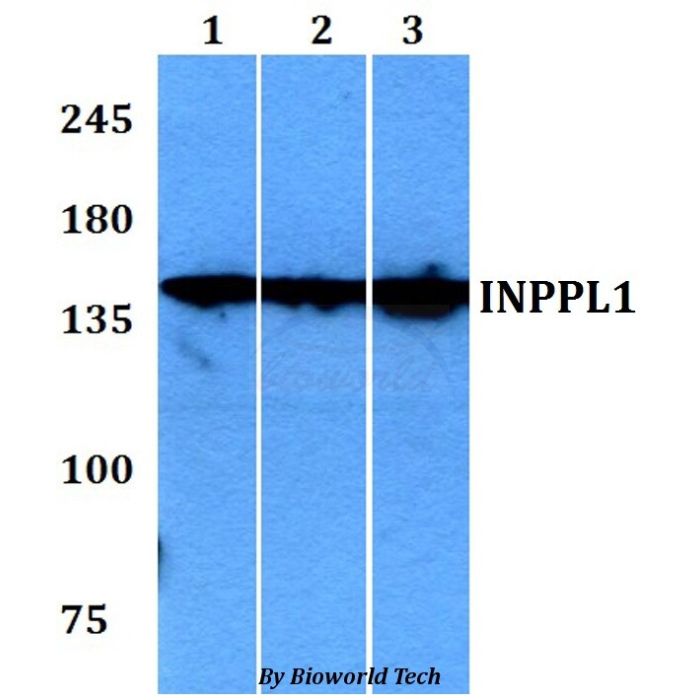
INPPL1 polyclonal, anti-human, mouse, rat
€305.00
In stock
SKU
BS60810
Background:
The production, survival and function of monocytes and macrophages are regulated by the macrophage colony-stimulating factor M-CSF through its tyrosine kinase receptor Fms. Binding of M-CSF to Fms induces the tyrosine phosphorylation and association of SH2-containing inositol phosphatase SHIP with the phosphotyrosine-binding domain of Shc. The SHIP protein hydrolyzes PtdIns P3 to PtdIns Ps and results in strong inhibition of cell growth. SHIP is also a target for CD28, suggesting that SHIP may be involved in the regulation of T cell activation. SHIP has several splice variants and is expressed during hematopoiesis and spermatogenesis. SHIP-2, a homolog of SHIP, is expressed in both hemopoietic and non-hemopoietic cells. In addition to T and B cells, spleen, thymus and lung are shown to coexpress SHIP and SHIP-2. SHIP is also expressed in fibroblasts, heart, skeletal muscle and different brain areas and its expression is enhanced in TSH and EGF-stimulated cells. Like SHIP, SHIP-2 is tyrosine-phosphorylated and associates with Shc after ligation of the B-cell receptor to FcgRII. SHIP-2 causes cell cycle arrest in G1 phase in glioblastoma cells and plays a negative role in regulating the PI 3-kinase-PI 3-kinase B pathway. Both SHIP and SHIP-2 mediate FcgRIIB signaling, including inhibition of proliferation.
Alternative Name:
Phosphatidylinositol 3,4,5-trisphosphate 5-phosphatase 2, Inositol polyphosphate phosphatase-like protein 1, INPPL-1, Protein 51C, SH2 domain-containing inositol 5'-phosphatase 2, SH2 domain-containing inositol phosphatase 2, SHIP-2, INPPL1, SHIP2
Application Dilution: WB: 1:500~1:1000
Specificity: INPPL1 polyclonal antibody detects endogenous levels of INPPL1 protein.
Immunogen:
A synthetic peptide corresponding to residues in Human INPPL1.
MW: ~ 139 kDa
Swis Prot.: O15357
Purification & Purity:
The antibody was affinity-purified from rabbit antiserum by affinity-chromatography using epitope-specific immunogen and the purity is > 95% (by SDS-PAGE).
Format:
1 mg/ml in Phosphate buffered saline (PBS) with 15 mM sodium azide, approx. pH 7.2.
Storage:
Store at 4°C short term. Aliquot and store at -20°C long term. Avoid freeze-thaw cycles.
For research use only, not for use in diagnostic procedure.
The production, survival and function of monocytes and macrophages are regulated by the macrophage colony-stimulating factor M-CSF through its tyrosine kinase receptor Fms. Binding of M-CSF to Fms induces the tyrosine phosphorylation and association of SH2-containing inositol phosphatase SHIP with the phosphotyrosine-binding domain of Shc. The SHIP protein hydrolyzes PtdIns P3 to PtdIns Ps and results in strong inhibition of cell growth. SHIP is also a target for CD28, suggesting that SHIP may be involved in the regulation of T cell activation. SHIP has several splice variants and is expressed during hematopoiesis and spermatogenesis. SHIP-2, a homolog of SHIP, is expressed in both hemopoietic and non-hemopoietic cells. In addition to T and B cells, spleen, thymus and lung are shown to coexpress SHIP and SHIP-2. SHIP is also expressed in fibroblasts, heart, skeletal muscle and different brain areas and its expression is enhanced in TSH and EGF-stimulated cells. Like SHIP, SHIP-2 is tyrosine-phosphorylated and associates with Shc after ligation of the B-cell receptor to FcgRII. SHIP-2 causes cell cycle arrest in G1 phase in glioblastoma cells and plays a negative role in regulating the PI 3-kinase-PI 3-kinase B pathway. Both SHIP and SHIP-2 mediate FcgRIIB signaling, including inhibition of proliferation.
Alternative Name:
Phosphatidylinositol 3,4,5-trisphosphate 5-phosphatase 2, Inositol polyphosphate phosphatase-like protein 1, INPPL-1, Protein 51C, SH2 domain-containing inositol 5'-phosphatase 2, SH2 domain-containing inositol phosphatase 2, SHIP-2, INPPL1, SHIP2
Application Dilution: WB: 1:500~1:1000
Specificity: INPPL1 polyclonal antibody detects endogenous levels of INPPL1 protein.
Immunogen:
A synthetic peptide corresponding to residues in Human INPPL1.
MW: ~ 139 kDa
Swis Prot.: O15357
Purification & Purity:
The antibody was affinity-purified from rabbit antiserum by affinity-chromatography using epitope-specific immunogen and the purity is > 95% (by SDS-PAGE).
Format:
1 mg/ml in Phosphate buffered saline (PBS) with 15 mM sodium azide, approx. pH 7.2.
Storage:
Store at 4°C short term. Aliquot and store at -20°C long term. Avoid freeze-thaw cycles.
For research use only, not for use in diagnostic procedure.
| Is Featured? | No |
|---|
Write Your Own Review