
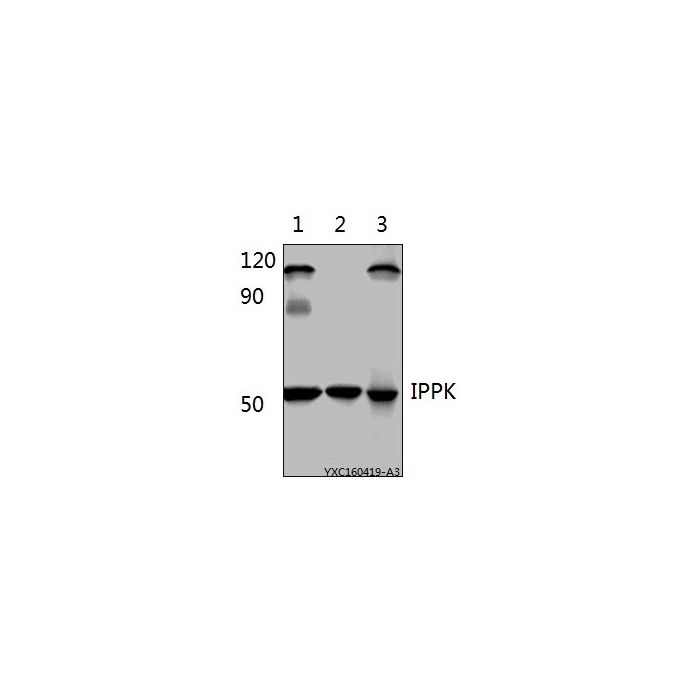
IPPK polyclonal, anti-human, mouse
€305.00
In stock
SKU
BS61524
Background:
IPPK (Inositol-pentakisphosphate 2-kinase) is a 491 amino acid gene product that belongs to the IPK1 type 2 family. IPPK expresses the conserved EXKPK motif which is found in both inositol-pentakisphosphate 2-kinase families 1 and 2. The primary function of IPPK has been found to be the ATP dependent phosphorylation of Ins(1,3,4,5,6)P5 at position 2 to form Ins(1,2,3,4,5,6)P6 (InsP6 or phytate). In plants, phytic acid (myo-inositol hexakisphosphate, InsP6) is an important molecule for phosphate storage and signaling. Mutation of the InsP6 gene can cause plants to be of greater susceptibility to many viral pathogens. In mice, InsP6 is believed to influence endocytosis and mRNA export. Homozygous mutations of the IPPK gene will prevent yolk sac development, indicating the importance of this gene product. IPPK is a ubiquitously expressed protein with highest expression found in heart, testis and brain.
Alternative Name:
Inositol-pentakisphosphate 2-kinase, IPK1 homolog, Inositol-1,3,4,5,6-pentakisphosphate 2-kinase, Ins(1,3,4,5,6)P5 2-kinase, InsP5 2-kinase
Application Dilution: WB: 1:500~1:1000
Specificity: IPPK polyclonal antibody detects endogenous levels of IPPK protein.
Immunogen:
Synthetic peptide, corresponding to amino acids 13-57 of Human IPPK.
MW: ~ 56 kDa
Swis Prot.: Q9H8X2
Purification & Purity:
The antibody was affinity-purified from rabbit antiserum by affinity-chromatography using epitope-specific immunogen and the purity is > 95% (by SDS-PAGE).
Format:
1 mg/ml in Phosphate buffered saline (PBS) with 0.05% sodium azide, approx. pH 7.3.
Storage:
Store at 4°C short term. Aliquot and store at -20°C long term. Avoid freeze-thaw cycles.
For research use only, not for use in diagnostic procedure.
IPPK (Inositol-pentakisphosphate 2-kinase) is a 491 amino acid gene product that belongs to the IPK1 type 2 family. IPPK expresses the conserved EXKPK motif which is found in both inositol-pentakisphosphate 2-kinase families 1 and 2. The primary function of IPPK has been found to be the ATP dependent phosphorylation of Ins(1,3,4,5,6)P5 at position 2 to form Ins(1,2,3,4,5,6)P6 (InsP6 or phytate). In plants, phytic acid (myo-inositol hexakisphosphate, InsP6) is an important molecule for phosphate storage and signaling. Mutation of the InsP6 gene can cause plants to be of greater susceptibility to many viral pathogens. In mice, InsP6 is believed to influence endocytosis and mRNA export. Homozygous mutations of the IPPK gene will prevent yolk sac development, indicating the importance of this gene product. IPPK is a ubiquitously expressed protein with highest expression found in heart, testis and brain.
Alternative Name:
Inositol-pentakisphosphate 2-kinase, IPK1 homolog, Inositol-1,3,4,5,6-pentakisphosphate 2-kinase, Ins(1,3,4,5,6)P5 2-kinase, InsP5 2-kinase
Application Dilution: WB: 1:500~1:1000
Specificity: IPPK polyclonal antibody detects endogenous levels of IPPK protein.
Immunogen:
Synthetic peptide, corresponding to amino acids 13-57 of Human IPPK.
MW: ~ 56 kDa
Swis Prot.: Q9H8X2
Purification & Purity:
The antibody was affinity-purified from rabbit antiserum by affinity-chromatography using epitope-specific immunogen and the purity is > 95% (by SDS-PAGE).
Format:
1 mg/ml in Phosphate buffered saline (PBS) with 0.05% sodium azide, approx. pH 7.3.
Storage:
Store at 4°C short term. Aliquot and store at -20°C long term. Avoid freeze-thaw cycles.
For research use only, not for use in diagnostic procedure.
| Is Featured? | No |
|---|
Write Your Own Review