
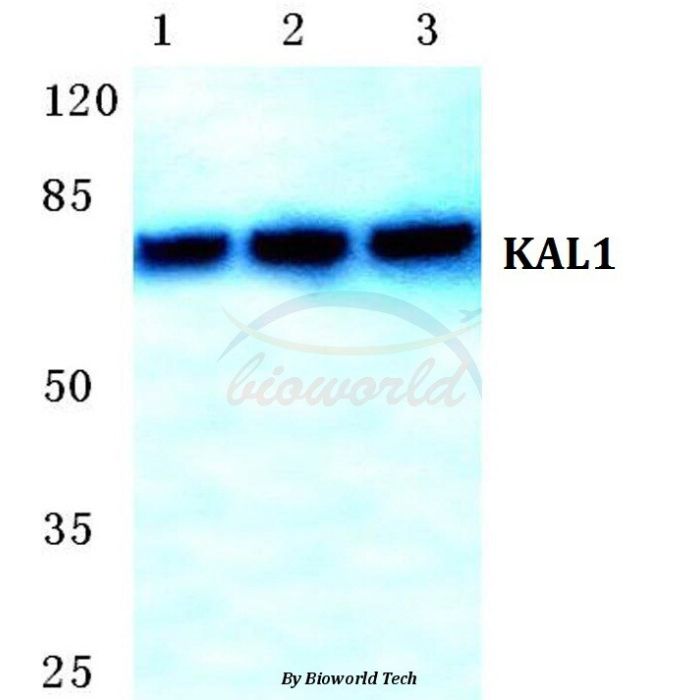
KAL1 polyclonal, anti-human, mouse, rat
€305.00
In stock
SKU
BS5771
Background:
Kallmann (KAL1) syndrome is an X-linked condition characterized by hypogonadism due to gonadotropin-releasing hormone (GnRH) deficiency, and a defective sense of smell, known as anosmia, due to the underdevelopment of the olfactory bulbs. GnRH is a key regulator of reproduction and sexual behavior. Anosmia associated with Kallmann syndrome is due to a defect in the migration and targeting of GnRH-secreting neurons and olfactory axons during embryonic development. Mutations in the KAL1 gene are responsible for X-linked Kallmann syndrome. The human KAL1 gene, located in the Xp22.3 region, encodes a 680 amino acid extracellular matrix adhesion protein, known as anosmin-1. Anosmin-1 plays an essential role in the patterning of mitral and tufted cell axon collaterals to the olfactory cortex. Anosmin-1 can be detected in the basement membranes and/or interstitial matrices of various structures including bronchial tubes, muscular walls of the digestive tract and forebrain subregions.
Alternative Name:
Anosmin1, Anosmin-1, Adhesion molecule-like X-linked, Kallmann syndrome protein, KAL1, ADMLX, KAL, KALIG1
Application Dilution: WB: 1:500~1:1000
Specificity: KAL1 polyclonal antibody detects endogenous levels of KAL1 protein.
Immunogen:
Synthetic peptide, corresponding to amino acids 205-250 of Human KAL1.
MW: ~ 76 kDa
Swis Prot.: P23352
Purification & Purity:
The antibody was affinity-purified from rabbit antiserum by affinity-chromatography using epitope-specific immunogen and the purity is > 95% (by SDS-PAGE).
Format:
1 mg/ml in Phosphate buffered saline (PBS) with 0.05% sodium azide, approx. pH 7.2.
Storage:
Store at 4°C short term. Aliquot and store at -20°C long term. Avoid freeze-thaw cycles.
For research use only, not for use in diagnostic procedure.
Kallmann (KAL1) syndrome is an X-linked condition characterized by hypogonadism due to gonadotropin-releasing hormone (GnRH) deficiency, and a defective sense of smell, known as anosmia, due to the underdevelopment of the olfactory bulbs. GnRH is a key regulator of reproduction and sexual behavior. Anosmia associated with Kallmann syndrome is due to a defect in the migration and targeting of GnRH-secreting neurons and olfactory axons during embryonic development. Mutations in the KAL1 gene are responsible for X-linked Kallmann syndrome. The human KAL1 gene, located in the Xp22.3 region, encodes a 680 amino acid extracellular matrix adhesion protein, known as anosmin-1. Anosmin-1 plays an essential role in the patterning of mitral and tufted cell axon collaterals to the olfactory cortex. Anosmin-1 can be detected in the basement membranes and/or interstitial matrices of various structures including bronchial tubes, muscular walls of the digestive tract and forebrain subregions.
Alternative Name:
Anosmin1, Anosmin-1, Adhesion molecule-like X-linked, Kallmann syndrome protein, KAL1, ADMLX, KAL, KALIG1
Application Dilution: WB: 1:500~1:1000
Specificity: KAL1 polyclonal antibody detects endogenous levels of KAL1 protein.
Immunogen:
Synthetic peptide, corresponding to amino acids 205-250 of Human KAL1.
MW: ~ 76 kDa
Swis Prot.: P23352
Purification & Purity:
The antibody was affinity-purified from rabbit antiserum by affinity-chromatography using epitope-specific immunogen and the purity is > 95% (by SDS-PAGE).
Format:
1 mg/ml in Phosphate buffered saline (PBS) with 0.05% sodium azide, approx. pH 7.2.
Storage:
Store at 4°C short term. Aliquot and store at -20°C long term. Avoid freeze-thaw cycles.
For research use only, not for use in diagnostic procedure.
| Is Featured? | No |
|---|
Write Your Own Review