
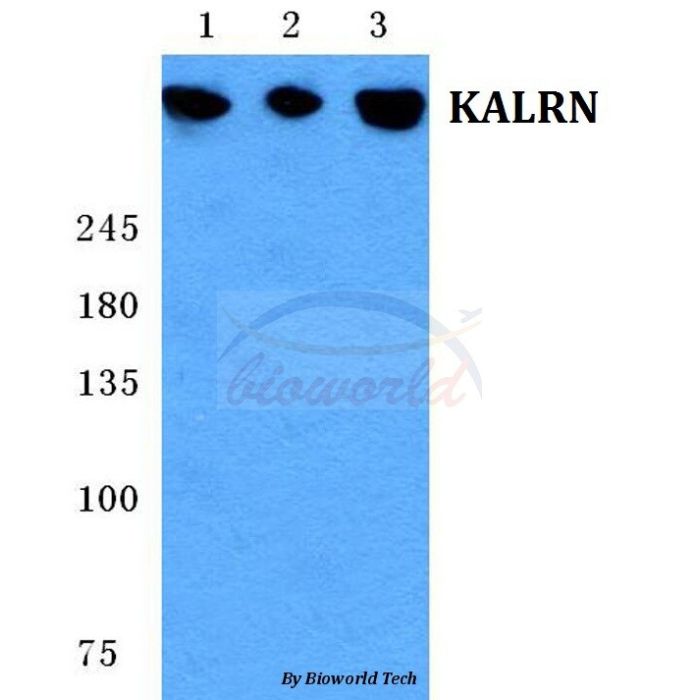
KALRN polyclonal, anti-human, mouse, rat
€305.00
In stock
SKU
BS5704
Background:
HAP1 (huntingtin-associated protein 1) binds to huntingtin. Huntingtin is a protein that contains a polyglutamine region and when the number of glutamine repeats exceeds 35, the gene encodes a version of huntingtin that leads to Huntington’s disease (HD). The ability of HAP1 to bind to huntingtin is enhanced by an expanded polyglutamine repeat region. HAP1 shows neuronal localization and moves with huntingtin in nerve fibers. HAP1 is primarily expressed in brain tissue, with greater expression in the olfactory bulb and brain stem. Mouse HAP1 is localized to membrane-bound organelles including large endosomes, tubulovesicular structures and budding vesicles in neurons. Duo, also designated huntingtin-associated protein interacting protein or HAPIP, binds Huntingtin-associated protein 1 (HAP1) and may have a role in vesicle trafficking and cytoskeletal function.
Alternative Name:
Kalirin, Huntingtin-associated protein-interacting protein, Protein Duo, Serine/threonine-protein kinase with Dbl- and pleckstrin homology domain, DUET, DUO, HAPIP, TRAD
Application Dilution: WB: 1:500~1:1000, ICC: 1:50~1:200
Specificity: KALRN polyclonal antibody detects endogenous levels of KALRN protein.
Immunogen:
Synthetic peptide, corresponding to amino acids 895-940 of Human KALRN.
MW: ~ 192, 350 kDa
Swis Prot.: O60229
Purification & Purity:
The antibody was affinity-purified from rabbit antiserum by affinity-chromatography using epitope-specific immunogen and the purity is > 95% (by SDS-PAGE).
Format:
1 mg/ml in Phosphate buffered saline (PBS) with 0.05% sodium azide, approx. pH 7.2.
Storage:
Store at 4°C short term. Aliquot and store at -20°C long term. Avoid freeze-thaw cycles.
For research use only, not for use in diagnostic procedure.
HAP1 (huntingtin-associated protein 1) binds to huntingtin. Huntingtin is a protein that contains a polyglutamine region and when the number of glutamine repeats exceeds 35, the gene encodes a version of huntingtin that leads to Huntington’s disease (HD). The ability of HAP1 to bind to huntingtin is enhanced by an expanded polyglutamine repeat region. HAP1 shows neuronal localization and moves with huntingtin in nerve fibers. HAP1 is primarily expressed in brain tissue, with greater expression in the olfactory bulb and brain stem. Mouse HAP1 is localized to membrane-bound organelles including large endosomes, tubulovesicular structures and budding vesicles in neurons. Duo, also designated huntingtin-associated protein interacting protein or HAPIP, binds Huntingtin-associated protein 1 (HAP1) and may have a role in vesicle trafficking and cytoskeletal function.
Alternative Name:
Kalirin, Huntingtin-associated protein-interacting protein, Protein Duo, Serine/threonine-protein kinase with Dbl- and pleckstrin homology domain, DUET, DUO, HAPIP, TRAD
Application Dilution: WB: 1:500~1:1000, ICC: 1:50~1:200
Specificity: KALRN polyclonal antibody detects endogenous levels of KALRN protein.
Immunogen:
Synthetic peptide, corresponding to amino acids 895-940 of Human KALRN.
MW: ~ 192, 350 kDa
Swis Prot.: O60229
Purification & Purity:
The antibody was affinity-purified from rabbit antiserum by affinity-chromatography using epitope-specific immunogen and the purity is > 95% (by SDS-PAGE).
Format:
1 mg/ml in Phosphate buffered saline (PBS) with 0.05% sodium azide, approx. pH 7.2.
Storage:
Store at 4°C short term. Aliquot and store at -20°C long term. Avoid freeze-thaw cycles.
For research use only, not for use in diagnostic procedure.
| Is Featured? | No |
|---|
Write Your Own Review