
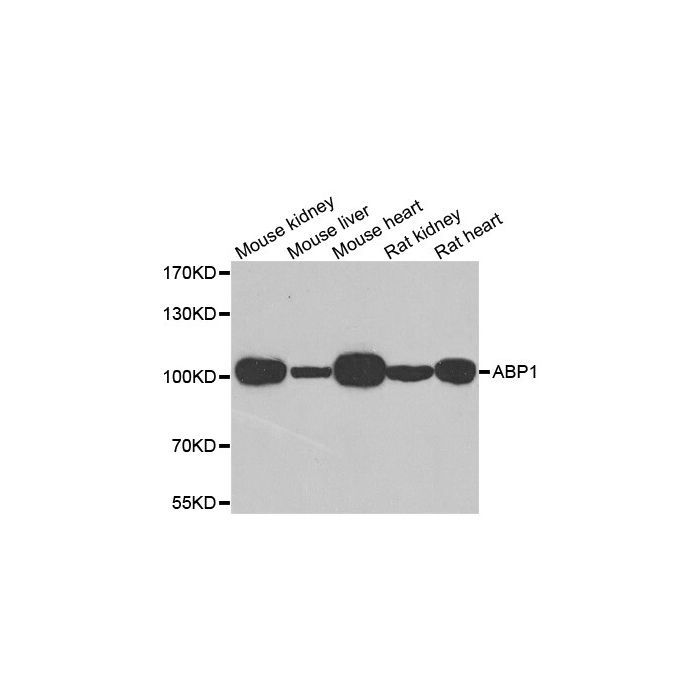
KAO polyclonal, anti-human, mouse, rat
€388.00
In stock
SKU
BS7991
Background:
Kidney amine oxidase (KAO), also called diamine oxidase (DAO) and amiloride-binding protein (ABP), is a member of the copper/topaquinone oxidase family. Notable compounds degraded by KAO include putrescine, histamine, spermine and spermidine, as well as substances involved in allergic and immune responses, cell proliferation, tissue differentiation, tumor formation, and possibly apoptosis. The secreted KAO protein can be detected in the extracellular space of placenta and kidney. Placental KAO is thought to play a role in the regulation of female reproductive function. KAO consists of two isoforms due to alternative splicing. Isoform 1 is the common 751 amino acid form while isoform 2 contains the additional 19 amino acids between residues 619 and 637.
Alternative Name:
ABP, Abp1, ABP1_HUMAN, Amiloride binding protein 1 (amine oxidase (copper containing)), Amiloride binding protein 1, Amiloride binding protein, Amiloride sensitive amine oxidase, Amiloride-binding protein, Amiloride-sensitive amine oxidase [copper-containing], Amine oxidase copper domain containing protein 1, AOC1, DAO, DAO1, Diamine oxidase, Histaminase, KAO, Kidney amine oxidase,
Application Dilution: WB: 1:500 - 1:2000, IF: 1:50 - 1:200
Specificity: KAO polyclonal antibody detects endogenous levels of KAO protein.
Immunogen:
Recombinant full length Human KAO.
MW: ~ 85 kDa
Swis Prot.: P19801
Purification & Purity:
The antibody was affinity-purified from rabbit antiserum by affinity-chromatography using epitope-specific immunogen and the purity is > 95% (by SDS-PAGE).
Format:
1mg/ml in PBS with 0.1% Sodium Azide, 50% Glycerol.
Storage:
Store at 4°C short term. Aliquot and store at -20°C long term. Avoid freeze-thaw cycles.
For research use only, not for use in diagnostic procedure.
Kidney amine oxidase (KAO), also called diamine oxidase (DAO) and amiloride-binding protein (ABP), is a member of the copper/topaquinone oxidase family. Notable compounds degraded by KAO include putrescine, histamine, spermine and spermidine, as well as substances involved in allergic and immune responses, cell proliferation, tissue differentiation, tumor formation, and possibly apoptosis. The secreted KAO protein can be detected in the extracellular space of placenta and kidney. Placental KAO is thought to play a role in the regulation of female reproductive function. KAO consists of two isoforms due to alternative splicing. Isoform 1 is the common 751 amino acid form while isoform 2 contains the additional 19 amino acids between residues 619 and 637.
Alternative Name:
ABP, Abp1, ABP1_HUMAN, Amiloride binding protein 1 (amine oxidase (copper containing)), Amiloride binding protein 1, Amiloride binding protein, Amiloride sensitive amine oxidase, Amiloride-binding protein, Amiloride-sensitive amine oxidase [copper-containing], Amine oxidase copper domain containing protein 1, AOC1, DAO, DAO1, Diamine oxidase, Histaminase, KAO, Kidney amine oxidase,
Application Dilution: WB: 1:500 - 1:2000, IF: 1:50 - 1:200
Specificity: KAO polyclonal antibody detects endogenous levels of KAO protein.
Immunogen:
Recombinant full length Human KAO.
MW: ~ 85 kDa
Swis Prot.: P19801
Purification & Purity:
The antibody was affinity-purified from rabbit antiserum by affinity-chromatography using epitope-specific immunogen and the purity is > 95% (by SDS-PAGE).
Format:
1mg/ml in PBS with 0.1% Sodium Azide, 50% Glycerol.
Storage:
Store at 4°C short term. Aliquot and store at -20°C long term. Avoid freeze-thaw cycles.
For research use only, not for use in diagnostic procedure.
| Is Featured? | No |
|---|
Write Your Own Review