
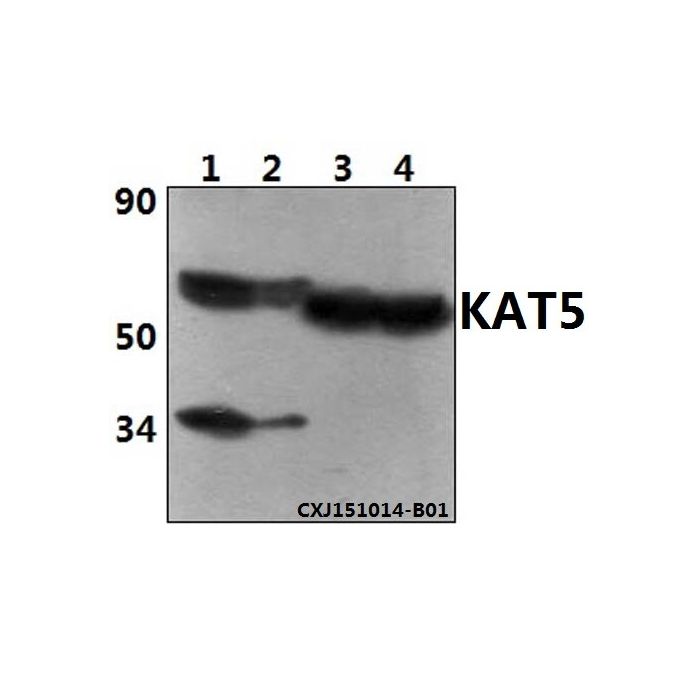
KAT5 polyclonal, anti-human, mouse, rat
€305.00
In stock
SKU
BS61356
Background:
The MOZ gene was initially isolated as a consequence of two variant translocations that were identified in a distinct subtype of acute myeloid leukemias and resulted in the formation of MOZ fusion proteins. These fusions involve the HAT domain of MOZ with the activation domain of either transcriptional co-activator protein TIF2/GRIP1 or CBP, and lead to enhanced transcriptional activation by a mechanism involving aberrant histone acetylation. Additional MOZ-related proteins, including MORF (MOZrelated factor) and TIP60 (TAT-interacting proteins 60), share significant similarities with MOZ including the putuative HAT domain. TIP60 was originally identified as a co-activator for the HIV TAT protein and also functions as a nuclear hormone receptor co-activator that enhances ligand dependent steroid receptor-mediated transactivation involving the androgen, estrogen and progesterone receptors.
Alternative Name:
Histone acetyltransferase KAT5, 60 kDa Tat-interactive protein, Tip60, Histone acetyltransferase HTATIP, HIV-1 Tat interactive protein, Lysine acetyltransferase 5, cPLA(2)-interacting protein, KAT5, HTATIP, TIP60
Application Dilution: WB: 1:500~1:1000
Specificity: KAT5 polyclonal antibodydetects endogenous levels of KAT5 protein
Immunogen:
A synthetic peptide corresponding to residues 54-99 in Human KAT5.
MW: ~ 58 kDa
Swis Prot.: Q92993
Purification & Purity:
The antibody was affinity-purified from rabbit antiserum by affinity-chromatography using epitope-specific immunogen and the purity is > 96% (by SDS-PAGE).
Format:
1 mg/ml in Phosphate buffered saline (PBS) with 0.05% sodium azide, approx. pH 7.3.
Storage:
Store at 4°C short term. Aliquot and store at -20°C long term. Avoid freeze-thaw cycles.
For research use only, not for use in diagnostic procedure.
The MOZ gene was initially isolated as a consequence of two variant translocations that were identified in a distinct subtype of acute myeloid leukemias and resulted in the formation of MOZ fusion proteins. These fusions involve the HAT domain of MOZ with the activation domain of either transcriptional co-activator protein TIF2/GRIP1 or CBP, and lead to enhanced transcriptional activation by a mechanism involving aberrant histone acetylation. Additional MOZ-related proteins, including MORF (MOZrelated factor) and TIP60 (TAT-interacting proteins 60), share significant similarities with MOZ including the putuative HAT domain. TIP60 was originally identified as a co-activator for the HIV TAT protein and also functions as a nuclear hormone receptor co-activator that enhances ligand dependent steroid receptor-mediated transactivation involving the androgen, estrogen and progesterone receptors.
Alternative Name:
Histone acetyltransferase KAT5, 60 kDa Tat-interactive protein, Tip60, Histone acetyltransferase HTATIP, HIV-1 Tat interactive protein, Lysine acetyltransferase 5, cPLA(2)-interacting protein, KAT5, HTATIP, TIP60
Application Dilution: WB: 1:500~1:1000
Specificity: KAT5 polyclonal antibodydetects endogenous levels of KAT5 protein
Immunogen:
A synthetic peptide corresponding to residues 54-99 in Human KAT5.
MW: ~ 58 kDa
Swis Prot.: Q92993
Purification & Purity:
The antibody was affinity-purified from rabbit antiserum by affinity-chromatography using epitope-specific immunogen and the purity is > 96% (by SDS-PAGE).
Format:
1 mg/ml in Phosphate buffered saline (PBS) with 0.05% sodium azide, approx. pH 7.3.
Storage:
Store at 4°C short term. Aliquot and store at -20°C long term. Avoid freeze-thaw cycles.
For research use only, not for use in diagnostic procedure.
| Is Featured? | No |
|---|
Write Your Own Review