
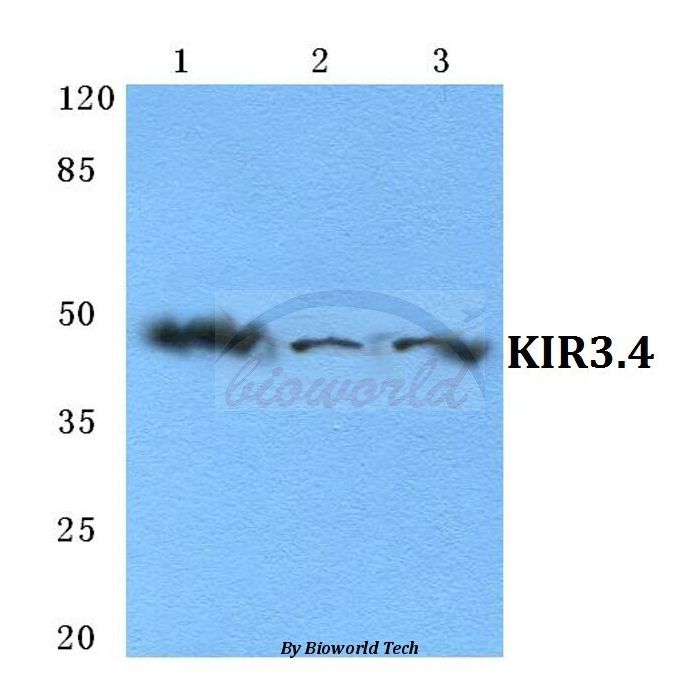
KIR3.4 polyclonal, anti-human, mouse, rat
€305.00
In stock
SKU
BS5775
Background:
G protein-coupled inwardly rectifying potassium channels (Kir3.1 through Kir3.4) are coupled to numerous neurotransmitter receptors in the brain and are abundantly expressed in the olfactory bulb, hippocampus, neocortex, dentate gyrus, cerebellar cortex and thalamus regions of the brain. Also known as GIRK, Kir3 potassium channels localize to the soma and dendrites as well as axons of neurons. Liberated Gbg subunits from G protein heterotrimers bind to and regulate Kir3 channel activity. Gb3- and Gb4-containing Gbg dimers bind directly to cytoplasmic domains of Kir3 proteins and increase the K+ current while Gb5-containing Gbg dimers inhibit Kir3 K+ current. Kir3 activity is also inhibited by tyrosine phosphorylation. Brain-derived neurotrophic factor activates receptor tyrosine kinase B, which then phosphorylates Kir3 tyrosine residues, effectively inactivating the Kir3 channels.
Alternative Name:
G protein-activated inward rectifier potassium channel 4, GIRK-4, GIRK4, Cardiac inward rectifier, CIR, Heart KATP channel, Inward rectifier K(+) channel Kir3.4, IRK-4, KATP-1, IRK4, KATP1, Potassium channel, inwardly rectifying subfamily J member 5, KCNJ5,
Application Dilution: WB: 1:500~1:1000, IF: 1:200
Specificity: KIR3.4 polyclonal antibody detects endogenous levels of KIR3.4 protein.
Immunogen:
Synthetic peptide, corresponding to the 374-419 of Human KIR3.4.
MW: ~ 48 kDa
Swis Prot.: P48544
Purification & Purity:
The antibody was affinity-purified from rabbit antiserum by affinity-chromatography using epitope-specific immunogen and the purity is > 95% (by SDS-PAGE).
Format:
1mg/ml in PBS with 0.1% Sodium Azide, 50% Glycerol.
Storage:
Store at 4°C short term. Aliquot and store at -20°C long term. Avoid freeze-thaw cycles.
For research use only, not for use in diagnostic procedure.
G protein-coupled inwardly rectifying potassium channels (Kir3.1 through Kir3.4) are coupled to numerous neurotransmitter receptors in the brain and are abundantly expressed in the olfactory bulb, hippocampus, neocortex, dentate gyrus, cerebellar cortex and thalamus regions of the brain. Also known as GIRK, Kir3 potassium channels localize to the soma and dendrites as well as axons of neurons. Liberated Gbg subunits from G protein heterotrimers bind to and regulate Kir3 channel activity. Gb3- and Gb4-containing Gbg dimers bind directly to cytoplasmic domains of Kir3 proteins and increase the K+ current while Gb5-containing Gbg dimers inhibit Kir3 K+ current. Kir3 activity is also inhibited by tyrosine phosphorylation. Brain-derived neurotrophic factor activates receptor tyrosine kinase B, which then phosphorylates Kir3 tyrosine residues, effectively inactivating the Kir3 channels.
Alternative Name:
G protein-activated inward rectifier potassium channel 4, GIRK-4, GIRK4, Cardiac inward rectifier, CIR, Heart KATP channel, Inward rectifier K(+) channel Kir3.4, IRK-4, KATP-1, IRK4, KATP1, Potassium channel, inwardly rectifying subfamily J member 5, KCNJ5,
Application Dilution: WB: 1:500~1:1000, IF: 1:200
Specificity: KIR3.4 polyclonal antibody detects endogenous levels of KIR3.4 protein.
Immunogen:
Synthetic peptide, corresponding to the 374-419 of Human KIR3.4.
MW: ~ 48 kDa
Swis Prot.: P48544
Purification & Purity:
The antibody was affinity-purified from rabbit antiserum by affinity-chromatography using epitope-specific immunogen and the purity is > 95% (by SDS-PAGE).
Format:
1mg/ml in PBS with 0.1% Sodium Azide, 50% Glycerol.
Storage:
Store at 4°C short term. Aliquot and store at -20°C long term. Avoid freeze-thaw cycles.
For research use only, not for use in diagnostic procedure.
| Is Featured? | No |
|---|
Write Your Own Review