
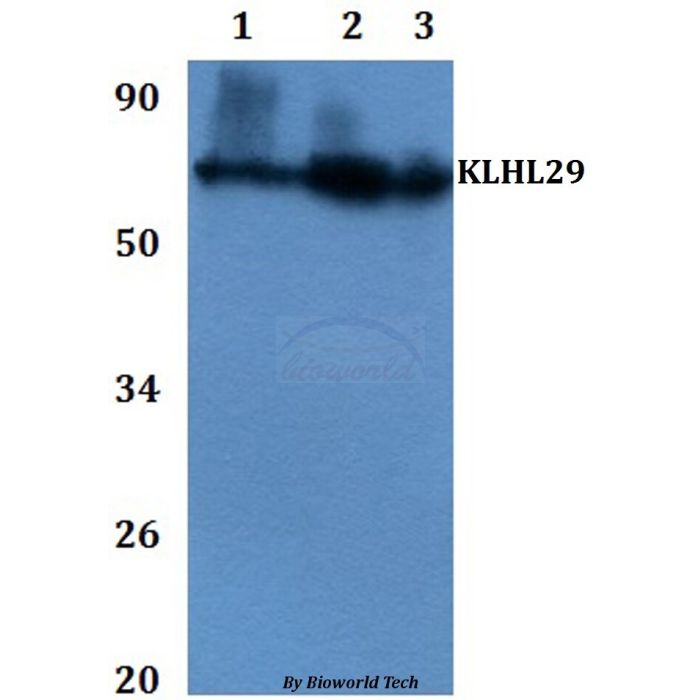
KLHL29 polyclonal, anti-human, mouse, rat
€305.00
In stock
SKU
BS61204
Background:
KLHL29 (Kelch-like protein 29), also known as KBTBD9, is a 655 amino acid protein that is related to the Drosophila Kelch protein. Mutations affecting Kelch function result in failure of Kelch to associate with the ring canals and subsequent female sterility. Human KLHL29 contains six kelch repeats and one BTB (POZ) domain. The BTB (Broad-Complex, Tramtrack and Bric a brac) domain, also known as the POZ (Poxvirus and Zinc finger) domain, is an N-terminal homodimerization domain that contains multiple copies of kelch repeats and/or C2H2-type zinc fingers. Proteins that contain BTB domains are thought to be involved in transcriptional regulation via control of chromatin structure and function. KLHL29 exists as two alternatively spliced isoforms which are encoded by a gene that maps to human chromosome 2p24.1.
Alternative Name:
Kelch-like protein 29, Kelch repeat and BTB domain-containing protein 9, KLHL29, KBTBD9, KIAA1921
Application Dilution: WB: 1:500~1:1000
Specificity: KLHL29 polyclonal antibody detects endogenous levels of KLHL29 protein.
Immunogen:
A synthetic peptide corresponding to residues in Human KLHL29.
MW: ~ 75 kDa
Swis Prot.: Q96CT2
Purification & Purity:
The antibody was affinity-purified from rabbit antiserum by affinity-chromatography using epitope-specific immunogen and the purity is > 95% (by SDS-PAGE).
Format:
1 mg/ml in Phosphate buffered saline (PBS) with 0.05% sodium azide, approx. pH 7.3.
Storage:
Store at 4°C short term. Aliquot and store at -20°C long term. Avoid freeze-thaw cycles.
For research use only, not for use in diagnostic procedure.
KLHL29 (Kelch-like protein 29), also known as KBTBD9, is a 655 amino acid protein that is related to the Drosophila Kelch protein. Mutations affecting Kelch function result in failure of Kelch to associate with the ring canals and subsequent female sterility. Human KLHL29 contains six kelch repeats and one BTB (POZ) domain. The BTB (Broad-Complex, Tramtrack and Bric a brac) domain, also known as the POZ (Poxvirus and Zinc finger) domain, is an N-terminal homodimerization domain that contains multiple copies of kelch repeats and/or C2H2-type zinc fingers. Proteins that contain BTB domains are thought to be involved in transcriptional regulation via control of chromatin structure and function. KLHL29 exists as two alternatively spliced isoforms which are encoded by a gene that maps to human chromosome 2p24.1.
Alternative Name:
Kelch-like protein 29, Kelch repeat and BTB domain-containing protein 9, KLHL29, KBTBD9, KIAA1921
Application Dilution: WB: 1:500~1:1000
Specificity: KLHL29 polyclonal antibody detects endogenous levels of KLHL29 protein.
Immunogen:
A synthetic peptide corresponding to residues in Human KLHL29.
MW: ~ 75 kDa
Swis Prot.: Q96CT2
Purification & Purity:
The antibody was affinity-purified from rabbit antiserum by affinity-chromatography using epitope-specific immunogen and the purity is > 95% (by SDS-PAGE).
Format:
1 mg/ml in Phosphate buffered saline (PBS) with 0.05% sodium azide, approx. pH 7.3.
Storage:
Store at 4°C short term. Aliquot and store at -20°C long term. Avoid freeze-thaw cycles.
For research use only, not for use in diagnostic procedure.
| Is Featured? | No |
|---|
Write Your Own Review