
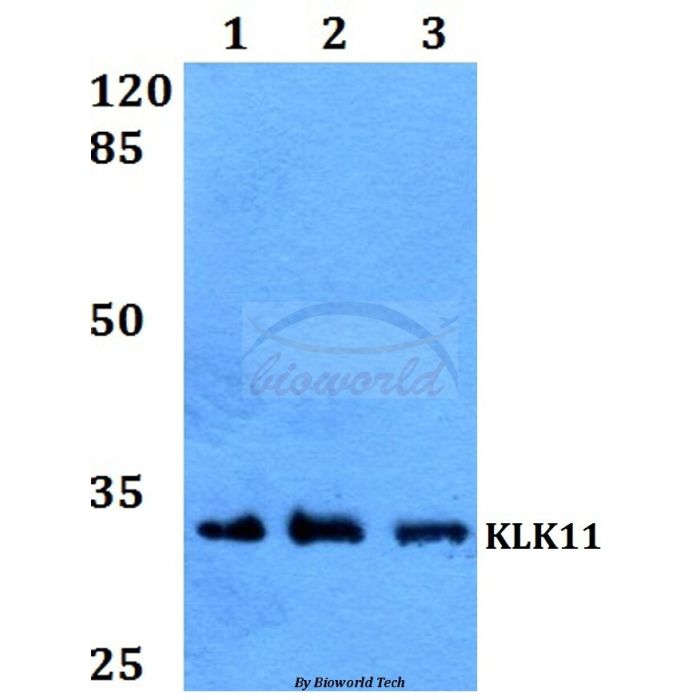
KLK11 polyclonal, anti-human, mouse, rat
€305.00
In stock
SKU
BS60012
Background:
The human KLK genes are clustered on chromosome 19q13. Unlike other kalllikreins, the KLK4-15 encoded proteases are less related and do not contain a conventional KLK loop. Clusters of genes exhibit high prostatic (KLK2-4, KLK15) or pancreatic (KLK6-13) expression. KLK2 is also known as glandular kallikrein 2, tissue kallikrein or HGK-1, and KLK3 is known as prostate-specific antigen (PSA). Both KLK2 and KLK3 have important applications in prostate cancer and breast cancer diagnostics. KLK4, KLK5, KLK9, KLK13, KLK12 and KLK14 have been previously known as KLK-L1, KLK-L2, KLK-L3, KLK-L4, KLK-L5 and KLK-L6, respectively. Many of the KLKs are regulated by steroid hormones and a few of them, specifically KLK3, KLK6 and KLK10, are known to be downregulated in breast and other cancers.
Alternative Name:
Kallikrein-11, Kallikrein11, Kallikrein 11, hK11, Hippostasin, Serine protease 20, Trypsin-like protease, Kallikrein-11 inactive chain 1, Kallikrein-11 inactive chain 2, PRSS20, TLSP, UNQ649/PRO1279
Application Dilution: WB: 1:500~1:1000
Specificity: KLK11 polyclonal antibody detects endogenous levels of KLK11 protein.
Immunogen:
A synthetic peptide corresponding to residues in Human KLK11.
MW: ~ 32 kDa
Swis Prot.: Q9UBX7
Purification & Purity:
The antibody was affinity-purified from rabbit antiserum by affinity-chromatography using epitope-specific immunogen and the purity is > 95% (by SDS-PAGE).
Format:
1mg/ml in PBS with 0.1% Sodium Azide, 50% Glycerol.
Storage:
Store at 4°C short term. Aliquot and store at -20°C long term. Avoid freeze-thaw cycles.
For research use only, not for use in diagnostic procedure.
The human KLK genes are clustered on chromosome 19q13. Unlike other kalllikreins, the KLK4-15 encoded proteases are less related and do not contain a conventional KLK loop. Clusters of genes exhibit high prostatic (KLK2-4, KLK15) or pancreatic (KLK6-13) expression. KLK2 is also known as glandular kallikrein 2, tissue kallikrein or HGK-1, and KLK3 is known as prostate-specific antigen (PSA). Both KLK2 and KLK3 have important applications in prostate cancer and breast cancer diagnostics. KLK4, KLK5, KLK9, KLK13, KLK12 and KLK14 have been previously known as KLK-L1, KLK-L2, KLK-L3, KLK-L4, KLK-L5 and KLK-L6, respectively. Many of the KLKs are regulated by steroid hormones and a few of them, specifically KLK3, KLK6 and KLK10, are known to be downregulated in breast and other cancers.
Alternative Name:
Kallikrein-11, Kallikrein11, Kallikrein 11, hK11, Hippostasin, Serine protease 20, Trypsin-like protease, Kallikrein-11 inactive chain 1, Kallikrein-11 inactive chain 2, PRSS20, TLSP, UNQ649/PRO1279
Application Dilution: WB: 1:500~1:1000
Specificity: KLK11 polyclonal antibody detects endogenous levels of KLK11 protein.
Immunogen:
A synthetic peptide corresponding to residues in Human KLK11.
MW: ~ 32 kDa
Swis Prot.: Q9UBX7
Purification & Purity:
The antibody was affinity-purified from rabbit antiserum by affinity-chromatography using epitope-specific immunogen and the purity is > 95% (by SDS-PAGE).
Format:
1mg/ml in PBS with 0.1% Sodium Azide, 50% Glycerol.
Storage:
Store at 4°C short term. Aliquot and store at -20°C long term. Avoid freeze-thaw cycles.
For research use only, not for use in diagnostic procedure.
| Is Featured? | No |
|---|
Write Your Own Review