
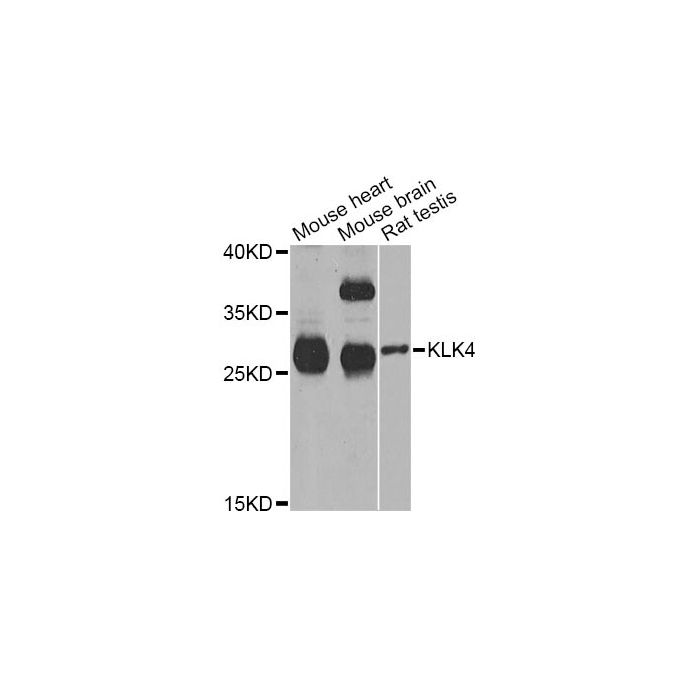
KLK4 polyclonal, anti-human, mouse, rat
€388.00
In stock
SKU
BS8319
Background:
Kallikreins (KLKs) belong to the serine protease family of proteolytic enzymes. Human pancreatic/renal KLK encodes for the KLK1 enzyme, which is involved in post-translational processing of polypeptide precursors. The function of the other members of KLK gene family is currently unknown, but evidence suggests that many KLKs are implicated in carcinogenesis. The human KLK gene family consists of 15 serine proteases . The human KLK genes are clustered on chromosome 19q13. Unlike other kalllikreins, the KLK4-15 encoded proteases are less related and do not contain a conventional KLK loop. Clusters of genes exhibit high prostatic (KLK2-4, KLK15) or pancreatic (KLK6-13) expression. KLK2 is also known as glandular kallikrein 2, tissue kallikrein, or HGK-1 and KLK3 is known as prostate-specific antigen (PSA). Both KLK2 and KLK3 have important applications in prostate cancer and breast cancer diagnostics. KLK4, KLK5, KLK9, KLK13, KLK12 and KLK14 have been previously known as KLK-L1, KLK-L2, KLK-L3, KLK-L4, KLK-L5 and KLK-L6, respectively. Many of the KLKs are regulated by steroid hormones and a few of them, specifically KLK3, KLK6 and KLK10, are known to be downregulated in breast and other cancers .
Alternative Name:
Kallikrein-4, Enamel matrix serine proteinase 1, Kallikrein-like protein 1, KLK-L1, Prostase, Serine protease 17, KLK4, EMSP1, PRSS17, PSTS
Application Dilution: WB: 1:500~1:2000, IF: 1:50~1:200
Specificity: KLK4 polyclonal antibody detects endogenous levels of KLK4 protein.
Immunogen:
Recombinant full length Human KLK4.
MW: ~ 27 kDa
Swis Prot.: Q9Y5K2
Purification & Purity:
The antibody was affinity-purified from rabbit antiserum by affinity-chromatography using epitope-specific immunogen and the purity is > 95% (by SDS-PAGE).
Format:
1mg/ml in PBS with 0.1% Sodium Azide, 50% Glycerol.
Storage:
Store at 4°C short term. Aliquot and store at -20°C long term. Avoid freeze-thaw cycles.
For research use only, not for use in diagnostic procedure.
Kallikreins (KLKs) belong to the serine protease family of proteolytic enzymes. Human pancreatic/renal KLK encodes for the KLK1 enzyme, which is involved in post-translational processing of polypeptide precursors. The function of the other members of KLK gene family is currently unknown, but evidence suggests that many KLKs are implicated in carcinogenesis. The human KLK gene family consists of 15 serine proteases . The human KLK genes are clustered on chromosome 19q13. Unlike other kalllikreins, the KLK4-15 encoded proteases are less related and do not contain a conventional KLK loop. Clusters of genes exhibit high prostatic (KLK2-4, KLK15) or pancreatic (KLK6-13) expression. KLK2 is also known as glandular kallikrein 2, tissue kallikrein, or HGK-1 and KLK3 is known as prostate-specific antigen (PSA). Both KLK2 and KLK3 have important applications in prostate cancer and breast cancer diagnostics. KLK4, KLK5, KLK9, KLK13, KLK12 and KLK14 have been previously known as KLK-L1, KLK-L2, KLK-L3, KLK-L4, KLK-L5 and KLK-L6, respectively. Many of the KLKs are regulated by steroid hormones and a few of them, specifically KLK3, KLK6 and KLK10, are known to be downregulated in breast and other cancers .
Alternative Name:
Kallikrein-4, Enamel matrix serine proteinase 1, Kallikrein-like protein 1, KLK-L1, Prostase, Serine protease 17, KLK4, EMSP1, PRSS17, PSTS
Application Dilution: WB: 1:500~1:2000, IF: 1:50~1:200
Specificity: KLK4 polyclonal antibody detects endogenous levels of KLK4 protein.
Immunogen:
Recombinant full length Human KLK4.
MW: ~ 27 kDa
Swis Prot.: Q9Y5K2
Purification & Purity:
The antibody was affinity-purified from rabbit antiserum by affinity-chromatography using epitope-specific immunogen and the purity is > 95% (by SDS-PAGE).
Format:
1mg/ml in PBS with 0.1% Sodium Azide, 50% Glycerol.
Storage:
Store at 4°C short term. Aliquot and store at -20°C long term. Avoid freeze-thaw cycles.
For research use only, not for use in diagnostic procedure.
| Is Featured? | No |
|---|
Write Your Own Review