
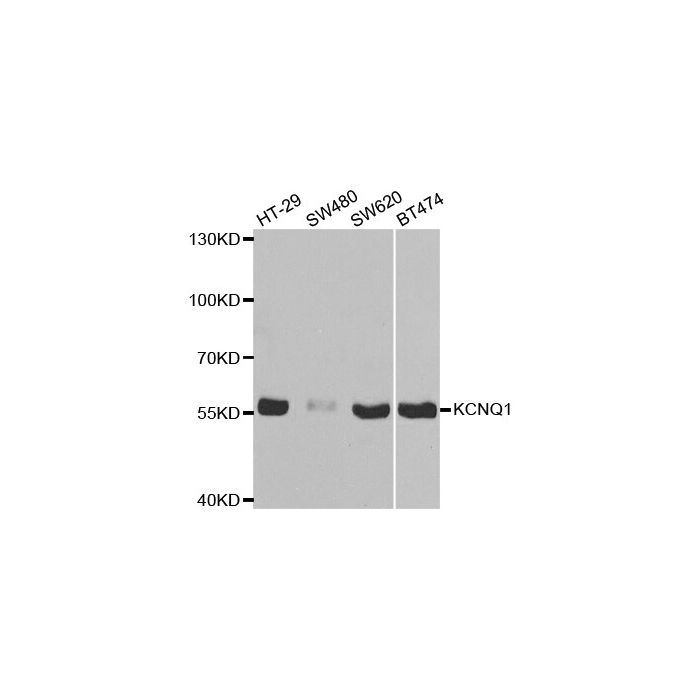
Kv7.1 polyclonal, anti-human, mouse
€388.00
In stock
SKU
BS6923
Background:
Voltage-gated K+ channels in the plasma membrane control the repolarization and the frequency of action potentials in neurons, muscles and other excitable cells. A specific K+ channel, comprised of an α subunit KCNQ1 and a β subunit KCNE1, a small protein which spans the membrane only once, is predominantly expressed in the heart and in the cochlea, and is responsible for regulating the slow, depolarization-activated potassium current. Mutations in the genes encoding for KCNQ1 and KCNE1 lead to cardiac disease because they directly impair electrical signaling, and mutations in KCNQ4 are implicated in the onset of deafness. KCNQ proteins, including KCNQ1 and KCNQ4, characteristically contain six transmembrane domains and function as tetramers. KCNQ4 forms heteromeric channels with KCNQ3 and is expressed in several tissues, including the cochlea, where it is present in outer hair cells.
Alternative Name:
Potassium voltage-gated channel subfamily KQT member 1, IKs producing slow voltage-gated potassium channel subunit alpha KvLQT1, KQT-like 1, Voltage-gated potassium channel subunit Kv7.1, KCNQ1, KCNA8, KCNA9, KVLQT1
Application Dilution: WB: 1:500 - 1:2000
Specificity: Kv7.1 polyclonal antibody detects endogenous levels of Kv7.1 protein.
Immunogen:
Recombinant full length Human Kv7.1.
MW: ~ 75 kDa
Swis Prot.: P51787
Purification & Purity:
The antibody was affinity-purified from rabbit antiserum by affinity-chromatography using epitope-specific immunogen and the purity is > 95% (by SDS-PAGE).
Format:
1 mg/ml in Phosphate buffered saline (PBS) with 0.05% sodium azide, approx. pH 7.2.
Storage:
Store at 4°C short term. Aliquot and store at -20°C long term. Avoid freeze-thaw cycles.
For research use only, not for use in diagnostic procedure.
Voltage-gated K+ channels in the plasma membrane control the repolarization and the frequency of action potentials in neurons, muscles and other excitable cells. A specific K+ channel, comprised of an α subunit KCNQ1 and a β subunit KCNE1, a small protein which spans the membrane only once, is predominantly expressed in the heart and in the cochlea, and is responsible for regulating the slow, depolarization-activated potassium current. Mutations in the genes encoding for KCNQ1 and KCNE1 lead to cardiac disease because they directly impair electrical signaling, and mutations in KCNQ4 are implicated in the onset of deafness. KCNQ proteins, including KCNQ1 and KCNQ4, characteristically contain six transmembrane domains and function as tetramers. KCNQ4 forms heteromeric channels with KCNQ3 and is expressed in several tissues, including the cochlea, where it is present in outer hair cells.
Alternative Name:
Potassium voltage-gated channel subfamily KQT member 1, IKs producing slow voltage-gated potassium channel subunit alpha KvLQT1, KQT-like 1, Voltage-gated potassium channel subunit Kv7.1, KCNQ1, KCNA8, KCNA9, KVLQT1
Application Dilution: WB: 1:500 - 1:2000
Specificity: Kv7.1 polyclonal antibody detects endogenous levels of Kv7.1 protein.
Immunogen:
Recombinant full length Human Kv7.1.
MW: ~ 75 kDa
Swis Prot.: P51787
Purification & Purity:
The antibody was affinity-purified from rabbit antiserum by affinity-chromatography using epitope-specific immunogen and the purity is > 95% (by SDS-PAGE).
Format:
1 mg/ml in Phosphate buffered saline (PBS) with 0.05% sodium azide, approx. pH 7.2.
Storage:
Store at 4°C short term. Aliquot and store at -20°C long term. Avoid freeze-thaw cycles.
For research use only, not for use in diagnostic procedure.
| Is Featured? | No |
|---|
Write Your Own Review