
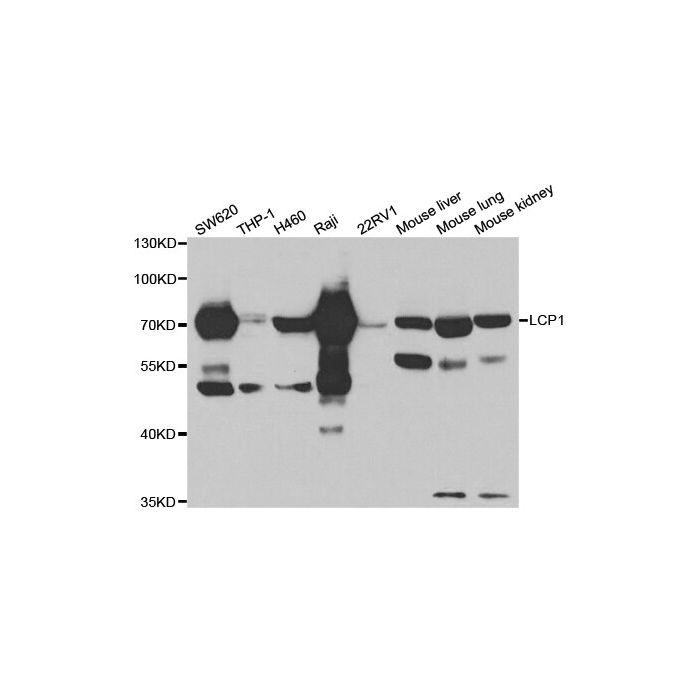
LCP1 polyclonal, anti-human, mouse
€388.00
In stock
SKU
BS7623
Background:
Plastins are a family of actin-binding proteins that are conserved throughout eukaryote evolution and expressed in most tissues of higher eukaryotes. In humans, two ubiquitous plastin isoforms (L and T) have been identified. Plastin 1 (otherwise known as Fimbrin) is a third distinct plastin isoform which is specifically expressed at high levels in the small intestine. The L isoform is expressed only in hemopoietic cell lineages, while the T isoform has been found in all other normal cells of solid tissues that have replicative potential (fibroblasts, endothelial cells, epithelial cells, melanocytes, etc.). However, L-plastin has been found in many types of malignant human cells of non-hemopoietic origin suggesting that its expression is induced accompanying tumorigenesis in solid tissues.
Alternative Name:
CP64, L plastin, L-plastin, Larval cuticle protein 1, LC64P, LCP-1, LCP1, LPL, Lplastin, Lymphocyte cytosolic protein 1, Plastin 2, Plastin-2, PLS2, PLSL_HUMAN,
Application Dilution: WB: 1:500 - 1:2000, IP: 1:20 - 1:50
Specificity: LCP1 polyclonal antibody detects endogenous levels of LCP1 protein.
Immunogen:
Recombinant full length Human LCP1.
MW: ~70 kDa
Swis Prot.: P13796
Purification & Purity:
The antibody was affinity-purified from rabbit antiserum by affinity-chromatography using epitope-specific immunogen and the purity is > 95% (by SDS-PAGE).
Format:
1mg/ml in PBS with 0.1% Sodium Azide, 50% Glycerol.
Storage:
Store at 4°C short term. Aliquot and store at -20°C long term. Avoid freeze-thaw cycles.
For research use only, not for use in diagnostic procedure.
Plastins are a family of actin-binding proteins that are conserved throughout eukaryote evolution and expressed in most tissues of higher eukaryotes. In humans, two ubiquitous plastin isoforms (L and T) have been identified. Plastin 1 (otherwise known as Fimbrin) is a third distinct plastin isoform which is specifically expressed at high levels in the small intestine. The L isoform is expressed only in hemopoietic cell lineages, while the T isoform has been found in all other normal cells of solid tissues that have replicative potential (fibroblasts, endothelial cells, epithelial cells, melanocytes, etc.). However, L-plastin has been found in many types of malignant human cells of non-hemopoietic origin suggesting that its expression is induced accompanying tumorigenesis in solid tissues.
Alternative Name:
CP64, L plastin, L-plastin, Larval cuticle protein 1, LC64P, LCP-1, LCP1, LPL, Lplastin, Lymphocyte cytosolic protein 1, Plastin 2, Plastin-2, PLS2, PLSL_HUMAN,
Application Dilution: WB: 1:500 - 1:2000, IP: 1:20 - 1:50
Specificity: LCP1 polyclonal antibody detects endogenous levels of LCP1 protein.
Immunogen:
Recombinant full length Human LCP1.
MW: ~70 kDa
Swis Prot.: P13796
Purification & Purity:
The antibody was affinity-purified from rabbit antiserum by affinity-chromatography using epitope-specific immunogen and the purity is > 95% (by SDS-PAGE).
Format:
1mg/ml in PBS with 0.1% Sodium Azide, 50% Glycerol.
Storage:
Store at 4°C short term. Aliquot and store at -20°C long term. Avoid freeze-thaw cycles.
For research use only, not for use in diagnostic procedure.
| Is Featured? | No |
|---|
Write Your Own Review