
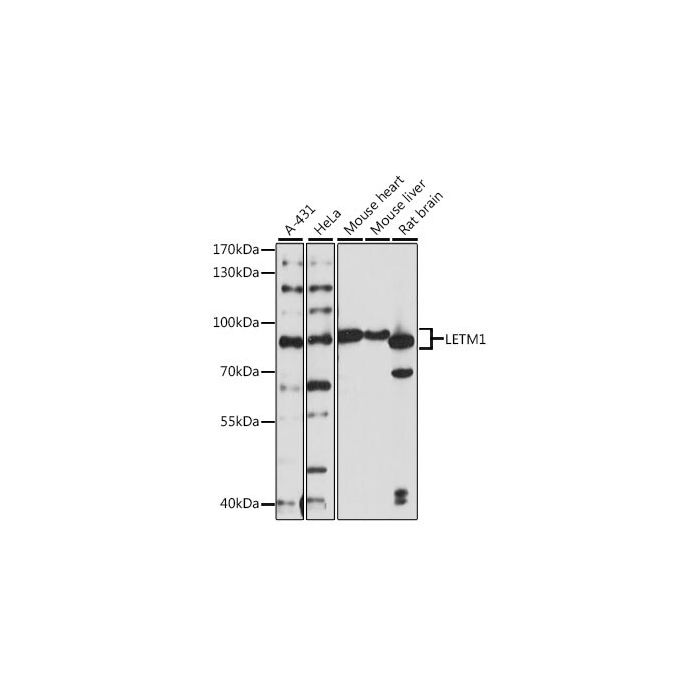
LETM1 polyclonal, anti-human, mouse, rat
€388.00
In stock
SKU
BS72732
Background:
This gene encodes a protein that is localized to the inner mitochondrial membrane. The protein functions to maintain the mitochondrial tubular shapes and is required for normal mitochondrial morphology and cellular viability. Mutations in this gene cause Wolf-Hirschhorn syndrome, a complex malformation syndrome caused by the deletion of parts of the distal short arm of chromosome 4. Related pseudogenes have been identified on chromosomes 8, 15 and 19.
Application Dilution: WB: 1:500 - 1:2000
Specificity: LETM1 polyclonal antibody detects endogenous levels of LETM1 protein.
Immunogen:
Recombinant protein of human LETM1
MW: 83kDa
Swis Prot.: O95202
Purification & Purity:
The antibody was affinity-purified from rabbit antiserum by affinity-chromatography using epitope-specific immunogen and the purity is > 95% (by SDS-PAGE).
Format:
1mg/ml in PBS, 50% glycerol, pH7.3.
Storage:
Store at 4°C short term. Aliquot and store at -20°C long term. Avoid freeze-thaw cycles.
For research use only, not for use in diagnostic procedure.
This gene encodes a protein that is localized to the inner mitochondrial membrane. The protein functions to maintain the mitochondrial tubular shapes and is required for normal mitochondrial morphology and cellular viability. Mutations in this gene cause Wolf-Hirschhorn syndrome, a complex malformation syndrome caused by the deletion of parts of the distal short arm of chromosome 4. Related pseudogenes have been identified on chromosomes 8, 15 and 19.
Application Dilution: WB: 1:500 - 1:2000
Specificity: LETM1 polyclonal antibody detects endogenous levels of LETM1 protein.
Immunogen:
Recombinant protein of human LETM1
MW: 83kDa
Swis Prot.: O95202
Purification & Purity:
The antibody was affinity-purified from rabbit antiserum by affinity-chromatography using epitope-specific immunogen and the purity is > 95% (by SDS-PAGE).
Format:
1mg/ml in PBS, 50% glycerol, pH7.3.
Storage:
Store at 4°C short term. Aliquot and store at -20°C long term. Avoid freeze-thaw cycles.
For research use only, not for use in diagnostic procedure.
| Is Featured? | No |
|---|
Write Your Own Review