
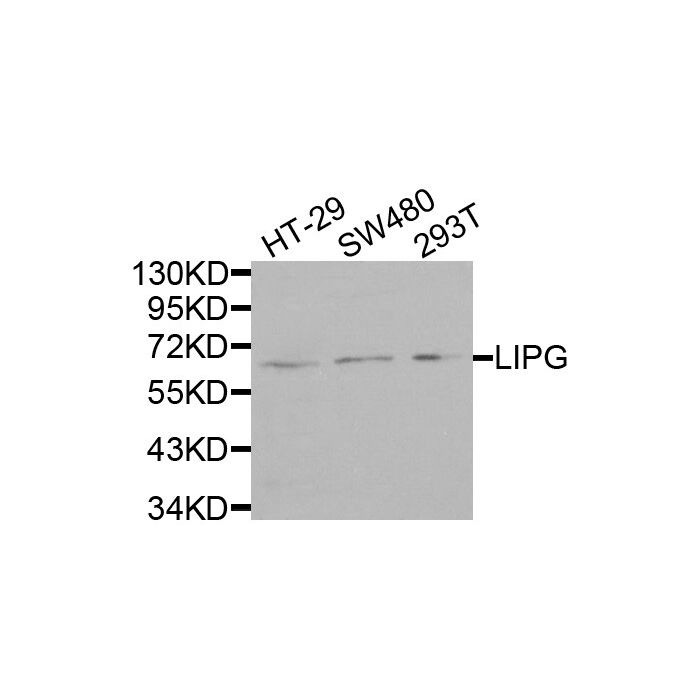
LIPG polyclonal, anti-human, mouse, rat
€388.00
In stock
SKU
BS7695
Background:
The Lipase gene family belongs to one of the most robust genetic superfamilies found in living organisms, which includes esterases and thioesterases. Members of the AB hydrolase subfamily include hepatic lipase (HL), endothelial lipase (EDL or EL), lipoprotein lipase (LPL), pancreatic lipase (PL), gastric lipase (GL) and LCAT. These family members play a crucial role in the metabolism of lipids. Defects in LPL may cause chylomicronemia syndrome or a form of lipoprotein lipase deficiency characterized by hypertriglyceridemia. Endothelial lipase, which also is known as endothelial cell-derived lipase, has both triglyceride and phospholipase activity. This protein, which is synthesized in endothelial cells, can bind heparin. It is expressed primarily in placenta, liver, thyroid, kidney, lung, testis and ovary tissue.
Alternative Name:
EDL, EL, Endothelial cell-derived lipase, Endothelial lipase, Endothelial lipase precursor, Lipase endothelial, LIPE_HUMAN, LIPG, Lipoprotein lipase H, PL, PRO719,
Application Dilution: WB: 1:500~1:2000, IHC: 1:50~1:200
Specificity: LIPG polyclonal antibody detects endogenous levels of LIPG protein.
Immunogen:
Recombinant full length Human LIPG.
MW: ~ 57 kDa
Swis Prot.: Q9Y5X9
Purification & Purity:
The antibody was affinity-purified from rabbit antiserum by affinity-chromatography using epitope-specific immunogen and the purity is > 95% (by SDS-PAGE).
Format:
1mg/ml in PBS with 0.1% Sodium Azide, 50% Glycerol.
Storage:
Store at 4°C short term. Aliquot and store at -20°C long term. Avoid freeze-thaw cycles.
For research use only, not for use in diagnostic procedure.
The Lipase gene family belongs to one of the most robust genetic superfamilies found in living organisms, which includes esterases and thioesterases. Members of the AB hydrolase subfamily include hepatic lipase (HL), endothelial lipase (EDL or EL), lipoprotein lipase (LPL), pancreatic lipase (PL), gastric lipase (GL) and LCAT. These family members play a crucial role in the metabolism of lipids. Defects in LPL may cause chylomicronemia syndrome or a form of lipoprotein lipase deficiency characterized by hypertriglyceridemia. Endothelial lipase, which also is known as endothelial cell-derived lipase, has both triglyceride and phospholipase activity. This protein, which is synthesized in endothelial cells, can bind heparin. It is expressed primarily in placenta, liver, thyroid, kidney, lung, testis and ovary tissue.
Alternative Name:
EDL, EL, Endothelial cell-derived lipase, Endothelial lipase, Endothelial lipase precursor, Lipase endothelial, LIPE_HUMAN, LIPG, Lipoprotein lipase H, PL, PRO719,
Application Dilution: WB: 1:500~1:2000, IHC: 1:50~1:200
Specificity: LIPG polyclonal antibody detects endogenous levels of LIPG protein.
Immunogen:
Recombinant full length Human LIPG.
MW: ~ 57 kDa
Swis Prot.: Q9Y5X9
Purification & Purity:
The antibody was affinity-purified from rabbit antiserum by affinity-chromatography using epitope-specific immunogen and the purity is > 95% (by SDS-PAGE).
Format:
1mg/ml in PBS with 0.1% Sodium Azide, 50% Glycerol.
Storage:
Store at 4°C short term. Aliquot and store at -20°C long term. Avoid freeze-thaw cycles.
For research use only, not for use in diagnostic procedure.
| Is Featured? | No |
|---|
Write Your Own Review