
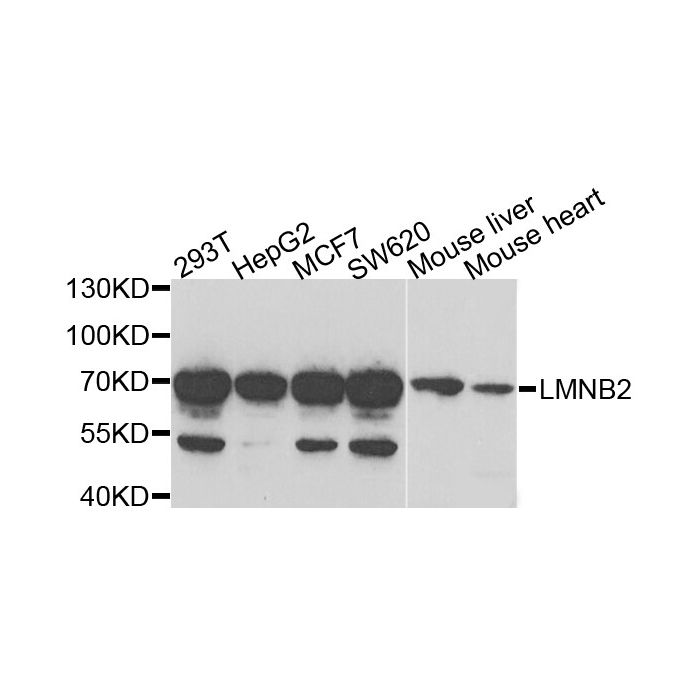
LMNB2 polyclonal, anti-human, mouse, rat
€388.00
In stock
SKU
BS8254
Background:
A unique family of Cysteine proteases has been described that differs in sequence, structure and substrate specificity from any previously described protease family. This family, termed CED-3/ICE, functions as key components of the apoptotic machinery and act to destroy specific target proteins which are critical to cellular longevity. Nuclear lamins are critical to maintaining the integrity of the nuclear envelope and cellular morphology as components of the nuclear lamina, a fibrous layer on the nucleoplasmic side of the inner nuclear membrane, which is thought to provide a framework for the nuclear envelope and may also interact with chromatin. B-type lamins undergo a series of modifications, such as farnesylation and phosphorylation. Increased phosphorylation of the lamins occurs before envelope disintegration and probably plays a role in regulating lamin associations. Nuclear Lamin B is fragmented as a consequence of apoptosis by an unidentified member of the ICE family.
Alternative Name:
Lamin-B2, LMNB2, LMN2
Application Dilution: WB: 1:500~1:2000, IHC/IF: 1:50~1:200
Specificity: LMNB2 polyclonal antibody detects endogenous levels of LMNB2 protein.
Immunogen:
Recombinant full length Human LMNB2.
MW: ~ 68 kDa
Swis Prot.: Q03252
Purification & Purity:
The antibody was affinity-purified from rabbit antiserum by affinity-chromatography using epitope-specific immunogen and the purity is > 95% (by SDS-PAGE).
Format:
1mg/ml in PBS with 0.1% Sodium Azide, 50% Glycerol.
Storage:
Store at 4°C short term. Aliquot and store at -20°C long term. Avoid freeze-thaw cycles.
For research use only, not for use in diagnostic procedure.
A unique family of Cysteine proteases has been described that differs in sequence, structure and substrate specificity from any previously described protease family. This family, termed CED-3/ICE, functions as key components of the apoptotic machinery and act to destroy specific target proteins which are critical to cellular longevity. Nuclear lamins are critical to maintaining the integrity of the nuclear envelope and cellular morphology as components of the nuclear lamina, a fibrous layer on the nucleoplasmic side of the inner nuclear membrane, which is thought to provide a framework for the nuclear envelope and may also interact with chromatin. B-type lamins undergo a series of modifications, such as farnesylation and phosphorylation. Increased phosphorylation of the lamins occurs before envelope disintegration and probably plays a role in regulating lamin associations. Nuclear Lamin B is fragmented as a consequence of apoptosis by an unidentified member of the ICE family.
Alternative Name:
Lamin-B2, LMNB2, LMN2
Application Dilution: WB: 1:500~1:2000, IHC/IF: 1:50~1:200
Specificity: LMNB2 polyclonal antibody detects endogenous levels of LMNB2 protein.
Immunogen:
Recombinant full length Human LMNB2.
MW: ~ 68 kDa
Swis Prot.: Q03252
Purification & Purity:
The antibody was affinity-purified from rabbit antiserum by affinity-chromatography using epitope-specific immunogen and the purity is > 95% (by SDS-PAGE).
Format:
1mg/ml in PBS with 0.1% Sodium Azide, 50% Glycerol.
Storage:
Store at 4°C short term. Aliquot and store at -20°C long term. Avoid freeze-thaw cycles.
For research use only, not for use in diagnostic procedure.
| Is Featured? | No |
|---|
Write Your Own Review