
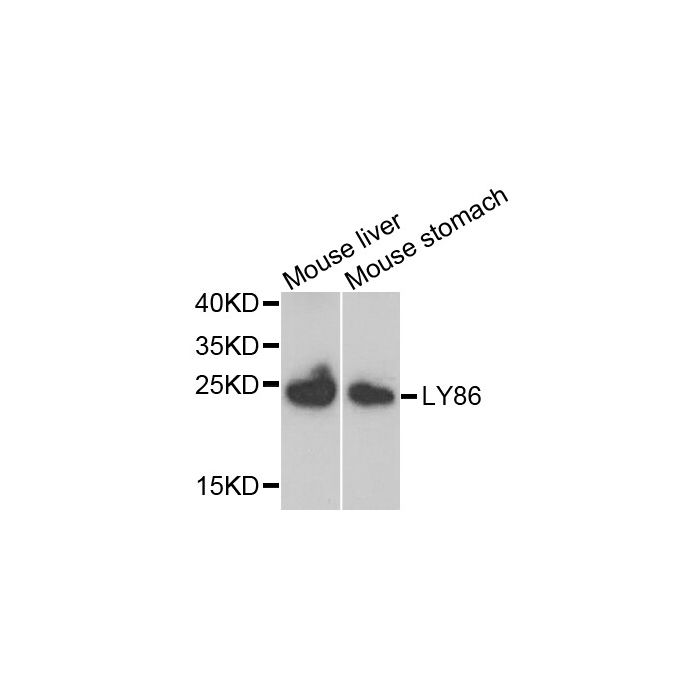
LY86 polyclonal, anti-human, mouse
€388.00
In stock
SKU
BS7951
Background:
RP105 (CD180) was originally discovered as a mouse B cell surface molecule that transmits an activation signal. This signal leads to resistance against irradiation-induced apoptosis and massive B cell proliferation. RP105 is associated with another molecule, MD-1, which has an important role in the cell surface expression of RP105. MD-1, also known as lymphocyte antigen 68 and RP105 associated protein, associates with and regulates the cell surface expression of RP105. RP105/MD-1 constitutes an LPS-signaling complex on B cells and, like MD-2, enhances the LPS signaling via TLR4. MD-1 contains 162 amino acids and has a predicted 19 amino acid signal peptide and 2 N-glycosylation sites. MD-1 is highly expressed in B cells, monocytes and tonsil, and is localized on the surface of cells despite its lack of a transmembrane region.
Alternative Name:
BPAD, dJ80N2.1, Ly 86, Ly-86, LY86, LY86_HUMAN, Lymphocyte antigen 86, Lymphocyte antigen 86 precursor, Major affective disorder 1, MD 1, MD1 protein, MD1 RP105 associated, MD1 RP105 associated, MMD 1, Protein MD 1, Protein MD-1, RP1-80N2.1,
Application Dilution: WB: 1:500~1:2000, IHC: 1:50~1:200
Specificity: LY86 polyclonal antibody detects endogenous levels of LY86 protein.
Immunogen:
Recombinant full length Human LY86.
MW: ~ 18, 27 kDa
Swis Prot.: O95711
Purification & Purity:
The antibody was affinity-purified from rabbit antiserum by affinity-chromatography using epitope-specific immunogen and the purity is > 95% (by SDS-PAGE).
Format:
1mg/ml in PBS with 0.1% Sodium Azide, 50% Glycerol.
Storage:
Store at 4°C short term. Aliquot and store at -20°C long term. Avoid freeze-thaw cycles.
For research use only, not for use in diagnostic procedure.
RP105 (CD180) was originally discovered as a mouse B cell surface molecule that transmits an activation signal. This signal leads to resistance against irradiation-induced apoptosis and massive B cell proliferation. RP105 is associated with another molecule, MD-1, which has an important role in the cell surface expression of RP105. MD-1, also known as lymphocyte antigen 68 and RP105 associated protein, associates with and regulates the cell surface expression of RP105. RP105/MD-1 constitutes an LPS-signaling complex on B cells and, like MD-2, enhances the LPS signaling via TLR4. MD-1 contains 162 amino acids and has a predicted 19 amino acid signal peptide and 2 N-glycosylation sites. MD-1 is highly expressed in B cells, monocytes and tonsil, and is localized on the surface of cells despite its lack of a transmembrane region.
Alternative Name:
BPAD, dJ80N2.1, Ly 86, Ly-86, LY86, LY86_HUMAN, Lymphocyte antigen 86, Lymphocyte antigen 86 precursor, Major affective disorder 1, MD 1, MD1 protein, MD1 RP105 associated, MD1 RP105 associated, MMD 1, Protein MD 1, Protein MD-1, RP1-80N2.1,
Application Dilution: WB: 1:500~1:2000, IHC: 1:50~1:200
Specificity: LY86 polyclonal antibody detects endogenous levels of LY86 protein.
Immunogen:
Recombinant full length Human LY86.
MW: ~ 18, 27 kDa
Swis Prot.: O95711
Purification & Purity:
The antibody was affinity-purified from rabbit antiserum by affinity-chromatography using epitope-specific immunogen and the purity is > 95% (by SDS-PAGE).
Format:
1mg/ml in PBS with 0.1% Sodium Azide, 50% Glycerol.
Storage:
Store at 4°C short term. Aliquot and store at -20°C long term. Avoid freeze-thaw cycles.
For research use only, not for use in diagnostic procedure.
| Is Featured? | No |
|---|
Write Your Own Review