
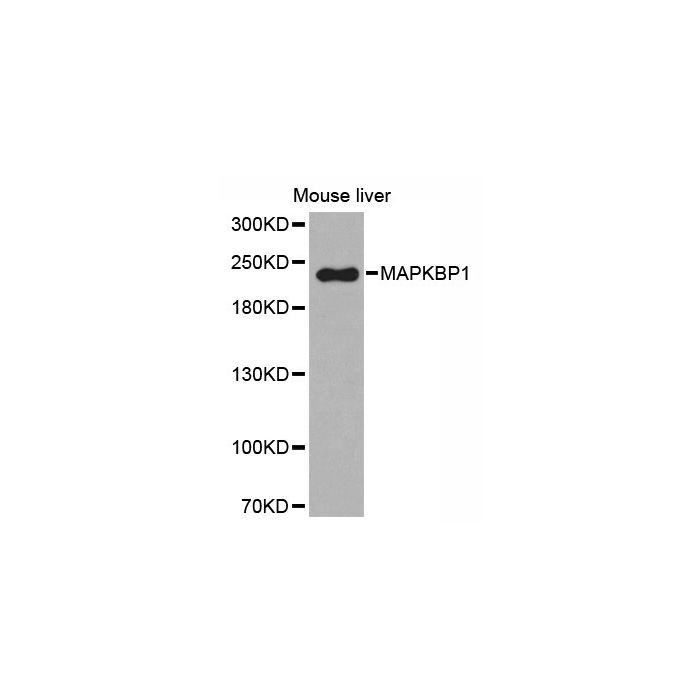
MAPKBP1 polyclonal, anti-human, mouse, rat
€388.00
In stock
SKU
BS71418
Background:
MAP kinases play a significant role in many biological processes, including cell adhesion and spreading, cell differentiation and apoptosis. MAPKBP-1 (mitogen-activated protein kinase binding protein 1), also known as JNKBP-1, is a 1,514 amino acid protein that contains twelve WD repeats. Induced by TRAF2 (TNF receptor-associated factor 2) and Tak1 (TGF-β-activated kinase 1), MAPKBP-1 is thought to act an adaptor protein for NFκB (nuclear factor κ-B) activation. MAPKBP-1 interacts with JNK3 and may promote TRAF2 polyubiquitination. MAPKBP-1 exists as six alternatively spliced variants and is encoded by a gene located on human chromosome 15. Human chromosome 15 houses over 700 genes and comprises nearly 3% of the human genome. Angelman syndrome, Prader-Willi syndrome, Tay-Sachs disease and Marfan syndrome are all associated with defects in chromosome 15-localized genes.
Alternative Name:
Mitogen-activated protein kinase-binding protein 1, JNK-binding protein 1, JNKBP-1, JNKBP1, KIAA0596
Application Dilution: WB: 1:500 - 1:2000, IHC: 1:50 - 1:200
Specificity: MAPKBP1 polyclonal antibody detects endogenous levels of MAPKBP1 protein.
Immunogen:
A synthetic peptide of human MAPKBP1.
MW: ~ 109 kDa,164 kDa
Swis Prot.: O60336
Purification & Purity:
The antibody was affinity-purified from rabbit antiserum by affinity-chromatography using epitope-specific immunogen and the purity is > 95% (by SDS-PAGE).
Format:
1mg/ml in PBS with 0.02% sodium azide, 50% glycerol, pH7.3.
Storage:
Store at 4°C short term. Aliquot and store at -20°C long term. Avoid freeze-thaw cycles.
For research use only, not for use in diagnostic procedure.
MAP kinases play a significant role in many biological processes, including cell adhesion and spreading, cell differentiation and apoptosis. MAPKBP-1 (mitogen-activated protein kinase binding protein 1), also known as JNKBP-1, is a 1,514 amino acid protein that contains twelve WD repeats. Induced by TRAF2 (TNF receptor-associated factor 2) and Tak1 (TGF-β-activated kinase 1), MAPKBP-1 is thought to act an adaptor protein for NFκB (nuclear factor κ-B) activation. MAPKBP-1 interacts with JNK3 and may promote TRAF2 polyubiquitination. MAPKBP-1 exists as six alternatively spliced variants and is encoded by a gene located on human chromosome 15. Human chromosome 15 houses over 700 genes and comprises nearly 3% of the human genome. Angelman syndrome, Prader-Willi syndrome, Tay-Sachs disease and Marfan syndrome are all associated with defects in chromosome 15-localized genes.
Alternative Name:
Mitogen-activated protein kinase-binding protein 1, JNK-binding protein 1, JNKBP-1, JNKBP1, KIAA0596
Application Dilution: WB: 1:500 - 1:2000, IHC: 1:50 - 1:200
Specificity: MAPKBP1 polyclonal antibody detects endogenous levels of MAPKBP1 protein.
Immunogen:
A synthetic peptide of human MAPKBP1.
MW: ~ 109 kDa,164 kDa
Swis Prot.: O60336
Purification & Purity:
The antibody was affinity-purified from rabbit antiserum by affinity-chromatography using epitope-specific immunogen and the purity is > 95% (by SDS-PAGE).
Format:
1mg/ml in PBS with 0.02% sodium azide, 50% glycerol, pH7.3.
Storage:
Store at 4°C short term. Aliquot and store at -20°C long term. Avoid freeze-thaw cycles.
For research use only, not for use in diagnostic procedure.
| Is Featured? | No |
|---|
Write Your Own Review