
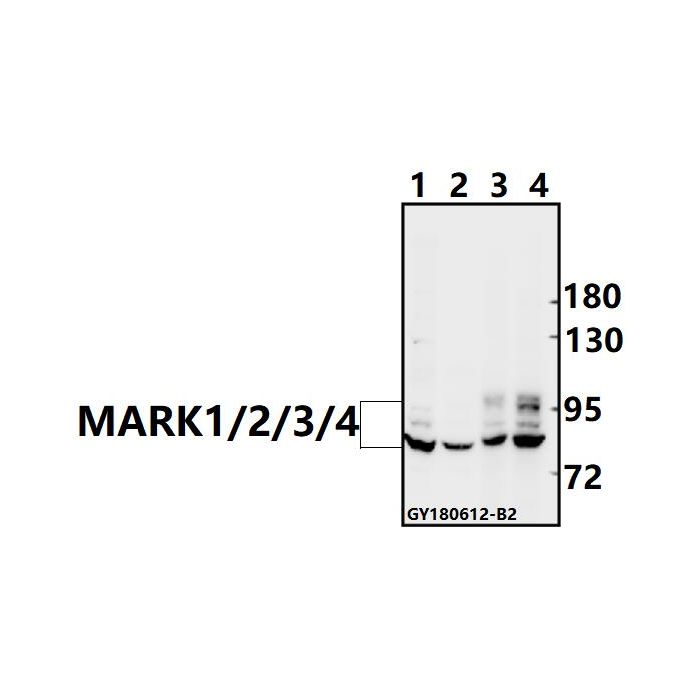
MARK1/2/3/4 (N211) polyclonal, anti-human, mouse, rat
€305.00
In stock
SKU
BS61877
Background:
Microtubule affinity-regulating kinase 2 (MARK2), also known as EMK1 (ELKL motif kinase 1) or Par1b, is a 788 amino acid protein that is a member of the protein kinase superfamily, MARK subfamily. Highly expressed in heart, brain, skeletal muscle and pancreas, MARK2 is essential for the asymmetric development of membrane domains around polarized epithelial cells. Activation of MARK2 by phosphorylation on Thr 208 allows the protein to modulate the building of a columnar versus a hepatic epithelial cell. MARK2 contains one KA1 (kinase-associated) domain, one protein kinase domain and one UBA domain. MARK2 is expressed as 14 isoforms produced by alternative splicing events. Some of these isoforms may function in graft rejection.
Alternative Name:
Serine/threonine-protein kinase MARK1, MAP/microtubule affinity-regulating kinase 1, PAR1 homolog c, Par-1c, Par1c;Serine/threonine-protein kinase MARK2, ELKL motif kinase 1, EMK-1, MAP/microtubule affinity-regulating kinase 2, PAR1 homolog, PAR1 homolog b, Par-1b, Par1b, MAP/microtubule affinity-regulating kinase 3, C-TAK1, cTAK1, Cdc25C-associated protein kinase 1, ELKL motif kinase 2, EMK-2, Protein kinase STK10, Ser/Thr protein kinase PAR-1, Par-1a, Serine/threonine-protein kinase p78, MAP/microtubule affinity-regulating kinase 4, MAP/microtubule affinity-regulating kinase-like 1, MARK4, KIAA1860, MARKL1
Application Dilution: WB: 1:500~1:1000
Specificity: MARK1/2/3/4 (N211) pAb detects endogenous levels of MARK1/2/3/4 (N211) protein.
Immunogen:
Synthetic peptide, corresponding Human MARK1/2/3/4 (N211).
MW: ~ 83 kDa
Swis Prot.: Q9P0L2/Q7KZI7/P27448/Q96L34
Purification & Purity:
The antibody was affinity-purified from rabbit antiserum by affinity-chromatography using epitope-specific immunogen and the purity is > 95% (by SDS-PAGE).
Format:
1 mg/ml in Phosphate buffered saline (PBS) with 0.05% sodium azide, approx. pH 7.3.
Storage:
Store at 4°C short term. Aliquot and store at -20°C long term. Avoid freeze-thaw cycles.
For research use only, not for use in diagnostic procedure.
Microtubule affinity-regulating kinase 2 (MARK2), also known as EMK1 (ELKL motif kinase 1) or Par1b, is a 788 amino acid protein that is a member of the protein kinase superfamily, MARK subfamily. Highly expressed in heart, brain, skeletal muscle and pancreas, MARK2 is essential for the asymmetric development of membrane domains around polarized epithelial cells. Activation of MARK2 by phosphorylation on Thr 208 allows the protein to modulate the building of a columnar versus a hepatic epithelial cell. MARK2 contains one KA1 (kinase-associated) domain, one protein kinase domain and one UBA domain. MARK2 is expressed as 14 isoforms produced by alternative splicing events. Some of these isoforms may function in graft rejection.
Alternative Name:
Serine/threonine-protein kinase MARK1, MAP/microtubule affinity-regulating kinase 1, PAR1 homolog c, Par-1c, Par1c;Serine/threonine-protein kinase MARK2, ELKL motif kinase 1, EMK-1, MAP/microtubule affinity-regulating kinase 2, PAR1 homolog, PAR1 homolog b, Par-1b, Par1b, MAP/microtubule affinity-regulating kinase 3, C-TAK1, cTAK1, Cdc25C-associated protein kinase 1, ELKL motif kinase 2, EMK-2, Protein kinase STK10, Ser/Thr protein kinase PAR-1, Par-1a, Serine/threonine-protein kinase p78, MAP/microtubule affinity-regulating kinase 4, MAP/microtubule affinity-regulating kinase-like 1, MARK4, KIAA1860, MARKL1
Application Dilution: WB: 1:500~1:1000
Specificity: MARK1/2/3/4 (N211) pAb detects endogenous levels of MARK1/2/3/4 (N211) protein.
Immunogen:
Synthetic peptide, corresponding Human MARK1/2/3/4 (N211).
MW: ~ 83 kDa
Swis Prot.: Q9P0L2/Q7KZI7/P27448/Q96L34
Purification & Purity:
The antibody was affinity-purified from rabbit antiserum by affinity-chromatography using epitope-specific immunogen and the purity is > 95% (by SDS-PAGE).
Format:
1 mg/ml in Phosphate buffered saline (PBS) with 0.05% sodium azide, approx. pH 7.3.
Storage:
Store at 4°C short term. Aliquot and store at -20°C long term. Avoid freeze-thaw cycles.
For research use only, not for use in diagnostic procedure.
| Is Featured? | No |
|---|
Write Your Own Review