
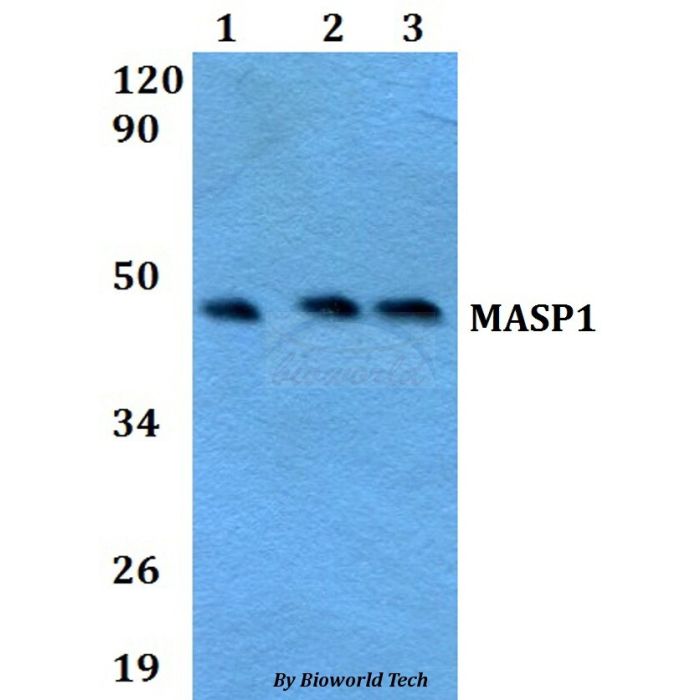
MASP1 polyclonal, anti-human, mouse, rat
€305.00
In stock
SKU
BS60635
Background:
Mannose (or mannan)-binding lectin (MBL), also known as serum mannose-binding protein (MBP), initiates the lectin branch of the innate immune response by binding to the surface of potentially pathogenic microorganisms and initiating complement fixation through an N-terminal collagen-like domain. MBL is a key component in immune response in that it can directly trigger neutralization of invading microorganisms by an Ab-independent mechanism. Mutations of human MBL are associated with immunodeficiency resulting from a reduction in the ability of the mutant MBL to initiate complement fixation. In human, three types of MBL-associated serine proteases, MASP-1, MASP-2 and MASP-3, and a truncated form of MASP-2 (small MBL-associated protein; sMAP or MAp19) complex with MBL to activate the lectin pathway of the complement system. MASP-3 is an alternatively spliced product from the MASP-1 gene. The heavy/A chains are identical between MASP-1 and MASP-3 but the light/B chains are entirely different. Activated MASPs subsequently cleave and activate downstream components of the complement pathway.
Alternative Name:
Mannan-binding lectin serine protease 1, Complement factor MASP-3, Complement-activating component of Ra-reactive factor, Mannose-binding lectin-associated serine protease 1, MASP-1, Mannose-binding protein-associated serine protease, Ra-reactive factor serine protease p100, RaRF, Serine protease 5, MASP1, CRARF, CRARF1, PRSS5
Application Dilution: WB: 1:500~1:1000
Specificity: MASP1 polyclonal antibody detects endogenous levels of MASP1 protein.
Immunogen:
A synthetic peptide corresponding to residues in Human MASP1
MW: ~ 47 kDa
Swis Prot.: P48740
Purification & Purity:
The antibody was affinity-purified from rabbit antiserum by affinity-chromatography using epitope-specific immunogen and the purity is > 95% (by SDS-PAGE).
Format:
1 mg/ml in Phosphate buffered saline (PBS) with 15 mM sodium azide, approx. pH 7.2.
Storage:
Store at 4°C short term. Aliquot and store at -20°C long term. Avoid freeze-thaw cycles.
For research use only, not for use in diagnostic procedure.
Mannose (or mannan)-binding lectin (MBL), also known as serum mannose-binding protein (MBP), initiates the lectin branch of the innate immune response by binding to the surface of potentially pathogenic microorganisms and initiating complement fixation through an N-terminal collagen-like domain. MBL is a key component in immune response in that it can directly trigger neutralization of invading microorganisms by an Ab-independent mechanism. Mutations of human MBL are associated with immunodeficiency resulting from a reduction in the ability of the mutant MBL to initiate complement fixation. In human, three types of MBL-associated serine proteases, MASP-1, MASP-2 and MASP-3, and a truncated form of MASP-2 (small MBL-associated protein; sMAP or MAp19) complex with MBL to activate the lectin pathway of the complement system. MASP-3 is an alternatively spliced product from the MASP-1 gene. The heavy/A chains are identical between MASP-1 and MASP-3 but the light/B chains are entirely different. Activated MASPs subsequently cleave and activate downstream components of the complement pathway.
Alternative Name:
Mannan-binding lectin serine protease 1, Complement factor MASP-3, Complement-activating component of Ra-reactive factor, Mannose-binding lectin-associated serine protease 1, MASP-1, Mannose-binding protein-associated serine protease, Ra-reactive factor serine protease p100, RaRF, Serine protease 5, MASP1, CRARF, CRARF1, PRSS5
Application Dilution: WB: 1:500~1:1000
Specificity: MASP1 polyclonal antibody detects endogenous levels of MASP1 protein.
Immunogen:
A synthetic peptide corresponding to residues in Human MASP1
MW: ~ 47 kDa
Swis Prot.: P48740
Purification & Purity:
The antibody was affinity-purified from rabbit antiserum by affinity-chromatography using epitope-specific immunogen and the purity is > 95% (by SDS-PAGE).
Format:
1 mg/ml in Phosphate buffered saline (PBS) with 15 mM sodium azide, approx. pH 7.2.
Storage:
Store at 4°C short term. Aliquot and store at -20°C long term. Avoid freeze-thaw cycles.
For research use only, not for use in diagnostic procedure.
| Is Featured? | No |
|---|
Write Your Own Review