
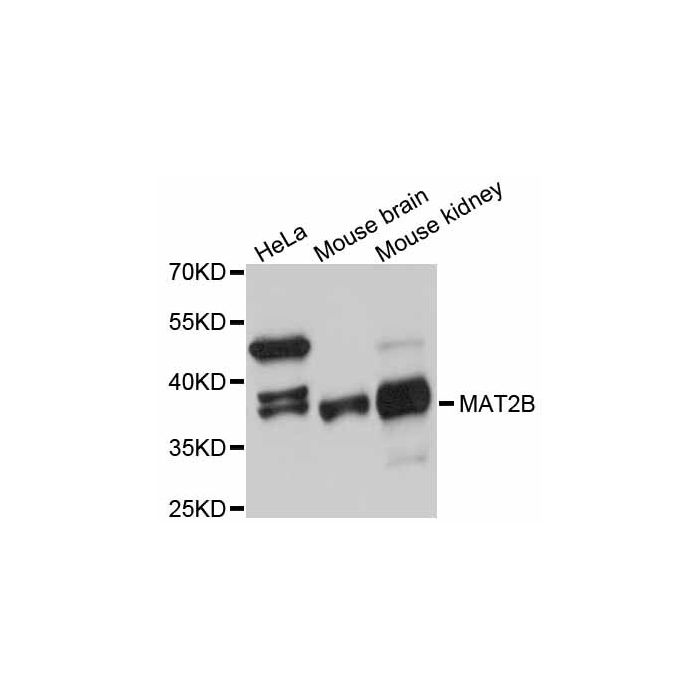
MAT2B polyclonal, anti-human, mouse
€388.00
In stock
SKU
BS71679
Background:
The protein encoded by this gene belongs to the methionine adenosyltransferase (MAT) family. MAT catalyzes the biosynthesis of S-adenosylmethionine from methionine and ATP. This protein is the regulatory beta subunit of MAT. Alternative splicing results in multiple transcript variants encoding different isoforms.
Alternative Name:
TGR, MAT-II, SDR23E1, MATIIbeta, Nbla02999
Application Dilution: WB : 1:500 - 1:2000
Specificity: MAT2B polyclonal antibody detects endogenous levels of MAT2B protein.
Immunogen:
Recombinant protein of human MAT2B
MW: Predicted band size: 38 kDa, Observed band size: Refer to Figures
Swis Prot.: Q9NZL9
Purification & Purity:
The antibody was affinity-purified from rabbit antiserum by affinity-chromatography using epitope-specific immunogen and the purity is > 95% (by SDS-PAGE).
Format:
1mg/ml in PBS with 0.02% sodium azide, 50% glycerol, pH7.3.
Storage:
Store at 4°C short term. Aliquot and store at -20°C long term. Avoid freeze-thaw cycles.
For research use only, not for use in diagnostic procedure.
The protein encoded by this gene belongs to the methionine adenosyltransferase (MAT) family. MAT catalyzes the biosynthesis of S-adenosylmethionine from methionine and ATP. This protein is the regulatory beta subunit of MAT. Alternative splicing results in multiple transcript variants encoding different isoforms.
Alternative Name:
TGR, MAT-II, SDR23E1, MATIIbeta, Nbla02999
Application Dilution: WB : 1:500 - 1:2000
Specificity: MAT2B polyclonal antibody detects endogenous levels of MAT2B protein.
Immunogen:
Recombinant protein of human MAT2B
MW: Predicted band size: 38 kDa, Observed band size: Refer to Figures
Swis Prot.: Q9NZL9
Purification & Purity:
The antibody was affinity-purified from rabbit antiserum by affinity-chromatography using epitope-specific immunogen and the purity is > 95% (by SDS-PAGE).
Format:
1mg/ml in PBS with 0.02% sodium azide, 50% glycerol, pH7.3.
Storage:
Store at 4°C short term. Aliquot and store at -20°C long term. Avoid freeze-thaw cycles.
For research use only, not for use in diagnostic procedure.
| Is Featured? | No |
|---|
Write Your Own Review