
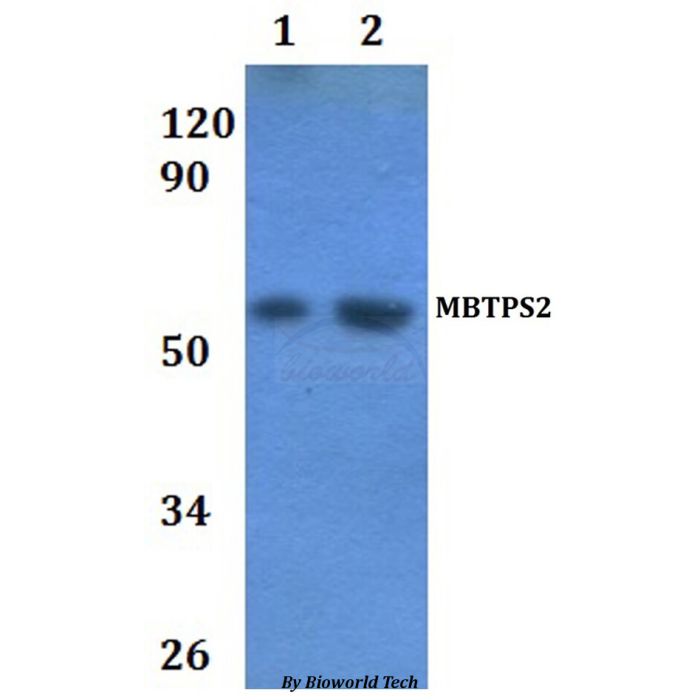
MBTPS2 polyclonal, anti-human, mouse
€305.00
In stock
SKU
BS61210
Background:
The transcription factors SREBPs (sterol regulatory element binding proteins) span the ER membrane and, in response to sterol depletion, the N-terminal domain of SREBPs are proteolytically activated, released from the membrane and then translocate to the nucleus where they induce the expression of genes regulating cholesterol metabolism. This proteolytic activation requires the sequential cleavage of SREBPs at Site-1, within the lumen of the ER, followed by cleavage at Site-2, within the first transmembrane domain. The cleavage at Site-1 separates the N-terminal and C-terminal domains of the protein and it requires the serine protease, S1P (Site-1 protease). Site-2 is subsequently processed by a putative zinc metalloprotease S2P, which releases the activated N-terminal domain for nuclear translocation. This proteolytic pathway is tightly regulated by sterol levels and is under the control of SCAP (SREBP cleavage-activating protein). SCAP, a sterol sensor, is latently bound to the C-terminal regulatory domains of the SREBPs, and it regulates cleavage of SREBPs at Site-1. Sterol levels influence the activity of SCAP, as SCAP is activated only in sterol-depleted cells and it inhibited by sterol accumulation.
Alternative Name:
Membrane-bound transcription factor site-2 protease (EC:3.4.24.85), Endopeptidase S2P, Sterol regulatory element-binding proteins intramembrane protease, SREBPs intramembrane protease, MBTPS2, S2P
Application Dilution: WB: 1:500~1:1000
Specificity: MBTPS2 polyclonal antibody detects endogenous levels of MBTPS2 protein.
Immunogen:
A synthetic peptide corresponding to residues in Human MBTPS2.
MW: ~ 57 kDa
Swis Prot.: O43462
Purification & Purity:
The antibody was affinity-purified from rabbit antiserum by affinity-chromatography using epitope-specific immunogen and the purity is > 95% (by SDS-PAGE).
Format:
1 mg/ml in Phosphate buffered saline (PBS) with 0.05% sodium azide, approx. pH 7.3.
Storage:
Store at 4°C short term. Aliquot and store at -20°C long term. Avoid freeze-thaw cycles.
For research use only, not for use in diagnostic procedure.
The transcription factors SREBPs (sterol regulatory element binding proteins) span the ER membrane and, in response to sterol depletion, the N-terminal domain of SREBPs are proteolytically activated, released from the membrane and then translocate to the nucleus where they induce the expression of genes regulating cholesterol metabolism. This proteolytic activation requires the sequential cleavage of SREBPs at Site-1, within the lumen of the ER, followed by cleavage at Site-2, within the first transmembrane domain. The cleavage at Site-1 separates the N-terminal and C-terminal domains of the protein and it requires the serine protease, S1P (Site-1 protease). Site-2 is subsequently processed by a putative zinc metalloprotease S2P, which releases the activated N-terminal domain for nuclear translocation. This proteolytic pathway is tightly regulated by sterol levels and is under the control of SCAP (SREBP cleavage-activating protein). SCAP, a sterol sensor, is latently bound to the C-terminal regulatory domains of the SREBPs, and it regulates cleavage of SREBPs at Site-1. Sterol levels influence the activity of SCAP, as SCAP is activated only in sterol-depleted cells and it inhibited by sterol accumulation.
Alternative Name:
Membrane-bound transcription factor site-2 protease (EC:3.4.24.85), Endopeptidase S2P, Sterol regulatory element-binding proteins intramembrane protease, SREBPs intramembrane protease, MBTPS2, S2P
Application Dilution: WB: 1:500~1:1000
Specificity: MBTPS2 polyclonal antibody detects endogenous levels of MBTPS2 protein.
Immunogen:
A synthetic peptide corresponding to residues in Human MBTPS2.
MW: ~ 57 kDa
Swis Prot.: O43462
Purification & Purity:
The antibody was affinity-purified from rabbit antiserum by affinity-chromatography using epitope-specific immunogen and the purity is > 95% (by SDS-PAGE).
Format:
1 mg/ml in Phosphate buffered saline (PBS) with 0.05% sodium azide, approx. pH 7.3.
Storage:
Store at 4°C short term. Aliquot and store at -20°C long term. Avoid freeze-thaw cycles.
For research use only, not for use in diagnostic procedure.
| Is Featured? | No |
|---|
Write Your Own Review