
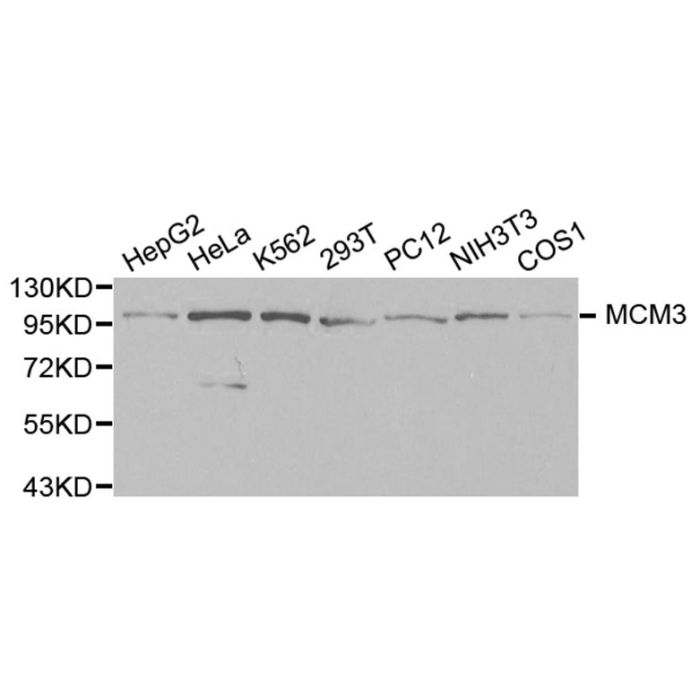
MCM3 polyclonal, anti-human, mouse, monkey
€388.00
In stock
SKU
BS6111
Background:
Acts as component of the MCM2-7 complex (MCM complex) which is the putative replicative helicase essential for 'once per cell cycle' DNA replication initiation and elongation in eukaryotic cells. The active ATPase sites in the MCM2-7 ring are formed through the interaction surfaces of two neighboring subunits such that a critical structure of a conserved arginine finger motif is provided in trans relative to the ATP-binding site of the Walker A box of the adjacent subunit. The six ATPase active sites, however, are likely to contribute differentially to the complex helicase activity. Required for DNA replication and cell proliferation.
Alternative Name:
Cervical cancer proto oncogene 5, DNA polymerase alpha holoenzyme associated P1, DNA polymerase alpha holoenzyme associated protein P1, DNA polymerase alpha holoenzyme-associated protein P1, DNA replication factor MCM3, DNA replication licensing factor MCM3, HCC 5, HCC5, hRlf beta subunit, Human cervical cancer proto oncogene 5, MCM 3, mcm3, MCM3 minichromosome maintenance deficient 3, MCM3, MGC1157, Minichromosome maintenance complex component 3, Minichromosome maintenance
Application Dilution: WB: 1:500~1:2000, IHC/IF: 1:50~1:200
Specificity: MCM3 polyclonal antibody detects endogenous levels of MCM3 protein.
Immunogen:
Recombinant full length Human MCM3.
MW: ~ 90 kDa
Swis Prot.: P25205
Purification & Purity:
The antibody was affinity-purified from rabbit antiserum by affinity-chromatography using epitope-specific immunogen and the purity is > 95% (by SDS-PAGE).
Format:
1mg/ml in PBS with 0.1% Sodium Azide, 50% Glycerol.
Storage:
Store at 4°C short term. Aliquot and store at -20°C long term. Avoid freeze-thaw cycles.
For research use only, not for use in diagnostic procedure.
Acts as component of the MCM2-7 complex (MCM complex) which is the putative replicative helicase essential for 'once per cell cycle' DNA replication initiation and elongation in eukaryotic cells. The active ATPase sites in the MCM2-7 ring are formed through the interaction surfaces of two neighboring subunits such that a critical structure of a conserved arginine finger motif is provided in trans relative to the ATP-binding site of the Walker A box of the adjacent subunit. The six ATPase active sites, however, are likely to contribute differentially to the complex helicase activity. Required for DNA replication and cell proliferation.
Alternative Name:
Cervical cancer proto oncogene 5, DNA polymerase alpha holoenzyme associated P1, DNA polymerase alpha holoenzyme associated protein P1, DNA polymerase alpha holoenzyme-associated protein P1, DNA replication factor MCM3, DNA replication licensing factor MCM3, HCC 5, HCC5, hRlf beta subunit, Human cervical cancer proto oncogene 5, MCM 3, mcm3, MCM3 minichromosome maintenance deficient 3, MCM3, MGC1157, Minichromosome maintenance complex component 3, Minichromosome maintenance
Application Dilution: WB: 1:500~1:2000, IHC/IF: 1:50~1:200
Specificity: MCM3 polyclonal antibody detects endogenous levels of MCM3 protein.
Immunogen:
Recombinant full length Human MCM3.
MW: ~ 90 kDa
Swis Prot.: P25205
Purification & Purity:
The antibody was affinity-purified from rabbit antiserum by affinity-chromatography using epitope-specific immunogen and the purity is > 95% (by SDS-PAGE).
Format:
1mg/ml in PBS with 0.1% Sodium Azide, 50% Glycerol.
Storage:
Store at 4°C short term. Aliquot and store at -20°C long term. Avoid freeze-thaw cycles.
For research use only, not for use in diagnostic procedure.
| Is Featured? | No |
|---|
Write Your Own Review