
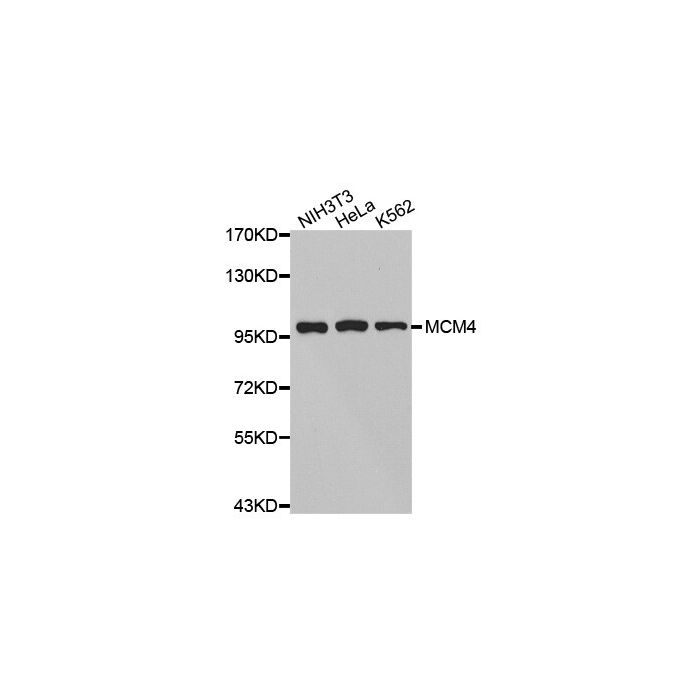
MCM4 polyclonal, anti-human, mouse, rat
€388.00
In stock
SKU
BS7158
Background:
The mini-chromosome maintenance (MCM) family of proteins, including MCM2, MCM3, MCM4 (Cdc21), MCM5 (Cdc46), MCM6 (Mis5) and MCM7 (Cdc47), are regulators of DNA replication that act to ensure replication occurs only once in the cell cycle. Expression of MCM proteins increases during cell growth, peaking at G1 to S phase. The MCM proteins each contain an ATP-binding motif, which is predicted to mediate ATP-dependent opening of double-stranded DNA. MCM proteins are regulated by E2F transcription factors, which induce MCM expression, and by protein kinases, which interact with MCM proteins to maintain the postreplicative state of the cell. MCM2/MCM4 complexes function as substrates for Cdc2/cyclin in vitro. Cleavage of MCM3, which can be prevented by caspase inhibitors, results in the inactivation of the MCM complex (composed of at least MCM proteins 2-6) during apoptosis. A complex composed of MCM4, MCM6 and MCM7 has been shown to be involved in DNA helicase activity, and MCM5 is involved in IFN-γ-induced Stat1α transcription activation.
Alternative Name:
DNA replication licensing factor MCM4, CDC21 homolog, P1-CDC21, CDC21
Application Dilution: WB: 1:500~1:2000, IHC: 1:50~1:200
Specificity: MCM4 polyclonal antibody detects endogenous levels of MCM4 protein.
Immunogen:
Recombinant full length Human MCM4 .
MW: ~90 kDa
Swis Prot.: P33991
Purification & Purity:
The antibody was affinity-purified from rabbit antiserum by affinity-chromatography using epitope-specific immunogen and the purity is > 95% (by SDS-PAGE).
Format:
1mg/ml in PBS with 0.1% Sodium Azide, 50% Glycerol.
Storage:
Store at 4°C short term. Aliquot and store at -20°C long term. Avoid freeze-thaw cycles.
For research use only, not for use in diagnostic procedure.
The mini-chromosome maintenance (MCM) family of proteins, including MCM2, MCM3, MCM4 (Cdc21), MCM5 (Cdc46), MCM6 (Mis5) and MCM7 (Cdc47), are regulators of DNA replication that act to ensure replication occurs only once in the cell cycle. Expression of MCM proteins increases during cell growth, peaking at G1 to S phase. The MCM proteins each contain an ATP-binding motif, which is predicted to mediate ATP-dependent opening of double-stranded DNA. MCM proteins are regulated by E2F transcription factors, which induce MCM expression, and by protein kinases, which interact with MCM proteins to maintain the postreplicative state of the cell. MCM2/MCM4 complexes function as substrates for Cdc2/cyclin in vitro. Cleavage of MCM3, which can be prevented by caspase inhibitors, results in the inactivation of the MCM complex (composed of at least MCM proteins 2-6) during apoptosis. A complex composed of MCM4, MCM6 and MCM7 has been shown to be involved in DNA helicase activity, and MCM5 is involved in IFN-γ-induced Stat1α transcription activation.
Alternative Name:
DNA replication licensing factor MCM4, CDC21 homolog, P1-CDC21, CDC21
Application Dilution: WB: 1:500~1:2000, IHC: 1:50~1:200
Specificity: MCM4 polyclonal antibody detects endogenous levels of MCM4 protein.
Immunogen:
Recombinant full length Human MCM4 .
MW: ~90 kDa
Swis Prot.: P33991
Purification & Purity:
The antibody was affinity-purified from rabbit antiserum by affinity-chromatography using epitope-specific immunogen and the purity is > 95% (by SDS-PAGE).
Format:
1mg/ml in PBS with 0.1% Sodium Azide, 50% Glycerol.
Storage:
Store at 4°C short term. Aliquot and store at -20°C long term. Avoid freeze-thaw cycles.
For research use only, not for use in diagnostic procedure.
| Is Featured? | No |
|---|
Write Your Own Review