
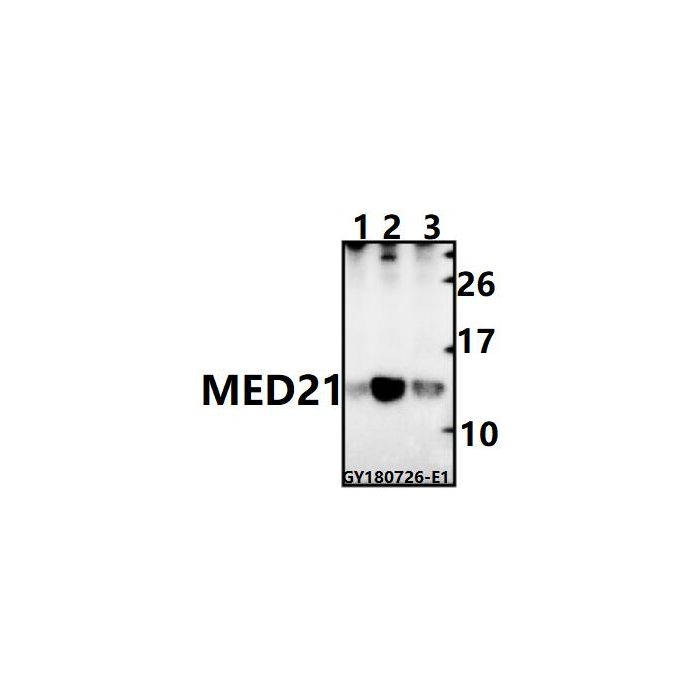
MED21 polyclonal, anti-human, mouse, rat
€328.00
In stock
SKU
BS61042
Background:
In mammalian cells, transcription is regulated in part by high molecular weight co-activating complexes that mediate signals between transcriptional activators and RNA polymerase. These complexes include the SMCC (SRB and MED protein cofactor complex), which consists of various subunits that share homology with several components of the yeast transcriptional mediator complexes and including the human proteins Srb7, Med6 (also designated DRIP33) and Med7 (also designated DRIP34). SMCC associates with the RNAPII (RNA polymerase II) holoenzyme through Srb7 and, in turn, enhances gene-specific activation or repression induced by DNA-binding transcription factors. Med6 and Med7, as well as other components of SMCC, associate with co-activator proteins from the TRAP (thyroid hormone receptor-activating protein) complex and DRIP (for vitamin D receptor interacting protein) complex to facilitate steroid receptor dependent transcriptional activation. Additionally, SMCC associates with PC4 (positive cofactor 4) to repress basal transcription independent of RNAPII activity.
Alternative Name:
Mediator of RNA polymerase II transcription subunit 21, Mediator complex subunit 21, RNA polymerase II holoenzyme component SRB7, RNAPII complex component SRB7, hSrb7, MED21, SRB7, SURB7
Application Dilution: WB: 1:500~1:1000
Specificity: MED21 polyclonal antibodydetects endogenous levels of MED21 protein.
Immunogen:
Synthetic peptide, corresponding Human MED21.
MW: ~ 15 kDa
Swis Prot.: Q13503
Purification & Purity:
The antibody was affinity-purified from rabbit antiserum by affinity-chromatography using epitope-specific immunogen and the purity is > 95% (by SDS-PAGE).
Format:
1 mg/ml in Phosphate buffered saline (PBS) with 0.05% sodium azide, approx. pH 7.3.
Storage:
Store at 4°C short term. Aliquot and store at -20°C long term. Avoid freeze-thaw cycles.
For research use only, not for use in diagnostic procedure.
In mammalian cells, transcription is regulated in part by high molecular weight co-activating complexes that mediate signals between transcriptional activators and RNA polymerase. These complexes include the SMCC (SRB and MED protein cofactor complex), which consists of various subunits that share homology with several components of the yeast transcriptional mediator complexes and including the human proteins Srb7, Med6 (also designated DRIP33) and Med7 (also designated DRIP34). SMCC associates with the RNAPII (RNA polymerase II) holoenzyme through Srb7 and, in turn, enhances gene-specific activation or repression induced by DNA-binding transcription factors. Med6 and Med7, as well as other components of SMCC, associate with co-activator proteins from the TRAP (thyroid hormone receptor-activating protein) complex and DRIP (for vitamin D receptor interacting protein) complex to facilitate steroid receptor dependent transcriptional activation. Additionally, SMCC associates with PC4 (positive cofactor 4) to repress basal transcription independent of RNAPII activity.
Alternative Name:
Mediator of RNA polymerase II transcription subunit 21, Mediator complex subunit 21, RNA polymerase II holoenzyme component SRB7, RNAPII complex component SRB7, hSrb7, MED21, SRB7, SURB7
Application Dilution: WB: 1:500~1:1000
Specificity: MED21 polyclonal antibodydetects endogenous levels of MED21 protein.
Immunogen:
Synthetic peptide, corresponding Human MED21.
MW: ~ 15 kDa
Swis Prot.: Q13503
Purification & Purity:
The antibody was affinity-purified from rabbit antiserum by affinity-chromatography using epitope-specific immunogen and the purity is > 95% (by SDS-PAGE).
Format:
1 mg/ml in Phosphate buffered saline (PBS) with 0.05% sodium azide, approx. pH 7.3.
Storage:
Store at 4°C short term. Aliquot and store at -20°C long term. Avoid freeze-thaw cycles.
For research use only, not for use in diagnostic procedure.
| Is Featured? | No |
|---|
Write Your Own Review