
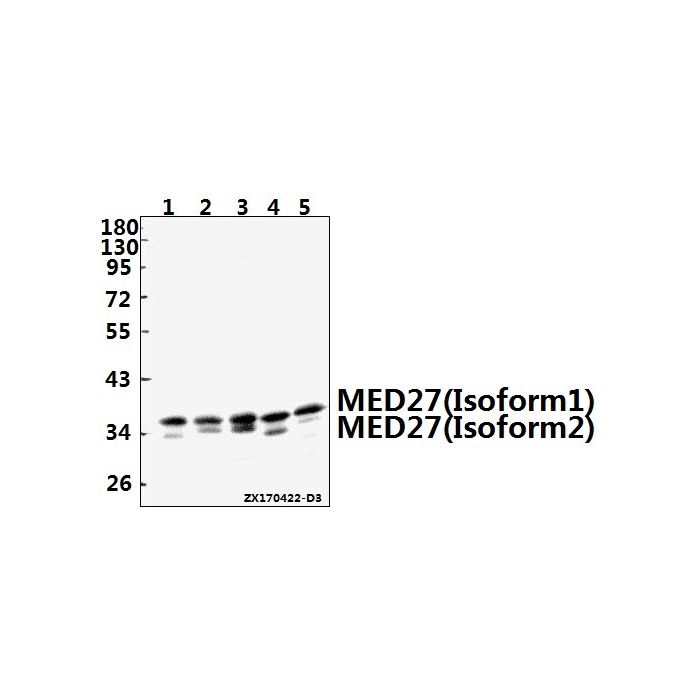
MED27 polyclonal, anti-human, mouse, rat
€305.00
In stock
SKU
BS61659
Background:
In mammalian cells, transcription is regulated in part by high molecular weight coactivating complexes that mediate signals between transcriptional activators and RNA polymerase. These complexes include CRSP (for cofactor required for Sp1 activation), which is required, in conjunction with TAFIIs, for transcriptional activation by Sp1. CRSP is ubiquitously expressed in various tissues and functions as a multimeric complex that consists of nine distinct subunits. Several members of the CRSP family share sequence similarity with multiple components of the yeast transcriptional mediator proteins, including CRSP150, which is related to yeast Rgr1, and CRSP70, which is similar to the elongation factor TFIIS. CRSP77 and CRSP150 are also related to proteins within the putative murine mediator complex, while CRSP130 and CRSP34 are largely unrelated to either murine or yeast proteins. CRSP subunits also associate with larger multimeric coactivaor complexes, including ARC/DRI, which binds directly to SREBP and nuclear hormone receptors to facilitate transcription, and with NAT, a polymerase II-interacting complex that represses activated transcription
Alternative Name:
Mediator of RNA polymerase II transcription subunit 27, Cofactor required for Sp1 transcriptional activation subunit 8, CRSP complex subunit 8, Mediator complex subunit 27, P37 TRAP/SMCC/PC2 subunit, Transcriptional coactivator CRSP34, MED27, CRSP34
Application Dilution: WB: 1:500~1:1000
Specificity: MED27 polyclonal antibody detects endogenous levels of MED27 protein.
Immunogen:
Synthetic peptide, corresponding Human MED27.
MW: ~ 35, 31 kDa
Swis Prot.: Q6P2C8
Purification & Purity:
The antibody was affinity-purified from rabbit antiserum by affinity-chromatography using epitope-specific immunogen and the purity is > 95% (by SDS-PAGE).
Format:
1 mg/ml in Phosphate buffered saline (PBS) with 0.05% sodium azide, approx. pH 7.3.
Storage:
Store at 4°C short term. Aliquot and store at -20°C long term. Avoid freeze-thaw cycles.
For research use only, not for use in diagnostic procedure.
In mammalian cells, transcription is regulated in part by high molecular weight coactivating complexes that mediate signals between transcriptional activators and RNA polymerase. These complexes include CRSP (for cofactor required for Sp1 activation), which is required, in conjunction with TAFIIs, for transcriptional activation by Sp1. CRSP is ubiquitously expressed in various tissues and functions as a multimeric complex that consists of nine distinct subunits. Several members of the CRSP family share sequence similarity with multiple components of the yeast transcriptional mediator proteins, including CRSP150, which is related to yeast Rgr1, and CRSP70, which is similar to the elongation factor TFIIS. CRSP77 and CRSP150 are also related to proteins within the putative murine mediator complex, while CRSP130 and CRSP34 are largely unrelated to either murine or yeast proteins. CRSP subunits also associate with larger multimeric coactivaor complexes, including ARC/DRI, which binds directly to SREBP and nuclear hormone receptors to facilitate transcription, and with NAT, a polymerase II-interacting complex that represses activated transcription
Alternative Name:
Mediator of RNA polymerase II transcription subunit 27, Cofactor required for Sp1 transcriptional activation subunit 8, CRSP complex subunit 8, Mediator complex subunit 27, P37 TRAP/SMCC/PC2 subunit, Transcriptional coactivator CRSP34, MED27, CRSP34
Application Dilution: WB: 1:500~1:1000
Specificity: MED27 polyclonal antibody detects endogenous levels of MED27 protein.
Immunogen:
Synthetic peptide, corresponding Human MED27.
MW: ~ 35, 31 kDa
Swis Prot.: Q6P2C8
Purification & Purity:
The antibody was affinity-purified from rabbit antiserum by affinity-chromatography using epitope-specific immunogen and the purity is > 95% (by SDS-PAGE).
Format:
1 mg/ml in Phosphate buffered saline (PBS) with 0.05% sodium azide, approx. pH 7.3.
Storage:
Store at 4°C short term. Aliquot and store at -20°C long term. Avoid freeze-thaw cycles.
For research use only, not for use in diagnostic procedure.
| Is Featured? | No |
|---|
Write Your Own Review