
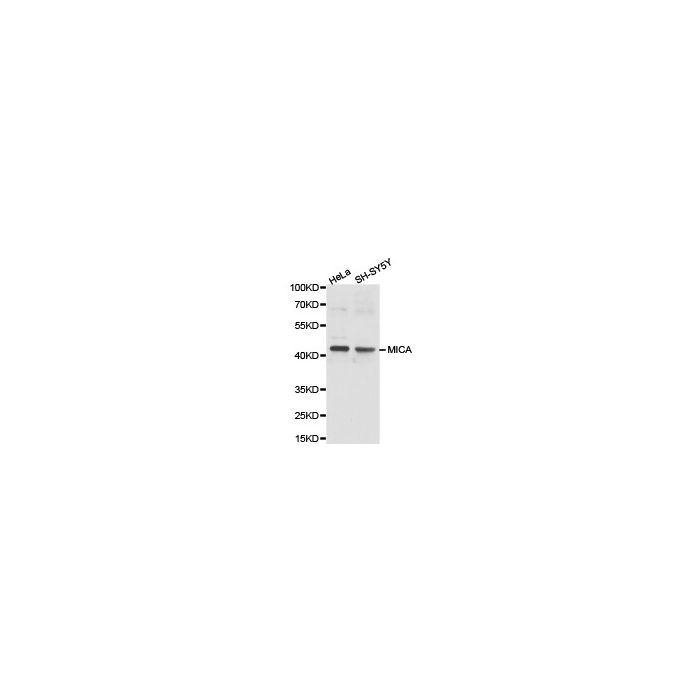
MICA polyclonal, anti-human, mouse, rat
€388.00
In stock
SKU
BS6664
Background:
MICA and MICB are stress-induced antigens that are related to major histocompatibility complex (MHC) class I molecules. MICA and MICB are frequently expressed in epithelial tumors. These highly glycosylated cell surface proteins are stably expressed without conventional class I peptide ligands or association with b-2-Microglobulin. The expression is induced on proliferating or heat shock-stressed epithelial cells. MICA and MICB are broadly recognized by intestinal epithelial Vd1 gd T cells expressing variable TCRs, suggesting that these antigens may play a central role in the signaling of cellular distress to evoke immune responses in the intestinal epithelium.
Alternative Name:
HLA class I antigen, FLJ36918, FLJ60820, MGC111087, MGC21250, MHC class I chain related gene A protein, MHC class I chain related protein A, MHC class I chain related protein A HLA B HLA C, MHC class I polypeptide related sequence A, MHC class I polypeptide-related sequence A, MHC class I related protein, MIC A, MIC-A, micA, MICA, OTTHUMP00000029088, OTTHUMP00000044528, OTTHUMP00000165170, OTTHUMP00000165172, PERB11.1, Stress inducible class I homolog,
Application Dilution: WB: 1:500~1:2000
Specificity: MICA polyclonal antibody detects endogenous levels of MICA protein.
Immunogen:
Recombinant full length Human MICA.
MW: ~ 43 kDa
Swis Prot.: Q29983
Purification & Purity:
The antibody was affinity-purified from rabbit antiserum by affinity-chromatography using epitope-specific immunogen and the purity is > 95% (by SDS-PAGE).
Format:
1mg/ml in PBS with 0.1% Sodium Azide, 50% Glycerol.
Storage:
Store at 4°C short term. Aliquot and store at -20°C long term. Avoid freeze-thaw cycles.
For research use only, not for use in diagnostic procedure.
MICA and MICB are stress-induced antigens that are related to major histocompatibility complex (MHC) class I molecules. MICA and MICB are frequently expressed in epithelial tumors. These highly glycosylated cell surface proteins are stably expressed without conventional class I peptide ligands or association with b-2-Microglobulin. The expression is induced on proliferating or heat shock-stressed epithelial cells. MICA and MICB are broadly recognized by intestinal epithelial Vd1 gd T cells expressing variable TCRs, suggesting that these antigens may play a central role in the signaling of cellular distress to evoke immune responses in the intestinal epithelium.
Alternative Name:
HLA class I antigen, FLJ36918, FLJ60820, MGC111087, MGC21250, MHC class I chain related gene A protein, MHC class I chain related protein A, MHC class I chain related protein A HLA B HLA C, MHC class I polypeptide related sequence A, MHC class I polypeptide-related sequence A, MHC class I related protein, MIC A, MIC-A, micA, MICA, OTTHUMP00000029088, OTTHUMP00000044528, OTTHUMP00000165170, OTTHUMP00000165172, PERB11.1, Stress inducible class I homolog,
Application Dilution: WB: 1:500~1:2000
Specificity: MICA polyclonal antibody detects endogenous levels of MICA protein.
Immunogen:
Recombinant full length Human MICA.
MW: ~ 43 kDa
Swis Prot.: Q29983
Purification & Purity:
The antibody was affinity-purified from rabbit antiserum by affinity-chromatography using epitope-specific immunogen and the purity is > 95% (by SDS-PAGE).
Format:
1mg/ml in PBS with 0.1% Sodium Azide, 50% Glycerol.
Storage:
Store at 4°C short term. Aliquot and store at -20°C long term. Avoid freeze-thaw cycles.
For research use only, not for use in diagnostic procedure.
| Is Featured? | No |
|---|
Write Your Own Review