
Microcephalin polyclonal, anti-human, mouse, rat
€305.00
In stock
SKU
BS5900
Background:
Microcephalin (MCPH1, BRCT-repeat inhibitor of TERT expression 1, BRIT1) modulates brain size and has been proliferating under strong positive selection for several thousand years, although the nature of the positive selection is poorly understood. Human Microcephalin contains three BRCA1 C-terminal (BRCT) domains and shares 57% identity with its mouse ortholog, the most conserved regions being BRCT domains where there is 80% identity. Predominant expression of human Microcephalin is observed in fetal brain, liver and kidney tissues and is expressed during neurogenesis in mice. Microcephalin displays significantly higher rates of protein evolution in primates than in rodents; this trend is most noticeable for the subset of genes associated with nervous system development. Microcephalin has a very young, single nucleotide, polymorphism haplotype associated with modern humans; this gene is presumably still evolving in Homo sapiens. It functions in DNA damage response and regulation of cell cycle checkpoints.
Alternative Name:
MCPH1, BRCT-repeat inhibitor of TERT expression 1, BRIT1
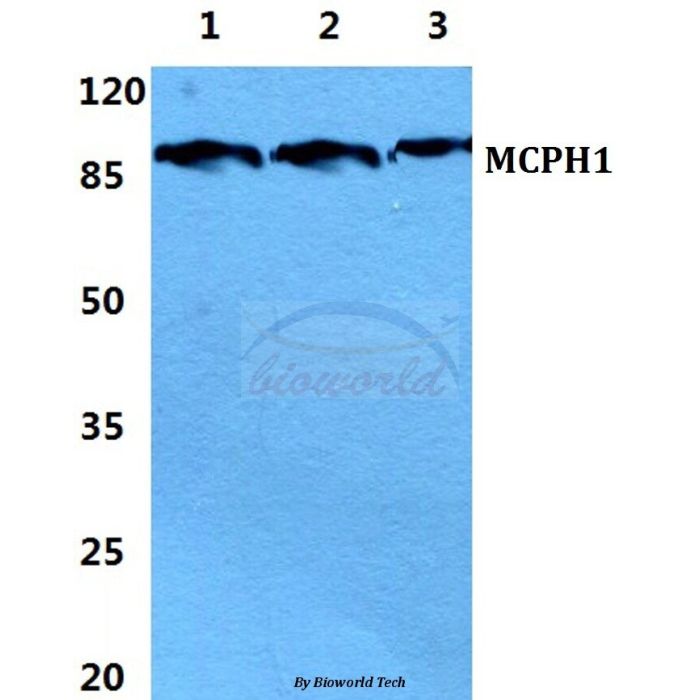
Application Dilution: WB: 1:500~1:1000, IHC: 1:50~1:200
Specificity: Microcephalin polyclonal antibody detects endogenous levels of Microcephalin protein.
Immunogen:
Synthetic peptide, corresponding to amino acids 141-186 of Human Microcephalin.
MW: ~ 95 kDa
Swis Prot.: Q8NEM0
Purification & Purity:
The antibody was affinity-purified from rabbit antiserum by affinity-chromatography using epitope-specific immunogen and the purity is > 95% (by SDS-PAGE).
Format:
1 mg/ml in Phosphate buffered saline (PBS) with 0.05% sodium azide, approx. pH 7.2.
Storage:
Store at 4°C short term. Aliquot and store at -20°C long term. Avoid freeze-thaw cycles.
For research use only, not for use in diagnostic procedure.
Microcephalin (MCPH1, BRCT-repeat inhibitor of TERT expression 1, BRIT1) modulates brain size and has been proliferating under strong positive selection for several thousand years, although the nature of the positive selection is poorly understood. Human Microcephalin contains three BRCA1 C-terminal (BRCT) domains and shares 57% identity with its mouse ortholog, the most conserved regions being BRCT domains where there is 80% identity. Predominant expression of human Microcephalin is observed in fetal brain, liver and kidney tissues and is expressed during neurogenesis in mice. Microcephalin displays significantly higher rates of protein evolution in primates than in rodents; this trend is most noticeable for the subset of genes associated with nervous system development. Microcephalin has a very young, single nucleotide, polymorphism haplotype associated with modern humans; this gene is presumably still evolving in Homo sapiens. It functions in DNA damage response and regulation of cell cycle checkpoints.
Alternative Name:
MCPH1, BRCT-repeat inhibitor of TERT expression 1, BRIT1
Application Dilution: WB: 1:500~1:1000, IHC: 1:50~1:200
Specificity: Microcephalin polyclonal antibody detects endogenous levels of Microcephalin protein.
Immunogen:
Synthetic peptide, corresponding to amino acids 141-186 of Human Microcephalin.
MW: ~ 95 kDa
Swis Prot.: Q8NEM0
Purification & Purity:
The antibody was affinity-purified from rabbit antiserum by affinity-chromatography using epitope-specific immunogen and the purity is > 95% (by SDS-PAGE).
Format:
1 mg/ml in Phosphate buffered saline (PBS) with 0.05% sodium azide, approx. pH 7.2.
Storage:
Store at 4°C short term. Aliquot and store at -20°C long term. Avoid freeze-thaw cycles.
For research use only, not for use in diagnostic procedure.
| Is Featured? | No |
|---|
Write Your Own Review