
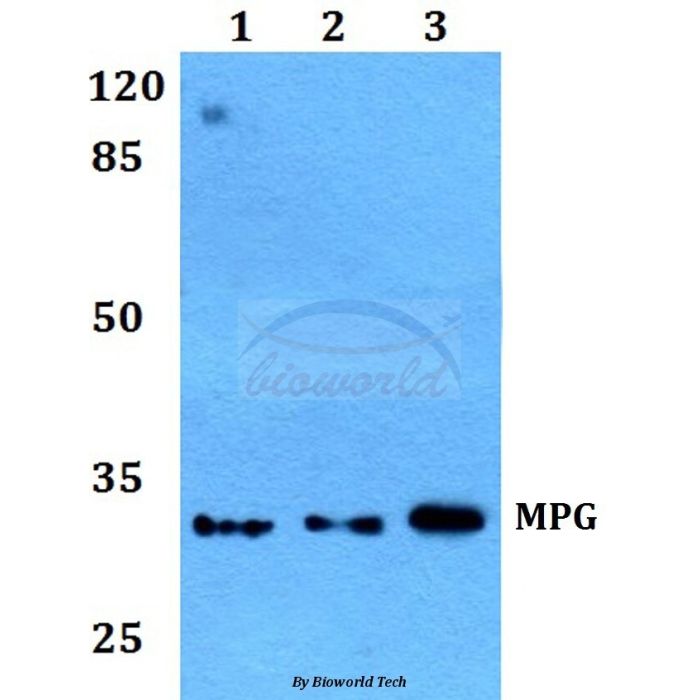
MPG polyclonal, anti-human, mouse, rat
€305.00
In stock
SKU
BS60143
Background:
Maintenance of DNA sequences is necessary for vertebrates and other life. DNA is under constant stress by a plethora of DNA-damaging agents present in both the environment and within cells. The potentially deleterious effects of DNA lesions in cells are elegantly resolved by sophisticated DNA repair systems, including base excision repair (BER), nucleotide excision repair (NER) and DNA repair methyltransferase (MTase). Methylated bases, such as 3-methyladenine (3MeA) and 7-methylguanine (7MeG) can be formed by agents in the environment and by endogenous cellular processes. Consequently, in the absence of exposure to environmental agents, DNA methylation damage can be incurred on the genomic DNA of normal mammalian cells. DNA N-glycosylases are base excision-repair proteins that locate and cleave damaged bases from DNA as the first step in restoring the sequence. 3MeA DNA glycosylases initiate base excision repair by removing 3MeA. These glycosylases also remove a broad spectrum of spontaneous and environmentally induced base lesions. The human N-methylpurine-DNA glycosylase gene maps to chromosome 16p13.3 and encodes a 298 amino acid protein, known as APNG.
Alternative Name:
DNA-3-methyladenine glycosylase, 3-alkyladenine DNA glycosylase, 3-methyladenine DNA glycosidase, ADPG, N-methylpurine-DNA glycosylase, AAG, ANPG, MID1
Application Dilution: WB: 1:500~1:1000
Specificity: MPG polyclonal antibody detects endogenous levels of MPG protein.
Immunogen:
A synthetic peptide corresponding to residues in Human MPG.
MW: ~ 33 kDa
Swis Prot.: P29372
Purification & Purity:
The antibody was affinity-purified from rabbit antiserum by affinity-chromatography using epitope-specific immunogen and the purity is > 95% (by SDS-PAGE).
Format:
1mg/ml in PBS with 0.1% Sodium Azide, 50% Glycerol.
Storage:
Store at 4°C short term. Aliquot and store at -20°C long term. Avoid freeze-thaw cycles.
For research use only, not for use in diagnostic procedure.
Maintenance of DNA sequences is necessary for vertebrates and other life. DNA is under constant stress by a plethora of DNA-damaging agents present in both the environment and within cells. The potentially deleterious effects of DNA lesions in cells are elegantly resolved by sophisticated DNA repair systems, including base excision repair (BER), nucleotide excision repair (NER) and DNA repair methyltransferase (MTase). Methylated bases, such as 3-methyladenine (3MeA) and 7-methylguanine (7MeG) can be formed by agents in the environment and by endogenous cellular processes. Consequently, in the absence of exposure to environmental agents, DNA methylation damage can be incurred on the genomic DNA of normal mammalian cells. DNA N-glycosylases are base excision-repair proteins that locate and cleave damaged bases from DNA as the first step in restoring the sequence. 3MeA DNA glycosylases initiate base excision repair by removing 3MeA. These glycosylases also remove a broad spectrum of spontaneous and environmentally induced base lesions. The human N-methylpurine-DNA glycosylase gene maps to chromosome 16p13.3 and encodes a 298 amino acid protein, known as APNG.
Alternative Name:
DNA-3-methyladenine glycosylase, 3-alkyladenine DNA glycosylase, 3-methyladenine DNA glycosidase, ADPG, N-methylpurine-DNA glycosylase, AAG, ANPG, MID1
Application Dilution: WB: 1:500~1:1000
Specificity: MPG polyclonal antibody detects endogenous levels of MPG protein.
Immunogen:
A synthetic peptide corresponding to residues in Human MPG.
MW: ~ 33 kDa
Swis Prot.: P29372
Purification & Purity:
The antibody was affinity-purified from rabbit antiserum by affinity-chromatography using epitope-specific immunogen and the purity is > 95% (by SDS-PAGE).
Format:
1mg/ml in PBS with 0.1% Sodium Azide, 50% Glycerol.
Storage:
Store at 4°C short term. Aliquot and store at -20°C long term. Avoid freeze-thaw cycles.
For research use only, not for use in diagnostic procedure.
| Is Featured? | No |
|---|
Write Your Own Review