
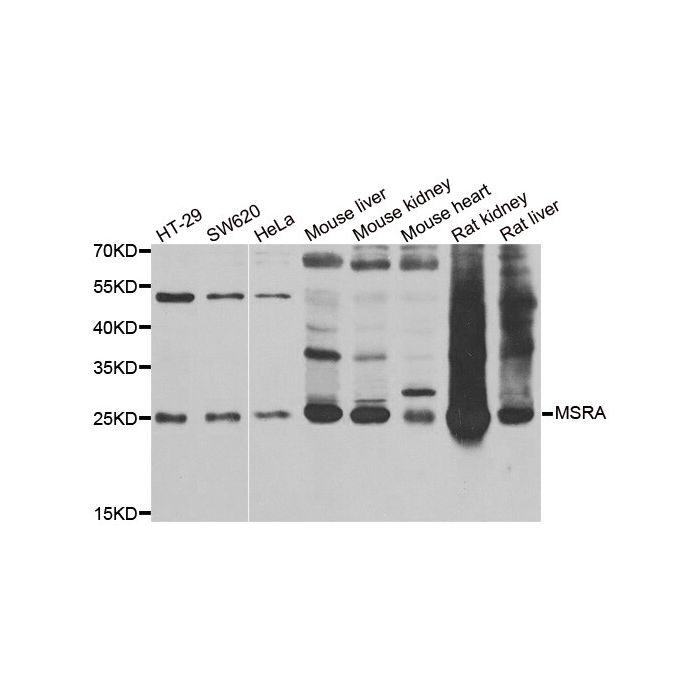
MSRA polyclonal, anti-human, mouse, rat
€388.00
In stock
SKU
BS8178
Background:
Protein-bound methionine residues are among the most susceptible to oxidative stress by biological reactive oxygen species (ROS) such as H2O2, hydroxyl radicals and superoxide ions, which result in the formation of methionine sulfoxide, or Met(O). Methionine sulfoxide reductase (MsrA) is an enzyme that catalyzes the thioredoxin-dependent reduction of Met(O) residues in proteins and in methyl sulfoxide compounds. MsrA is a ubiquitously expressed protein which is found in organisms from yeast to man. Mammalian MsrA is most highly expressed in liver, kidney, macrophages, neutrophils, cerebellum and brain neurons. Oxidation of proteins by ROS is associated with oxidative stress and age-related diseases such as Alzheimer’s disease. Recombinant mammalian MsrA retains enzymatic activity, and overexpression of the protein in yeast and human T cells increases their resistance to oxidative stress. Furthermore, MsrA activity decreases in all regions of the Alzheimer’s disease brain. These findings indicate that MsrA plays an important role in protecting cells against oxidative damage and early cell death.
Alternative Name:
Mitochondrial peptide methionine sulfoxide reductase, Peptide-methionine (S)-S-oxide reductase, Peptide Met(O) reductase, Protein-methionine-S-oxide reductase, PMSR, MSRA
Application Dilution: WB: 1:500~1:2000, IHC: 1:50~1:200
Specificity: MSRA polyclonal antibody detects endogenous levels of MSRA protein.
Immunogen:
Recombinant full length Human MSRA.
MW: ~ 26 kDa
Swis Prot.: Q9UJ68
Purification & Purity:
The antibody was affinity-purified from rabbit antiserum by affinity-chromatography using epitope-specific immunogen and the purity is > 95% (by SDS-PAGE).
Format:
1mg/ml in PBS with 0.1% Sodium Azide, 50% Glycerol.
Storage:
Store at 4°C short term. Aliquot and store at -20°C long term. Avoid freeze-thaw cycles.
For research use only, not for use in diagnostic procedure.
Protein-bound methionine residues are among the most susceptible to oxidative stress by biological reactive oxygen species (ROS) such as H2O2, hydroxyl radicals and superoxide ions, which result in the formation of methionine sulfoxide, or Met(O). Methionine sulfoxide reductase (MsrA) is an enzyme that catalyzes the thioredoxin-dependent reduction of Met(O) residues in proteins and in methyl sulfoxide compounds. MsrA is a ubiquitously expressed protein which is found in organisms from yeast to man. Mammalian MsrA is most highly expressed in liver, kidney, macrophages, neutrophils, cerebellum and brain neurons. Oxidation of proteins by ROS is associated with oxidative stress and age-related diseases such as Alzheimer’s disease. Recombinant mammalian MsrA retains enzymatic activity, and overexpression of the protein in yeast and human T cells increases their resistance to oxidative stress. Furthermore, MsrA activity decreases in all regions of the Alzheimer’s disease brain. These findings indicate that MsrA plays an important role in protecting cells against oxidative damage and early cell death.
Alternative Name:
Mitochondrial peptide methionine sulfoxide reductase, Peptide-methionine (S)-S-oxide reductase, Peptide Met(O) reductase, Protein-methionine-S-oxide reductase, PMSR, MSRA
Application Dilution: WB: 1:500~1:2000, IHC: 1:50~1:200
Specificity: MSRA polyclonal antibody detects endogenous levels of MSRA protein.
Immunogen:
Recombinant full length Human MSRA.
MW: ~ 26 kDa
Swis Prot.: Q9UJ68
Purification & Purity:
The antibody was affinity-purified from rabbit antiserum by affinity-chromatography using epitope-specific immunogen and the purity is > 95% (by SDS-PAGE).
Format:
1mg/ml in PBS with 0.1% Sodium Azide, 50% Glycerol.
Storage:
Store at 4°C short term. Aliquot and store at -20°C long term. Avoid freeze-thaw cycles.
For research use only, not for use in diagnostic procedure.
| Is Featured? | No |
|---|
Write Your Own Review