
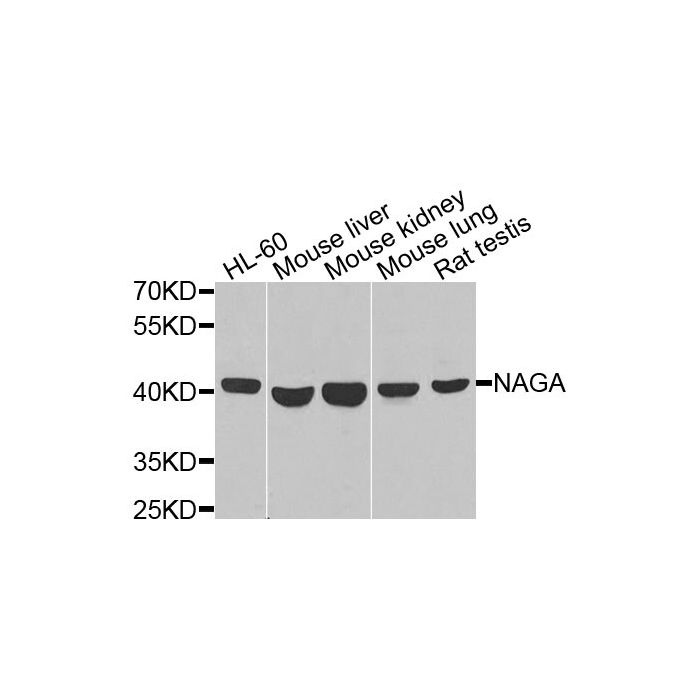
NAGA polyclonal, anti-human, mouse, rat
€388.00
In stock
SKU
BS71378
Background:
NAGA (N-acetylgalactosaminidase, α), also known as α-galactosidase B or GALB, is a 411 lysosomal protein belonging to the glycosyl hydrolase 27 family that may exist as a homodimer and plays a critical role in glycolipid breakdown. NAGA encodes α-N-acetylgalactosaminidase, a lysosomal enzyme, which cleaves α-N-acetylgalactosaminyl groups from glycoconjugates. Mapping to human chromosome 22q13.2, NAGA defects are the cause of an autosomal recessive disorder with three phenotypes, known as Schindler disease (types I, II and III) or NAGA deficiency (types I, II and III). Characterized by neurologic manifestations that range in severity, Schindler disease type I is the most severe form, followed by type III, which may have mild-to-moderate effects. Schindler disease type II, also known as Kanzaki disease, is characterized by mild intellectual impairment and angiokeratoma corporis diffusum.
Alternative Name:
Alpha-galactosidase B, α-galactosidase B, galactosidaseαB, galactosidase-αB,
Application Dilution: WB: 1:500 - 1:2000
Specificity: NAGA polyclonal antibody detects endogenous levels of NAGA protein.
Immunogen:
Recombinant protein of human NAGA.
MW: ~ 47 kDa
Swis Prot.: P17050
Purification & Purity:
The antibody was affinity-purified from rabbit antiserum by affinity-chromatography using epitope-specific immunogen and the purity is > 95% (by SDS-PAGE).
Format:
1mg/ml in PBS with 0.02% sodium azide, 50% glycerol, pH7.3.
Storage:
Store at 4°C short term. Aliquot and store at -20°C long term. Avoid freeze-thaw cycles.
For research use only, not for use in diagnostic procedure.
NAGA (N-acetylgalactosaminidase, α), also known as α-galactosidase B or GALB, is a 411 lysosomal protein belonging to the glycosyl hydrolase 27 family that may exist as a homodimer and plays a critical role in glycolipid breakdown. NAGA encodes α-N-acetylgalactosaminidase, a lysosomal enzyme, which cleaves α-N-acetylgalactosaminyl groups from glycoconjugates. Mapping to human chromosome 22q13.2, NAGA defects are the cause of an autosomal recessive disorder with three phenotypes, known as Schindler disease (types I, II and III) or NAGA deficiency (types I, II and III). Characterized by neurologic manifestations that range in severity, Schindler disease type I is the most severe form, followed by type III, which may have mild-to-moderate effects. Schindler disease type II, also known as Kanzaki disease, is characterized by mild intellectual impairment and angiokeratoma corporis diffusum.
Alternative Name:
Alpha-galactosidase B, α-galactosidase B, galactosidaseαB, galactosidase-αB,
Application Dilution: WB: 1:500 - 1:2000
Specificity: NAGA polyclonal antibody detects endogenous levels of NAGA protein.
Immunogen:
Recombinant protein of human NAGA.
MW: ~ 47 kDa
Swis Prot.: P17050
Purification & Purity:
The antibody was affinity-purified from rabbit antiserum by affinity-chromatography using epitope-specific immunogen and the purity is > 95% (by SDS-PAGE).
Format:
1mg/ml in PBS with 0.02% sodium azide, 50% glycerol, pH7.3.
Storage:
Store at 4°C short term. Aliquot and store at -20°C long term. Avoid freeze-thaw cycles.
For research use only, not for use in diagnostic procedure.
| Is Featured? | No |
|---|
Write Your Own Review