
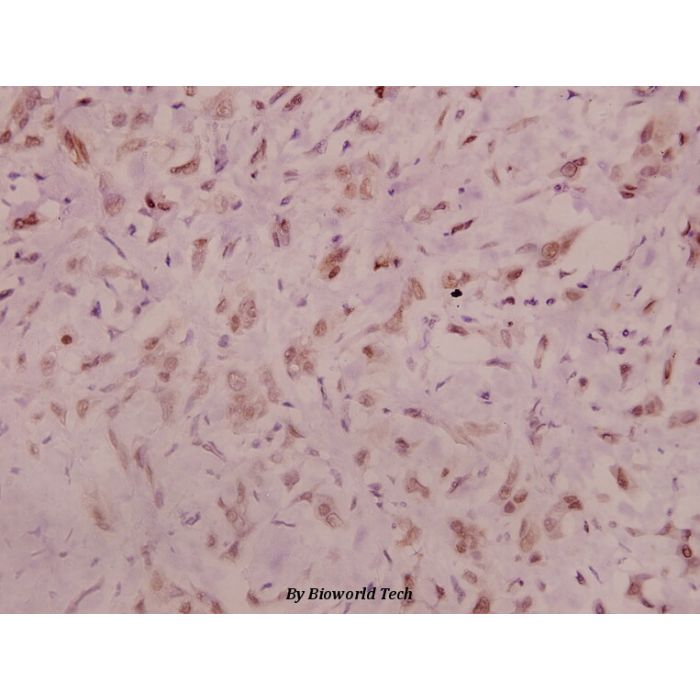
NMDAζ1 (phospho-S896) polyclonal, anti-human, mouse, rat
€328.00
In stock
SKU
BS5090
Background:
NMDA receptor subtype of glutamate-gated ion channels possesses high calcium permeability and voltage-dependent sensitivity to magnesium. Mediated by glycine. Plays a key role in synaptic plasticity, synaptogenesis, excitotoxicity, memory acquisition and learning. It mediates neuronal functions in glutamate neurotransmission. Is involved in the cell surface targeting of NMDA receptors. The ion channels activated by glutamate are divided into two classes. Those that are sensitive to N-methyl-D-aspartate (NMDA) are designated NMDA receptors (NMDAR) while those activated by kainate and a-amino-3-hydroxy-5-methyl-4-isoxalone propionic acid (AMPA) are known as kainate/AMPA receptors (K/AMPAR). NMDA receptors are among the most studied receptors in neuroscience because they are involved in neuronal cell development and plasticity, a cellular correlate for learning.
Alternative Name:
Glutamate receptor ionotropic, NMDA 1, GluN1, Glutamate [NMDA] receptor subunit zeta-1, N-methyl-D-aspartate receptor subunit NR1, NMD-R1, GRIN1, NMDAR1
Application Dilution: IHC: 1:50~1:200
Specificity: p-NMDAR1 (S896) polyclonal antibody detects endogenous levels of NMDAR1 protein only when phosphorylated at Ser896.
Immunogen:
Synthetic phosphopeptide derived from human NMDAζ1 around the phosphorylation site of Serine 896.
MW: ~ 105, 120 kDa
Swis Prot.: Q05586
Purification & Purity:
The antibody was affinity-purified from rabbit antiserum by affinity-chromatography using epitope-specific immunogen and the purity is > 95% (by SDS-PAGE).
Format:
1 mg/ml in Phosphate buffered saline (PBS) with 0.05% sodium azide, approx. pH 7.2.
Storage:
Store at 4°C short term. Aliquot and store at -20°C long term. Avoid freeze-thaw cycles.
For research use only, not for use in diagnostic procedure.
NMDA receptor subtype of glutamate-gated ion channels possesses high calcium permeability and voltage-dependent sensitivity to magnesium. Mediated by glycine. Plays a key role in synaptic plasticity, synaptogenesis, excitotoxicity, memory acquisition and learning. It mediates neuronal functions in glutamate neurotransmission. Is involved in the cell surface targeting of NMDA receptors. The ion channels activated by glutamate are divided into two classes. Those that are sensitive to N-methyl-D-aspartate (NMDA) are designated NMDA receptors (NMDAR) while those activated by kainate and a-amino-3-hydroxy-5-methyl-4-isoxalone propionic acid (AMPA) are known as kainate/AMPA receptors (K/AMPAR). NMDA receptors are among the most studied receptors in neuroscience because they are involved in neuronal cell development and plasticity, a cellular correlate for learning.
Alternative Name:
Glutamate receptor ionotropic, NMDA 1, GluN1, Glutamate [NMDA] receptor subunit zeta-1, N-methyl-D-aspartate receptor subunit NR1, NMD-R1, GRIN1, NMDAR1
Application Dilution: IHC: 1:50~1:200
Specificity: p-NMDAR1 (S896) polyclonal antibody detects endogenous levels of NMDAR1 protein only when phosphorylated at Ser896.
Immunogen:
Synthetic phosphopeptide derived from human NMDAζ1 around the phosphorylation site of Serine 896.
MW: ~ 105, 120 kDa
Swis Prot.: Q05586
Purification & Purity:
The antibody was affinity-purified from rabbit antiserum by affinity-chromatography using epitope-specific immunogen and the purity is > 95% (by SDS-PAGE).
Format:
1 mg/ml in Phosphate buffered saline (PBS) with 0.05% sodium azide, approx. pH 7.2.
Storage:
Store at 4°C short term. Aliquot and store at -20°C long term. Avoid freeze-thaw cycles.
For research use only, not for use in diagnostic procedure.
| Is Featured? | No |
|---|
Write Your Own Review