
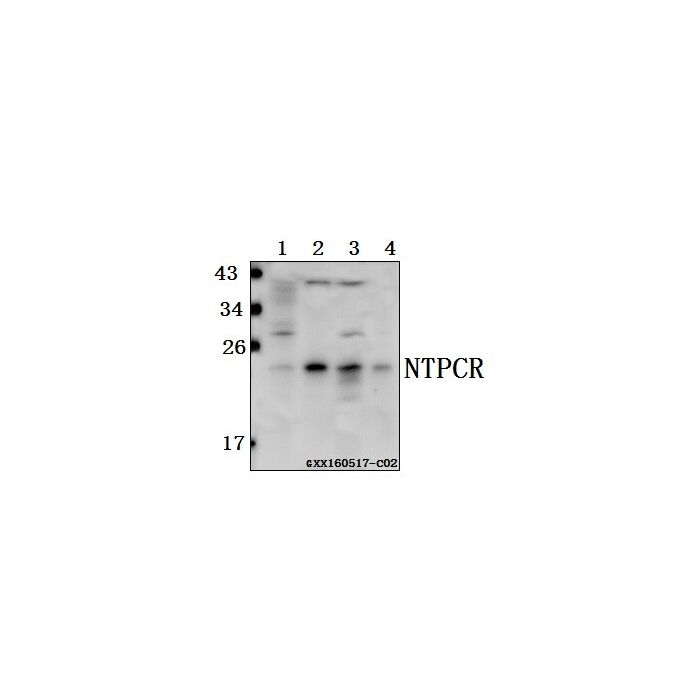
NTPCR polyclonal, anti-human, mouse, rat
€305.00
In stock
SKU
BS61566
Background:
Belonging to the THEP1 NTPase family, C1orf57 (also known as nucleoside triphosphate phosphohydrolase), and its mouse homolog, 2310079N02Rik, are 190 amino acid proteins that has nucleotide phosphatase activity towards ATP, GTP, TTP, CTP and UTP. Acting as a monomer, it also hydrolyzes nucleoside diphosphates with lower efficiency. The gene encoding C1orf57 maps to human chromosome 1, the largest human chromosome spanning about 260 million base pairs and making up 8% of the human genome. There are about 3,000 genes on chromosome 1, and considering the great number of genes there are also a large number of diseases associated with chromosome 1. Notably, the rare aging disease Hutchinson-Gilford progeria is associated with the LMNA gene which encodes lamin A. When defective, the LMNA gene product can build up in the nucleus and cause characteristic nuclear blebs. The mechanism of rapidly enhanced aging is unclear and is a topic of continuing exploration. The MUTYH gene is located on chromosome 1 and is partially responsible for familial adenomatous polyposis. Stickler syndrome, Parkinsons, Gaucher disease and Usher syndrome are also associated with chromosome 1.
Alternative Name:
Cancer-related nucleoside-triphosphatase, NTPase, Nucleoside triphosphate phosphohydrolase
Application Dilution: WB: 1:500~1:1000
Specificity: NTPCR polyclonal antibody detects endogenous levels of NTPCR protein.
Immunogen:
Synthetic peptide, corresponding to amino acids 145-189 of Human NTPCR
MW: ~ 21 kDa
Swis Prot.: Q9BSD7
Purification & Purity:
The antibody was affinity-purified from rabbit antiserum by affinity-chromatography using epitope-specific immunogen and the purity is > 95% (by SDS-PAGE)
Format:
1 mg/ml in Phosphate buffered saline (PBS) with 0.05% sodium azide, approx. pH 7.3.
Storage:
Store at 4°C short term. Aliquot and store at -20°C long term. Avoid freeze-thaw cycles.
For research use only, not for use in diagnostic procedure.
Belonging to the THEP1 NTPase family, C1orf57 (also known as nucleoside triphosphate phosphohydrolase), and its mouse homolog, 2310079N02Rik, are 190 amino acid proteins that has nucleotide phosphatase activity towards ATP, GTP, TTP, CTP and UTP. Acting as a monomer, it also hydrolyzes nucleoside diphosphates with lower efficiency. The gene encoding C1orf57 maps to human chromosome 1, the largest human chromosome spanning about 260 million base pairs and making up 8% of the human genome. There are about 3,000 genes on chromosome 1, and considering the great number of genes there are also a large number of diseases associated with chromosome 1. Notably, the rare aging disease Hutchinson-Gilford progeria is associated with the LMNA gene which encodes lamin A. When defective, the LMNA gene product can build up in the nucleus and cause characteristic nuclear blebs. The mechanism of rapidly enhanced aging is unclear and is a topic of continuing exploration. The MUTYH gene is located on chromosome 1 and is partially responsible for familial adenomatous polyposis. Stickler syndrome, Parkinsons, Gaucher disease and Usher syndrome are also associated with chromosome 1.
Alternative Name:
Cancer-related nucleoside-triphosphatase, NTPase, Nucleoside triphosphate phosphohydrolase
Application Dilution: WB: 1:500~1:1000
Specificity: NTPCR polyclonal antibody detects endogenous levels of NTPCR protein.
Immunogen:
Synthetic peptide, corresponding to amino acids 145-189 of Human NTPCR
MW: ~ 21 kDa
Swis Prot.: Q9BSD7
Purification & Purity:
The antibody was affinity-purified from rabbit antiserum by affinity-chromatography using epitope-specific immunogen and the purity is > 95% (by SDS-PAGE)
Format:
1 mg/ml in Phosphate buffered saline (PBS) with 0.05% sodium azide, approx. pH 7.3.
Storage:
Store at 4°C short term. Aliquot and store at -20°C long term. Avoid freeze-thaw cycles.
For research use only, not for use in diagnostic procedure.
| Is Featured? | No |
|---|
Write Your Own Review