
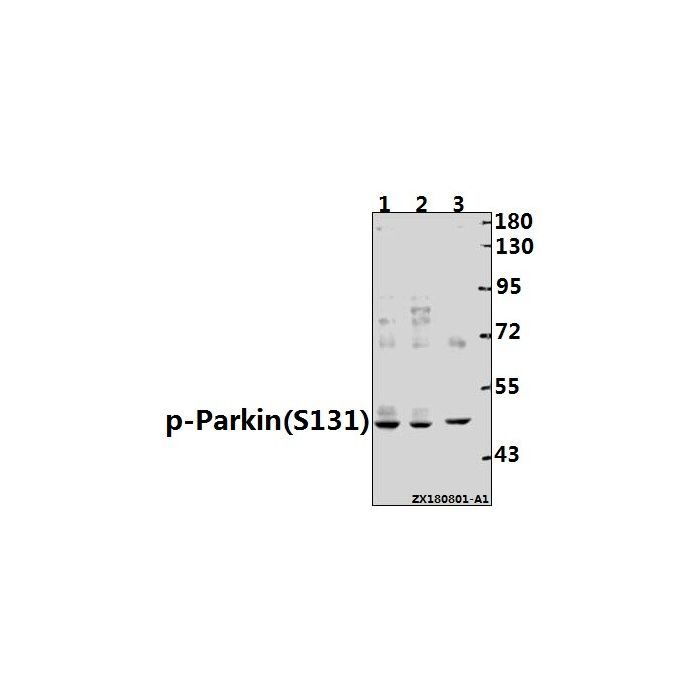
Parkin (phospho-S131) polyclonal, anti-human
€328.00
In stock
SKU
BS4341
Background:
Parkin is a zinc-finger protein that is related to ubiquitin at the amino terminus. The wild type Parkin gene, which maps to human chromosome 6q25.2- 27, encodes a 465 amino acid full-length protein that is expressed as multiple isoforms ranging from 50-58 kDa. Mutations in the Parkin gene are responsible for utosomal recessive juvenile Parkinson’s disease and commonly involve deletions of exons 3-5. In humans, Parkin is expressed in a subset of cells of the basal ganglia, midbrain, cerebellum and cerebral cortex, and is subject to alternative splicing in different tissues. Parkin expression is also high in the brainstem of mice, with the majority of immunopositive cells being neurons. The Parkin gene has been identified in a diverse group of organisms including mammals, birds, frog and fruit flies, suggesting that analogous functional roles of the Parkin protein may have been highly conserved during the course of evolution
Alternative Name:
E3 ubiquitin-protein ligase parkin, Parkinson juvenile disease protein 2, Parkinson disease protein 2, PARK2, PRKN
Application Dilution: WB: 1:500~1:1000
Specificity: Parkin (phospho-S131) polyclonal antibody detects endogenous levels of Parkin protein only when phosphorylated at Ser131.
Immunogen:
Synthetic peptide derived from human Parkin around the phosphorylation site of S131.
MW: ~ 52 kDa
Swis Prot.: O60260
Purification & Purity:
The antibody was affinity-purified from rabbit antiserum by affinity-chromatography using epitope-specific immunogen and the purity is > 95% (by SDS-PAGE).
Format:
1 mg/ml in Phosphate buffered saline (PBS) with 0.05% sodium azide, approx. pH 7.2.
Storage:
Store at 4°C short term. Aliquot and store at -20°C long term. Avoid freeze-thaw cycles.
For research use only, not for use in diagnostic procedure.
Parkin is a zinc-finger protein that is related to ubiquitin at the amino terminus. The wild type Parkin gene, which maps to human chromosome 6q25.2- 27, encodes a 465 amino acid full-length protein that is expressed as multiple isoforms ranging from 50-58 kDa. Mutations in the Parkin gene are responsible for utosomal recessive juvenile Parkinson’s disease and commonly involve deletions of exons 3-5. In humans, Parkin is expressed in a subset of cells of the basal ganglia, midbrain, cerebellum and cerebral cortex, and is subject to alternative splicing in different tissues. Parkin expression is also high in the brainstem of mice, with the majority of immunopositive cells being neurons. The Parkin gene has been identified in a diverse group of organisms including mammals, birds, frog and fruit flies, suggesting that analogous functional roles of the Parkin protein may have been highly conserved during the course of evolution
Alternative Name:
E3 ubiquitin-protein ligase parkin, Parkinson juvenile disease protein 2, Parkinson disease protein 2, PARK2, PRKN
Application Dilution: WB: 1:500~1:1000
Specificity: Parkin (phospho-S131) polyclonal antibody detects endogenous levels of Parkin protein only when phosphorylated at Ser131.
Immunogen:
Synthetic peptide derived from human Parkin around the phosphorylation site of S131.
MW: ~ 52 kDa
Swis Prot.: O60260
Purification & Purity:
The antibody was affinity-purified from rabbit antiserum by affinity-chromatography using epitope-specific immunogen and the purity is > 95% (by SDS-PAGE).
Format:
1 mg/ml in Phosphate buffered saline (PBS) with 0.05% sodium azide, approx. pH 7.2.
Storage:
Store at 4°C short term. Aliquot and store at -20°C long term. Avoid freeze-thaw cycles.
For research use only, not for use in diagnostic procedure.
| Is Featured? | No |
|---|
Write Your Own Review