
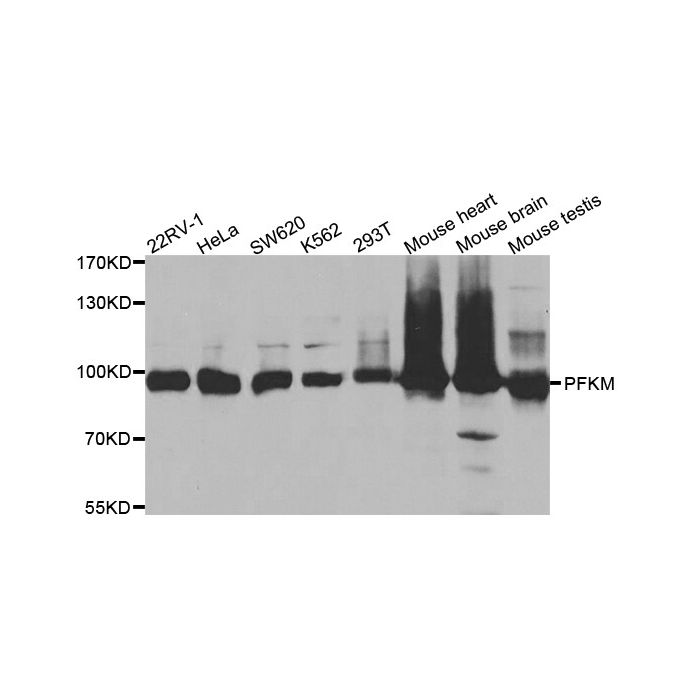
PFKM polyclonal, anti-human, mouse
€388.00
In stock
SKU
BS7596
Background:
Three phosphofructokinase isozymes exist in humans: muscle, liver and platelet. These isozymes function as subunits of the mammalian tetramer phosphofructokinase, which catalyzes the phosphorylation of fructose-6-phosphate to fructose-1,6-bisphosphate. Tetramer composition varies depending on tissue type. This gene encodes the muscle-type isozyme. Mutations in this gene have been associated with glycogen storage disease type VII, also known as Tarui disease. Alternatively spliced transcript variants have been described.
Alternative Name:
6 Phosphofructokinase Muscle Type, 6-phosphofructokinase, 6-phosphofructokinase muscle type, EC 2.7.1.1, EC 2.7.1.11, GSD7, K6PF_HUMAN, MGC8699, muscle type, PFK, muscle type, PFK-A, PFKA, PFKL, PFKM, PFKP, PFKX, Phosphofructo 1 Kinase Isozyme A, Phosphofructo-1-kinase isozyme A, Phosphofructokinase 1, Phosphofructokinase M, Phosphofructokinase, muscle, Phosphofructokinase, muscle type, Phosphofructokinase, polypeptide X, Phosphofructokinase-M, Phosphohexokinase,
Application Dilution: WB: 1:500~1:2000, IHC: 1:50~1:200
Specificity: PFKM polyclonal antibody detects endogenous levels of PFKM protein.
Immunogen:
Recombinant full length Human PFKM.
MW: ~85 kDa
Swis Prot.: P08237
Purification & Purity:
The antibody was affinity-purified from rabbit antiserum by affinity-chromatography using epitope-specific immunogen and the purity is > 95% (by SDS-PAGE).
Format:
1mg/ml in PBS with 0.1% Sodium Azide, 50% Glycerol.
Storage:
Store at 4°C short term. Aliquot and store at -20°C long term. Avoid freeze-thaw cycles.
For research use only, not for use in diagnostic procedure.
Three phosphofructokinase isozymes exist in humans: muscle, liver and platelet. These isozymes function as subunits of the mammalian tetramer phosphofructokinase, which catalyzes the phosphorylation of fructose-6-phosphate to fructose-1,6-bisphosphate. Tetramer composition varies depending on tissue type. This gene encodes the muscle-type isozyme. Mutations in this gene have been associated with glycogen storage disease type VII, also known as Tarui disease. Alternatively spliced transcript variants have been described.
Alternative Name:
6 Phosphofructokinase Muscle Type, 6-phosphofructokinase, 6-phosphofructokinase muscle type, EC 2.7.1.1, EC 2.7.1.11, GSD7, K6PF_HUMAN, MGC8699, muscle type, PFK, muscle type, PFK-A, PFKA, PFKL, PFKM, PFKP, PFKX, Phosphofructo 1 Kinase Isozyme A, Phosphofructo-1-kinase isozyme A, Phosphofructokinase 1, Phosphofructokinase M, Phosphofructokinase, muscle, Phosphofructokinase, muscle type, Phosphofructokinase, polypeptide X, Phosphofructokinase-M, Phosphohexokinase,
Application Dilution: WB: 1:500~1:2000, IHC: 1:50~1:200
Specificity: PFKM polyclonal antibody detects endogenous levels of PFKM protein.
Immunogen:
Recombinant full length Human PFKM.
MW: ~85 kDa
Swis Prot.: P08237
Purification & Purity:
The antibody was affinity-purified from rabbit antiserum by affinity-chromatography using epitope-specific immunogen and the purity is > 95% (by SDS-PAGE).
Format:
1mg/ml in PBS with 0.1% Sodium Azide, 50% Glycerol.
Storage:
Store at 4°C short term. Aliquot and store at -20°C long term. Avoid freeze-thaw cycles.
For research use only, not for use in diagnostic procedure.
| Is Featured? | No |
|---|
Write Your Own Review