
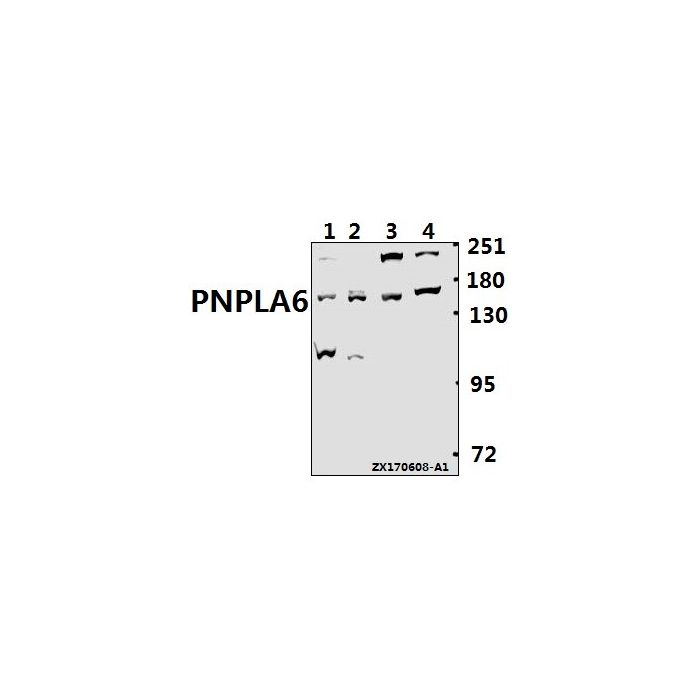
PNPLA6 polyclonal, anti-human, mouse, rat
€305.00
In stock
SKU
BS61695
Background:
Neuropathy target esterase (NTE) is a member of a newly discovered protein family, with a domain conserved through evolution. It is an integral membrane protein present in all neurons and in some non-neural cell types of vertebrates. NTE is important in neural development and has the capacity to hydrolyse esters. It is important in the cell-signalling pathway controlling interactions between neurons and accessory glial cells in nervous system development. NTE can be modified by organophosphates, which can cause neuropathy (characterized by axonal degeneration) in humans. NTE loss can lead to prominent neuronal pathology in the thalamus amd hippocampus and can also lead to defects in the cerebellum.
Alternative Name:
Neuropathy target esterase, Patatin-like phospholipase domain-containing protein 6, PNPLA6, NTE
Application Dilution: WB: 1:500~1:1000
Specificity: PNPLA6 polyclonal antibody detects endogenous levels of PNPLA6 protein.
Immunogen:
Synthetic peptide, corresponding Human PNPLA6.
MW: ~ 150 kDa
Swis Prot.: Q8IY17
Purification & Purity:
The antibody was affinity-purified from rabbit antiserum by affinity-chromatography using epitope-specific immunogen and the purity is > 95% (by SDS-PAGE).
Format:
1 mg/ml in Phosphate buffered saline (PBS) with 0.05% sodium azide, approx. pH 7.3.
Storage:
Store at 4°C short term. Aliquot and store at -20°C long term. Avoid freeze-thaw cycles.
For research use only, not for use in diagnostic procedure.
Neuropathy target esterase (NTE) is a member of a newly discovered protein family, with a domain conserved through evolution. It is an integral membrane protein present in all neurons and in some non-neural cell types of vertebrates. NTE is important in neural development and has the capacity to hydrolyse esters. It is important in the cell-signalling pathway controlling interactions between neurons and accessory glial cells in nervous system development. NTE can be modified by organophosphates, which can cause neuropathy (characterized by axonal degeneration) in humans. NTE loss can lead to prominent neuronal pathology in the thalamus amd hippocampus and can also lead to defects in the cerebellum.
Alternative Name:
Neuropathy target esterase, Patatin-like phospholipase domain-containing protein 6, PNPLA6, NTE
Application Dilution: WB: 1:500~1:1000
Specificity: PNPLA6 polyclonal antibody detects endogenous levels of PNPLA6 protein.
Immunogen:
Synthetic peptide, corresponding Human PNPLA6.
MW: ~ 150 kDa
Swis Prot.: Q8IY17
Purification & Purity:
The antibody was affinity-purified from rabbit antiserum by affinity-chromatography using epitope-specific immunogen and the purity is > 95% (by SDS-PAGE).
Format:
1 mg/ml in Phosphate buffered saline (PBS) with 0.05% sodium azide, approx. pH 7.3.
Storage:
Store at 4°C short term. Aliquot and store at -20°C long term. Avoid freeze-thaw cycles.
For research use only, not for use in diagnostic procedure.
| Is Featured? | No |
|---|
Write Your Own Review