
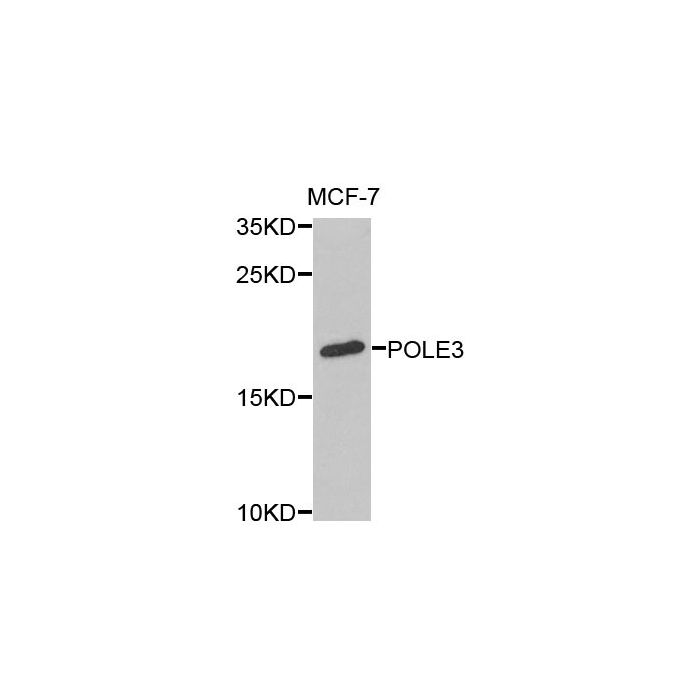
POLE3 polyclonal, anti-human, mouse
€388.00
In stock
SKU
BS8241
Background:
DNA replication is initiated by the binding of initiation factors to the origin of replication. Nucleosomes inhibit access to the replication machinery at these origin sequences. Nucleosome remodeling factors increase the accessibility of nucleosomal DNA to transcriptional regulators . CHRAC15 and CHRAC17 are subunits of the nucleosomal remodeling factor CHRAC (chromatin accessibility complex),which increases the accessibility of nucleosomal DNA in an ATP-dependent manner . Unlike other known chromatin remodelling factors, CHRAC also functions during chromatin assembly by using ATP to convert irregular chromatin into a regular array of nucleosomes with even spacing . This conversion process occurs when CHRAC organizes randomly deposited histones into a regularly spaced array . In the presence of CHRAC, the nucleosomal ATPase ISWI catalyses several ATP-dependent transitions of chromatin structure .
Alternative Name:
DNA polymerase epsilon subunit 3, Arsenic-transactivated protein, AsTP, Chromatin accessibility complex 17 kDa protein, CHRAC-17, HuCHRAC17, DNA polymerase II subunit 3, DNA polymerase epsilon subunit p17, POLE3, CHRAC17
Application Dilution: WB: 1:500~1:2000, IF: 1:50~1:200
Specificity: POLE3 polyclonal antibody detects endogenous levels of POLE3 protein.
Immunogen:
Recombinant full length Human POLE3.
MW: ~ 17 kDa
Swis Prot.: Q9NRF9
Purification & Purity:
The antibody was affinity-purified from rabbit antiserum by affinity-chromatography using epitope-specific immunogen and the purity is > 95% (by SDS-PAGE).
Format:
1mg/ml in PBS with 0.1% Sodium Azide, 50% Glycerol.
Storage:
Store at 4°C short term. Aliquot and store at -20°C long term. Avoid freeze-thaw cycles.
For research use only, not for use in diagnostic procedure.
DNA replication is initiated by the binding of initiation factors to the origin of replication. Nucleosomes inhibit access to the replication machinery at these origin sequences. Nucleosome remodeling factors increase the accessibility of nucleosomal DNA to transcriptional regulators . CHRAC15 and CHRAC17 are subunits of the nucleosomal remodeling factor CHRAC (chromatin accessibility complex),which increases the accessibility of nucleosomal DNA in an ATP-dependent manner . Unlike other known chromatin remodelling factors, CHRAC also functions during chromatin assembly by using ATP to convert irregular chromatin into a regular array of nucleosomes with even spacing . This conversion process occurs when CHRAC organizes randomly deposited histones into a regularly spaced array . In the presence of CHRAC, the nucleosomal ATPase ISWI catalyses several ATP-dependent transitions of chromatin structure .
Alternative Name:
DNA polymerase epsilon subunit 3, Arsenic-transactivated protein, AsTP, Chromatin accessibility complex 17 kDa protein, CHRAC-17, HuCHRAC17, DNA polymerase II subunit 3, DNA polymerase epsilon subunit p17, POLE3, CHRAC17
Application Dilution: WB: 1:500~1:2000, IF: 1:50~1:200
Specificity: POLE3 polyclonal antibody detects endogenous levels of POLE3 protein.
Immunogen:
Recombinant full length Human POLE3.
MW: ~ 17 kDa
Swis Prot.: Q9NRF9
Purification & Purity:
The antibody was affinity-purified from rabbit antiserum by affinity-chromatography using epitope-specific immunogen and the purity is > 95% (by SDS-PAGE).
Format:
1mg/ml in PBS with 0.1% Sodium Azide, 50% Glycerol.
Storage:
Store at 4°C short term. Aliquot and store at -20°C long term. Avoid freeze-thaw cycles.
For research use only, not for use in diagnostic procedure.
| Is Featured? | No |
|---|
Write Your Own Review