
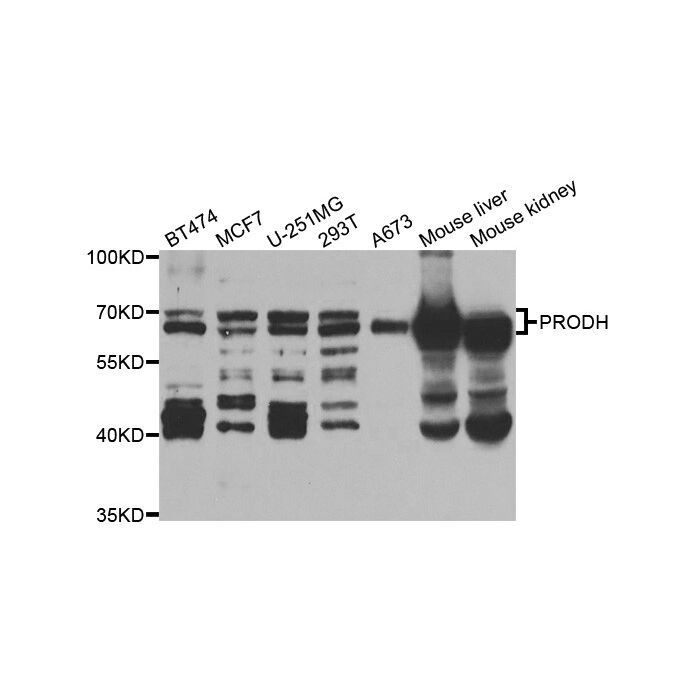
PRODH polyclonal, anti-human, mouse, rat
€388.00
In stock
SKU
BS7891
Background:
PRODH (proline dehydrogenase), also known as proline oxidase 2 (POX2), is a 516 amino acid protein belonging to the proline oxidase family. Induced during p53-induced apoptosis, PRODH catalyzes the first step in proline degradation by converting proline to delta-1-pyrroline-5-carboxylate. Defects in PRODH are the cause of hyperprolinemia type 1, a disorder characterized by elevated serum proline levels. Defects in PRODH may also be involved in the psychiatric and behavioral phenotypes associated with DiGeorge syndrome. Localized to the mitochondrion matrix, PRODH is expressed at higher levels in lung, brain and skeletal muscle and expressed at lower levels in heart, liver, kidney and pancreas. PRODH exists as two isoforms produced by alternative splicing.
Alternative Name:
HSPOX2, mitochondrial, P53 induced gene 6 protein, p53-induced gene 6 protein, PIG6, PROD_HUMAN, PRODH 1, PRODH 2, PRODH, PRODH1, PRODH2, Proline dehydrogenase, proline dehydrogenase (oxidase) 1, proline dehydrogenase (proline oxidase), Proline dehydrogenase 1, Proline oxidase 2, Proline oxidase, Proline oxidase, mitochondrial precursor, SCZD4, TP53I6, tumor protein p53 inducible protein 6,
Application Dilution: WB: 1:500~1:2000, IHC: 1:50~1:200
Specificity: PRODH polyclonal antibody detects endogenous levels of PRODH protein.
Immunogen:
Recombinant full length Human PRODH.
MW: ~ 60 kDa
Swis Prot.: O43272
Purification & Purity:
The antibody was affinity-purified from rabbit antiserum by affinity-chromatography using epitope-specific immunogen and the purity is > 95% (by SDS-PAGE).
Format:
1mg/ml in PBS with 0.1% Sodium Azide, 50% Glycerol.
Storage:
Store at 4°C short term. Aliquot and store at -20°C long term. Avoid freeze-thaw cycles.
For research use only, not for use in diagnostic procedure.
PRODH (proline dehydrogenase), also known as proline oxidase 2 (POX2), is a 516 amino acid protein belonging to the proline oxidase family. Induced during p53-induced apoptosis, PRODH catalyzes the first step in proline degradation by converting proline to delta-1-pyrroline-5-carboxylate. Defects in PRODH are the cause of hyperprolinemia type 1, a disorder characterized by elevated serum proline levels. Defects in PRODH may also be involved in the psychiatric and behavioral phenotypes associated with DiGeorge syndrome. Localized to the mitochondrion matrix, PRODH is expressed at higher levels in lung, brain and skeletal muscle and expressed at lower levels in heart, liver, kidney and pancreas. PRODH exists as two isoforms produced by alternative splicing.
Alternative Name:
HSPOX2, mitochondrial, P53 induced gene 6 protein, p53-induced gene 6 protein, PIG6, PROD_HUMAN, PRODH 1, PRODH 2, PRODH, PRODH1, PRODH2, Proline dehydrogenase, proline dehydrogenase (oxidase) 1, proline dehydrogenase (proline oxidase), Proline dehydrogenase 1, Proline oxidase 2, Proline oxidase, Proline oxidase, mitochondrial precursor, SCZD4, TP53I6, tumor protein p53 inducible protein 6,
Application Dilution: WB: 1:500~1:2000, IHC: 1:50~1:200
Specificity: PRODH polyclonal antibody detects endogenous levels of PRODH protein.
Immunogen:
Recombinant full length Human PRODH.
MW: ~ 60 kDa
Swis Prot.: O43272
Purification & Purity:
The antibody was affinity-purified from rabbit antiserum by affinity-chromatography using epitope-specific immunogen and the purity is > 95% (by SDS-PAGE).
Format:
1mg/ml in PBS with 0.1% Sodium Azide, 50% Glycerol.
Storage:
Store at 4°C short term. Aliquot and store at -20°C long term. Avoid freeze-thaw cycles.
For research use only, not for use in diagnostic procedure.
| Is Featured? | No |
|---|
Write Your Own Review