
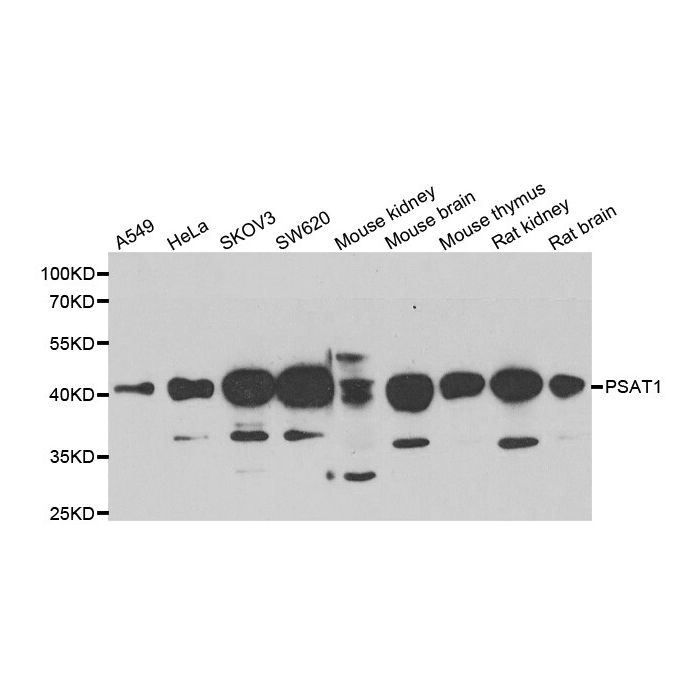
PSAT1 polyclonal, anti-human, mouse, rat
€388.00
In stock
SKU
BS8371
Background:
PSAT1 (phosphoserine aminotransferase 1), also known as phosphoserine aminotransferase, phosphohydroxythreonine aminotransferase, endometrial progesterone-induced protein, PSA, PSAT, EPIP or MGC1460, is a 370 amino acid protein belonging to the class-V pyridoxal-phosphate-dependent aminotransferase family and serC subfamily. PSAT1 catalyzes the second step in the L-serine synthesis pathway, converting 3-phosphohydroxypyruvate into 3-phosphoserine. While highly expressed in pancreas, brain, kidney and liver, PSAT1 is expressed at very low levels in colon, testis, thymus and prostate. There are two known isoforms of PSAT1 which result from alternative splicing events, and the gene encoding PSAT1 maps to human chromsome 9q21.2. PSAT1 deficiency can cause phosphoserine aminotransferase deficiency (PSATD), whose symptoms include psychomotor retardation, intractable seizures, acquired microcephaly and hypertonia.
Alternative Name:
Phosphoserine aminotransferase, Phosphohydroxythreonine aminotransferase, PSAT, PSAT1, PSA
Application Dilution: WB: 1:500~1:2000, IF: 1:50~1:200
Specificity: PSAT1 polyclonal antibody detects endogenous levels of PSAT1 protein.
Immunogen:
Recombinant full length Human PSAT1.
MW: ~ 40 kDa
Swis Prot.: Q9Y617
Purification & Purity:
The antibody was affinity-purified from rabbit antiserum by affinity-chromatography using epitope-specific immunogen and the purity is > 95% (by SDS-PAGE).
Format:
1mg/ml in PBS with 0.1% Sodium Azide, 50% Glycerol.
Storage:
Store at 4°C short term. Aliquot and store at -20°C long term. Avoid freeze-thaw cycles.
For research use only, not for use in diagnostic procedure.
PSAT1 (phosphoserine aminotransferase 1), also known as phosphoserine aminotransferase, phosphohydroxythreonine aminotransferase, endometrial progesterone-induced protein, PSA, PSAT, EPIP or MGC1460, is a 370 amino acid protein belonging to the class-V pyridoxal-phosphate-dependent aminotransferase family and serC subfamily. PSAT1 catalyzes the second step in the L-serine synthesis pathway, converting 3-phosphohydroxypyruvate into 3-phosphoserine. While highly expressed in pancreas, brain, kidney and liver, PSAT1 is expressed at very low levels in colon, testis, thymus and prostate. There are two known isoforms of PSAT1 which result from alternative splicing events, and the gene encoding PSAT1 maps to human chromsome 9q21.2. PSAT1 deficiency can cause phosphoserine aminotransferase deficiency (PSATD), whose symptoms include psychomotor retardation, intractable seizures, acquired microcephaly and hypertonia.
Alternative Name:
Phosphoserine aminotransferase, Phosphohydroxythreonine aminotransferase, PSAT, PSAT1, PSA
Application Dilution: WB: 1:500~1:2000, IF: 1:50~1:200
Specificity: PSAT1 polyclonal antibody detects endogenous levels of PSAT1 protein.
Immunogen:
Recombinant full length Human PSAT1.
MW: ~ 40 kDa
Swis Prot.: Q9Y617
Purification & Purity:
The antibody was affinity-purified from rabbit antiserum by affinity-chromatography using epitope-specific immunogen and the purity is > 95% (by SDS-PAGE).
Format:
1mg/ml in PBS with 0.1% Sodium Azide, 50% Glycerol.
Storage:
Store at 4°C short term. Aliquot and store at -20°C long term. Avoid freeze-thaw cycles.
For research use only, not for use in diagnostic procedure.
| Is Featured? | No |
|---|
Write Your Own Review