
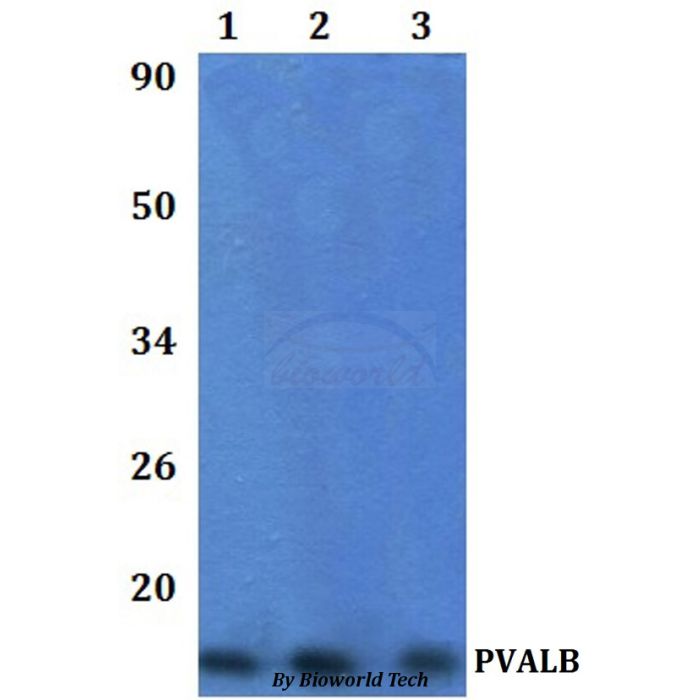
PVALB polyclonal, anti-human, mouse, rat
€305.00
In stock
SKU
BS61332
Background:
The family of EF-hand type Ca2+-binding proteins includes calbindin (previously designated vitamin D-dependent Ca2+-binding protein), S-100α and β, calgranulins A (also designated MRP8), B (also designated MRP14) and C (S-100 like proteins) and the parvalbumin family members, including parvalbumin α and parvalbumin β, also designated oncomodulin (OCM). Structurally and evolutionarily conserved, parvalbumin α and OCM proteins are distinct in expression and function. Parvalbumin α, also designated parvalbumin (PV), is most abundantly expressed in fast-contracting muscles with lower expression levels in brain and some endocrine tissues, including kidney and parathyroid. Research indicates that parvalbumin α plays a significant role in muscle relaxation. OCM was originally thought to have expression restricted to neoplastic tissues, early embryonic cells and certain tumor cell lines. Recent research shows that OCM is also expressed and secreted by macrophages where, in the retina it binds to retinal ganglion cells (RGCs) and functions to promote axon regeneration. OCM has also been detected in the auditory sensory cells of the organ of Corti in mammals. In humans, two different loci on chromosome 7 have been identified as OCM and OCM-like (LOC4951). These genes encode proteins 109 amino acids in length which share 99% sequence identity.
Alternative Name:
Parvalbumin alpha, PVALB
Application Dilution: WB: 1:500~1:1000
Specificity: PVALB polyclonal antibody detects endogenous levels of PVALB protein.
Immunogen:
A synthetic peptide corresponding to residues in Human PVALB.
MW: ~ 12 kDa
Swis Prot.: P20472
Purification & Purity:
The antibody was affinity-purified from rabbit antiserum by affinity-chromatography using epitope-specific immunogen and the purity is > 95% (by SDS-PAGE).
Format:
1 mg/ml in Phosphate buffered saline (PBS) with 0.05% sodium azide, approx. pH 7.3.
Storage:
Store at 4°C short term. Aliquot and store at -20°C long term. Avoid freeze-thaw cycles.
For research use only, not for use in diagnostic procedure.
The family of EF-hand type Ca2+-binding proteins includes calbindin (previously designated vitamin D-dependent Ca2+-binding protein), S-100α and β, calgranulins A (also designated MRP8), B (also designated MRP14) and C (S-100 like proteins) and the parvalbumin family members, including parvalbumin α and parvalbumin β, also designated oncomodulin (OCM). Structurally and evolutionarily conserved, parvalbumin α and OCM proteins are distinct in expression and function. Parvalbumin α, also designated parvalbumin (PV), is most abundantly expressed in fast-contracting muscles with lower expression levels in brain and some endocrine tissues, including kidney and parathyroid. Research indicates that parvalbumin α plays a significant role in muscle relaxation. OCM was originally thought to have expression restricted to neoplastic tissues, early embryonic cells and certain tumor cell lines. Recent research shows that OCM is also expressed and secreted by macrophages where, in the retina it binds to retinal ganglion cells (RGCs) and functions to promote axon regeneration. OCM has also been detected in the auditory sensory cells of the organ of Corti in mammals. In humans, two different loci on chromosome 7 have been identified as OCM and OCM-like (LOC4951). These genes encode proteins 109 amino acids in length which share 99% sequence identity.
Alternative Name:
Parvalbumin alpha, PVALB
Application Dilution: WB: 1:500~1:1000
Specificity: PVALB polyclonal antibody detects endogenous levels of PVALB protein.
Immunogen:
A synthetic peptide corresponding to residues in Human PVALB.
MW: ~ 12 kDa
Swis Prot.: P20472
Purification & Purity:
The antibody was affinity-purified from rabbit antiserum by affinity-chromatography using epitope-specific immunogen and the purity is > 95% (by SDS-PAGE).
Format:
1 mg/ml in Phosphate buffered saline (PBS) with 0.05% sodium azide, approx. pH 7.3.
Storage:
Store at 4°C short term. Aliquot and store at -20°C long term. Avoid freeze-thaw cycles.
For research use only, not for use in diagnostic procedure.
| Is Featured? | No |
|---|
Write Your Own Review