
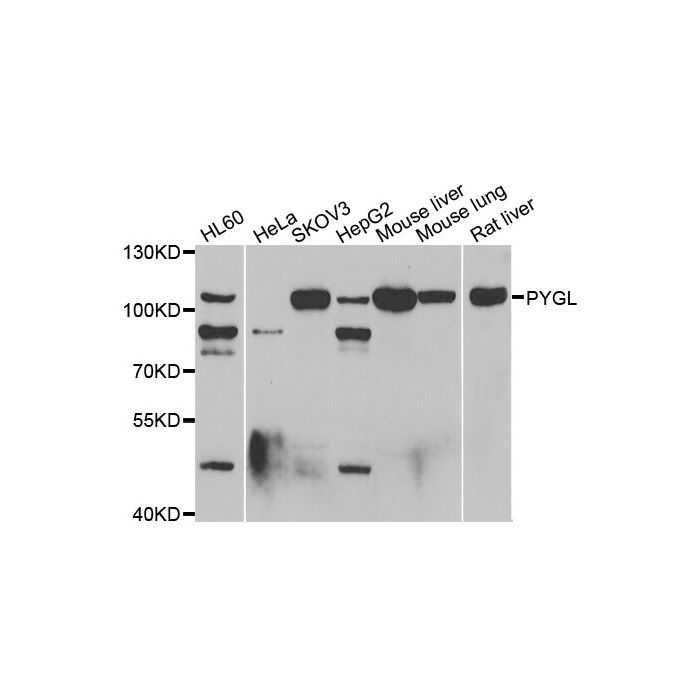
PYGL polyclonal, anti-human, mouse, rat
€388.00
In stock
SKU
BS8374
Background:
Glycolysis is an evolutionarily conserved series of ten chemical reactions that utilizes eleven enzymes to concomitantly generate pyruvate and ATP from glucose. Phospho-fructose kinase-2/fructose 2,6-bisphosphatase (PFK-2) stimulates the synthesis and degradation of fructose 2,6-bisphosphate. Glycogen phosphorylase (also known as GP) is an allosteric enzyme important in carbohydrate metabolism. Its activity is regulated through either noncovalent binding of metabolites or by covalent modification. Glycogen phosphorylase catalyzes the phosphorylation of glycogen to Glc-1-P. There are three genes which encode the brain, liver and muscle forms of glycogen phosphorylase, PYGB, PYGL and PYGM. Because of its fundamental role in the metabolism of glycogen, glycogen phosphorylase has been a target for the design of inhibitory compounds, which could be valuable in the therapeutic treatment of type 2 diabetes mellitus.
Alternative Name:
Glycogen phosphorylase, liver form, PYGL
Application Dilution: WB: 1:500~1:2000, IF: 1:50~1:200
Specificity: PYGL polyclonal antibody detects endogenous levels of PYGL protein.
Immunogen:
Recombinant full length Human PYGL.
MW: ~ 97 kDa
Swis Prot.: P06737
Purification & Purity:
The antibody was affinity-purified from rabbit antiserum by affinity-chromatography using epitope-specific immunogen and the purity is > 95% (by SDS-PAGE).
Format:
1mg/ml in PBS with 0.1% Sodium Azide, 50% Glycerol.
Storage:
Store at 4°C short term. Aliquot and store at -20°C long term. Avoid freeze-thaw cycles.
For research use only, not for use in diagnostic procedure.
Glycolysis is an evolutionarily conserved series of ten chemical reactions that utilizes eleven enzymes to concomitantly generate pyruvate and ATP from glucose. Phospho-fructose kinase-2/fructose 2,6-bisphosphatase (PFK-2) stimulates the synthesis and degradation of fructose 2,6-bisphosphate. Glycogen phosphorylase (also known as GP) is an allosteric enzyme important in carbohydrate metabolism. Its activity is regulated through either noncovalent binding of metabolites or by covalent modification. Glycogen phosphorylase catalyzes the phosphorylation of glycogen to Glc-1-P. There are three genes which encode the brain, liver and muscle forms of glycogen phosphorylase, PYGB, PYGL and PYGM. Because of its fundamental role in the metabolism of glycogen, glycogen phosphorylase has been a target for the design of inhibitory compounds, which could be valuable in the therapeutic treatment of type 2 diabetes mellitus.
Alternative Name:
Glycogen phosphorylase, liver form, PYGL
Application Dilution: WB: 1:500~1:2000, IF: 1:50~1:200
Specificity: PYGL polyclonal antibody detects endogenous levels of PYGL protein.
Immunogen:
Recombinant full length Human PYGL.
MW: ~ 97 kDa
Swis Prot.: P06737
Purification & Purity:
The antibody was affinity-purified from rabbit antiserum by affinity-chromatography using epitope-specific immunogen and the purity is > 95% (by SDS-PAGE).
Format:
1mg/ml in PBS with 0.1% Sodium Azide, 50% Glycerol.
Storage:
Store at 4°C short term. Aliquot and store at -20°C long term. Avoid freeze-thaw cycles.
For research use only, not for use in diagnostic procedure.
| Is Featured? | No |
|---|
Write Your Own Review